
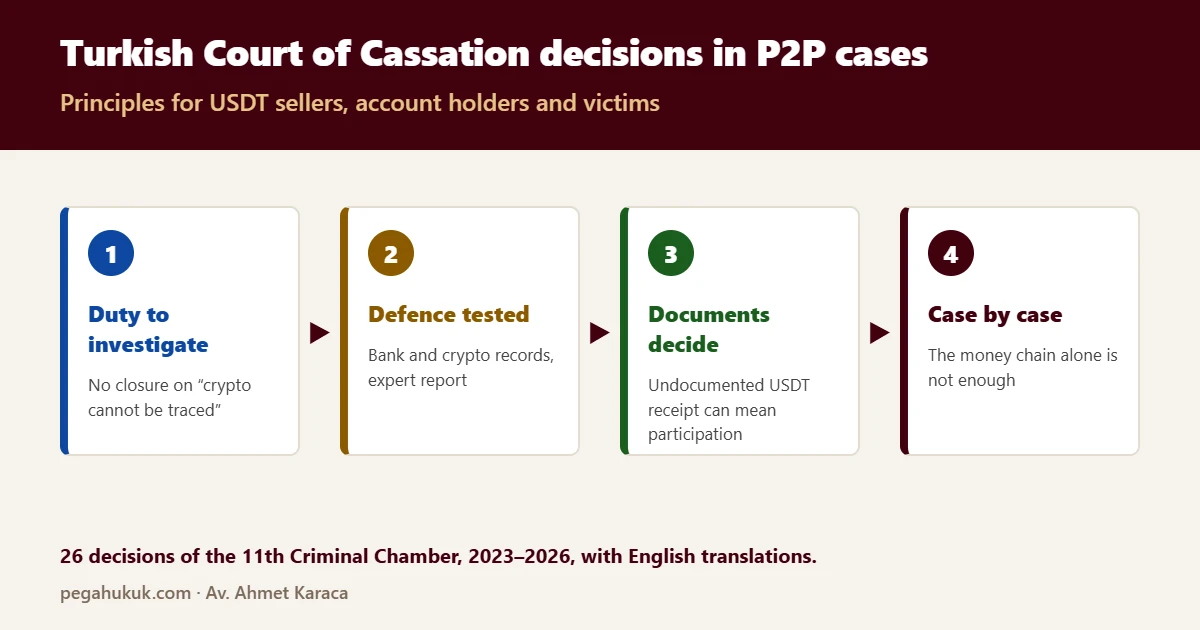
Three approaches stand out in the 2023–2026 crypto-related fraud decisions of the 11th Criminal Chamber of Türkiye’s Court of Cassation (Yargıtay). First, a non-prosecution decision cannot rest on the claim that crypto cannot be traced; exchange records, login IP addresses and wallet owners must be investigated. Second, where a suspect took the victim’s money for investment and says it was lost trading crypto, that defence must be tested against bank and crypto account movements, with an expert examination where needed, before the file is closed. Third, convictions were upheld for people who let their accounts be used for commission or moved victims’ money the same day to an exchange account opened in their own name, and the acquittal of a person who received USDT bought with the victim’s money but could not show the business behind it with information and an invoice was quashed. (Position as of October 2026.)
Last updated: · Prepared by: Av. Ahmet Karaca, Istanbul Bar Association (Registration No. 92414) · Verify on the Bar register
- The 11th Criminal Chamber called the reasoning that an offender cannot be found because crypto is outside the supervised financial system “flawed reasoning and incomplete investigation” (9 December 2024).
- In 2024–2026 appeals in the interest of the law, it held that the investigation should have included obtaining account movements and login IP addresses from the platform, identifying the owners of the addresses in Txid records (7 October 2024), and writing to centralised exchanges applying KYC, directly or by letters rogatory, with a crypto expert’s report (27 April 2026).
- On 21 May 2026, the finding that USDT bought with the victim’s money passed from one cold wallet to another supported quashing the acquittal of the person who received it; he had called it payment for a commercial service but produced no information or invoice.
- Convictions were upheld for people who let their accounts be used “for crypto transactions” in return for commission; these were not genuine P2P sales.
- The convictions of two defendants in the money chain who received no money directly from victims, had no communication with them and whose phones showed no element of crime were quashed (5 June 2024).
- The 3rd Civil Chamber upheld the dismissal of a defective-service claim against a crypto seller: the wills of the victim and the seller did not fully coincide, so no contract was formed (23 March 2026).
What does the Court of Cassation look at in a P2P-related fraud file?
The Court of Cassation does not stop at the first account that received the money; it asks where the money and the crypto went next. The Court of Cassation (Yargıtay) is the highest court of Türkiye’s ordinary judiciary, and almost all the criminal decisions discussed here come from its 11th Criminal Chamber. The approach cuts both ways. A prosecutor cannot close a victim’s file by saying crypto cannot be followed, and the same records test the defence of the person whose account received the victim’s money: someone who documents the trade and someone who moved the money to their own exchange account without explanation meet different outcomes.
P2P (kişiden kişiye kripto varlık alım satımı, person-to-person buying and selling of crypto assets) means selling one’s own crypto, usually USDT, to another person on the ad board of an exchange such as Binance, OKX or Bybit and receiving the price by bank transfer. Sellers usually enter fraud files through the triangle scheme (üçgen dolandırıcılık): the fraudster buys USDT from the seller while deceiving a victim into paying the seller, so the fraudster gets the USDT and the victim’s money sits in the seller’s account. See our guides to P2P triangle fraud in Turkey and to P2P crypto laws by country.
Many of the decisions were given on an appeal in the interest of the law (kanun yararına bozma, CMK Art. 309). In those files the Chamber quashes the decision of the criminal judgeship of peace (sulh ceza hâkimliği, a single-judge court that rules on measures and objections during the investigation) that rejected the victim’s objection to the prosecutor’s non-prosecution decision (kovuşturmaya yer olmadığı kararı, KYOK). They therefore show what must be investigated before a non-prosecution decision can be issued. The other decisions are appeals against convictions or acquittals and show when an account holder is held liable.
How does a P2P fraud file move through the Turkish system?
A P2P fraud file is a criminal investigation led by a public prosecutor, and it ends either in a non-prosecution decision or in an indictment and trial.
- Complaint. The victim complains to the public prosecutor’s office (Cumhuriyet başsavcılığı) or the police. The prosecutor must start investigating at once and collect the evidence both for and against the suspect (CMK Art. 160).
- Account suspension. On reasonable suspicion of certain offences, including fraud committed through information systems or banks (TCK Art. 158/1-f) or by posing as a public official or bank employee (TCK Art. 158/1-l), a bank, payment service provider or crypto-asset service provider may suspend the account used for up to 48 hours and must notify the prosecutor. The account holder may apply to the prosecutor, who decides within 24 hours. Within the suspension period, the proceeds in the account can be seized by a judge’s decision or, in urgent cases, by a prosecutor’s written order, which must be put before the judge within 24 hours and lapses unless the judge rules within 48 hours of the seizure; these institutions must also send information or documents requested by the prosecutor or the court within ten days (CMK Art. 128/A).
- Statements and records. People whose accounts received the victim’s money are heard as suspects (şüpheli), and bank, exchange and telecom records are collected.
- Prosecutor’s decision. If the evidence creates sufficient suspicion, the prosecutor files an indictment (iddianame, CMK Art. 170). In the aggravated fraud files discussed here, trial is before an assize court (ağır ceza mahkemesi), with an appeal to a regional court of appeal (istinaf) and, in the more serious cases, a further appeal to the Court of Cassation (temyiz); a regional court’s dismissal of an appeal against a prison sentence of five years or less, or against an acquittal for an offence punishable by up to ten years, is final (CMK Art. 286/2). Otherwise the prosecutor issues a non-prosecution decision (CMK Art. 172).
- Objection. The victim may object within two weeks of notification to the criminal judgeship of peace, which may have the investigation extended, accept the objection, in which case the prosecutor must indict, or reject it (CMK Art. 173). Its decision is final (CMK Art. 271/4).
- Appeal in the interest of the law. If the Ministry of Justice finds that a decision which became final without appellate review is unlawful, it asks the Chief Public Prosecutor’s Office at the Court of Cassation (Yargıtay Cumhuriyet Başsavcılığı) to seek its quashing, and the criminal chamber quashes it if the grounds are well founded (CMK Art. 309). In the files discussed here, the file then goes back to the criminal judgeship of peace that rejected the objection, which decides again after the necessary examination and investigation (CMK Art. 309/4-a).
Which Court of Cassation decisions matter for P2P files?
The table lists the decisions this guide relies on. All are decisions of the 11th Criminal Chamber unless stated otherwise.
| Decision | Facts | Outcome | Principle for a P2P file |
|---|---|---|---|
| E. 2024/2829, K. 2024/14948, 9 December 2024 | 36,351 USDT lost through Binance Connect and Trust Wallet | Quashed in the interest of the law | Saying the offender cannot be found because crypto is outside supervised finance is flawed; investigate the platform’s Turkish representation and the money’s fate. |
| E. 2023/5132, K. 2024/7356, 3 June 2024 | Police had identified the Binance account holder who received the victim’s crypto | Quashed in the interest of the law | Hear the identified account holder as a suspect and obtain the account movements. |
| E. 2024/516, K. 2024/11178, 7 October 2024 | Investment in a site called “bitget”; Txid records attached to the complaint | Quashed in the interest of the law | If the site is fake, establish who owns the addresses in the Txid records. |
| E. 2025/549, K. 2025/10818, 8 September 2025 | Crypto investment through Telegram; USD 45,000 | Quashed in the interest of the law | Request the complainant’s Binance account movements and login IPs; seek Telegram’s user data by letters rogatory; consider a standing search. |
| E. 2025/1315, K. 2025/13352, 20 October 2025 | Fake “Türk Petrolleri share” app; crypto demanded on a bonus pretext | Quashed in the interest of the law | Missing port data is no reason to close; investigate the social media page and lines, and ask the police cybercrime department about similar acts. |
| E. 2025/5763, K. 2026/4543, 27 April 2026 | WhatsApp investment, then a promise to recover the money | Quashed in the interest of the law | Write to KYC exchanges directly or by letters rogatory; obtain a crypto expert’s report. |
| E. 2026/529, K. 2026/6491, 15 June 2026 | Fake share investment; TRY 1,017,665 drawn on credit cards and cash advances and paid into crypto accounts | Quashed in the interest of the law | That the exchange has no Turkish representative, or that the victim could have found out by simple research, is no ground to close; request account movements and login IPs. |
| E. 2026/538, K. 2026/6490, 15 June 2026 | Investment money paid to a crypto platform company | Quashed in the interest of the law | Payment to a crypto platform company and investment risk do not rule out deceit; hear its officers and the line owners as suspects and obtain from it the complainant’s account movements and login IPs. |
| E. 2025/4535, K. 2026/2256, 2 March 2026 | Defence that a market fall wiped out the principal | Quashed in the interest of the law | No civil-dispute closure without a comparative expert examination of both sides’ bank and crypto movements. |
| E. 2024/527, K. 2024/11109, 7 October 2024 | Defence of trading losses on Paribu | Quashed in the interest of the law | Verify the claimed business with books, documents and bank records; then decide between TCK 158/1-h and 157. |
| E. 2026/1957, K. 2026/5736, 21 May 2026 | 42,865 USDT bought with the victim’s money traced between cold wallets | Regional court’s decision upholding the recipient’s acquittal quashed on the victim’s appeal | Calling the USDT payment for a service without any information or invoice was held, in this file, sufficient to find participation. |
| E. 2023/4510, K. 2023/10239, 14 December 2023 | Account given “for crypto transactions” for commission | Conviction upheld | Lending an account for commission while foreseeing fraud is not P2P selling. |
| E. 2024/3673, K. 2024/10848, 30 September 2024 | Defence: payment for crypto, only 3% commission | Conviction upheld | Those grounds of appeal were rejected and the conviction upheld. |
| E. 2026/2245, K. 2026/4966, 4 May 2026 | Fake police; same-day transfer to a crypto account opened with the defendant’s own ID | Conviction upheld | The ground of appeal that HTS and camera records were not examined failed. |
| E. 2025/5852, K. 2026/908, 21 January 2026 | Fake bank call; money reached the defendant’s biometrically verified OKX account | Conviction upheld | Grounds that he lacked technical know-how and was himself a victim failed; the trial court had relied on the biometric account opening. |
| E. 2025/4935, K. 2025/15290, 26 November 2025 | Fake police; account opened with the defendant’s line and selfie | Conviction upheld | He could give no information about the person he named in his defence. |
| E. 2023/6026, K. 2024/2387, 28 February 2024 | Money reached the defendant’s Binance account within minutes | Conviction upheld | A cracked-password defence did not prevail. |
| E. 2024/2576, K. 2024/7696, 5 June 2024 | Betting-scheme money circulated among the defendants | Quashed in favour of two defendants | No money directly from victims, no contact with them, nothing on their phones: the money chain alone is not enough. |
| E. 2024/2231, K. 2024/8180, 12 June 2024 | Fake car advert; same-day transfer to a crypto exchange | Convictions and acquittals upheld | Acquittal upheld where no money reached the account and no link to the offence lines was found. |
| E. 2023/2909, K. 2023/6665, 28 September 2023 | Account number given by a man in prison at the time | Quashed in the defendant’s favour | Giving an account number knowing an offence will be committed, without control over the act, is aiding (TCK 39/2-c), not joint perpetration. |
| E. 2023/1266, K. 2023/5643, 4 July 2023 | Bitcoin purchase tied to another defendant by IP-port and HTS records | Convictions upheld | Exchange IP-port data compared with HTS can show who made a transaction. |
| E. 2025/5732, K. 2026/3017, 23 March 2026 | Rented-account network; cards collected for a “bitcoin business” | Quashed in the interest of the law (against the suspects) | Not a civil dispute; extend the investigation and assess participation suspect by suspect. |
| 3rd Civil Chamber, E. 2025/4433, K. 2026/1482, 23 March 2026 | Defective-service claim against a person who took the victim’s cash and sent crypto where the fraudster said | Dismissal upheld | Where the victim’s and the seller’s wills did not fully coincide, no contract was formed. |
Why is “crypto cannot be traced” not a valid reason to close a file?
Because a crypto transfer made abroad or outside the banking system does not lift the prosecutor’s duty to investigate. CMK Art. 160/2 obliges the public prosecutor “to collect and preserve the evidence in favour of and against the suspect” (our translation), and the 11th Criminal Chamber applies that duty to crypto files.
On 9 December 2024 it reviewed a non-prosecution decision concerning 36,351 USDT that the complainant had deposited through Binance Connect into Trust Wallet and that was later withdrawn without consent. The prosecutor had said the offender could not technically be identified because the transactions took place outside supervised financial systems. The Chamber rejected that reasoning:
Rejecting the objection, instead of deciding to extend the investigation, upon the objection made against the non-prosecution decision issued as a result of the flawed reasoning and incomplete investigation in the form “…since virtual currency is not handled through financial systems supervised by the public authority (bank, participation bank, etc.), it is not technically possible to identify and trace the perpetrator…” is contrary to the Law…
Court of Cassation, 11th Criminal Chamber, E. 2024/2829, K. 2024/14948, 9 December 2024 (our translation)
Later decisions say how to investigate. On 27 April 2026 the Chamber asked that the centralised exchanges which received transfers, under KYC (know your customer, meaning identity verification), from the wallets the victim paid into be written to:
requesting detailed information, directly or through letters rogatory abroad, about the transactions carried out with the institutions described as centralised exchanges which are found to have received money transfers, by the identity verification method (KYC), from the crypto-currency wallets to which the complainant sent money, and obtaining a technical report from an expert specialised in information technology and the crypto-currency market
Court of Cassation, 11th Criminal Chamber, E. 2025/5763, K. 2026/4543, 27 April 2026 (our translation)
In a file where the victim invested in a site called “bitget” after a WhatsApp approach, the Chamber asked first whether the site had a representative in Türkiye and a genuine account in the complainant’s name and, if the site proved fake, that the investigation start from the Txid (the transaction identifier on the blockchain network) records attached to the complaint:
and, if it is understood that the site to which the complainant deposited money is a fake website with the same name, establishing to whom the Txid transaction addresses to which the complainant sent money belong
Court of Cassation, 11th Criminal Chamber, E. 2024/516, K. 2024/11178, 7 October 2024 (our translation)
Foreign infrastructure is no reason to stop either. Where non-prosecution decisions cited foreign infrastructure (K. 2024/7356), unresponsive authorities or companies in the United States (K. 2025/10818; K. 2026/4543) or the lack of a representative in Türkiye (K. 2026/6491), the Chamber quashed the judgeship decisions that had rejected the objections and asked for direct requests or international letters rogatory (istinabe), the formal channel for judicial assistance from another state.
For a P2P file the lesson is direct. The fraudster who paid the seller with the victim’s money sent the USDT somewhere. The release inside the exchange appears in the exchange’s own records and can be requested from it; once the buyer withdraws the USDT, every transfer is recorded openly on the blockchain network, and the exchange it reaches can be asked who holds the receiving account. Exchanges such as Binance, OKX and Bybit keep their users’ identity data, login IP addresses and account movements, and the Cybercrime Department of the General Directorate of Security, Türkiye’s national police (Emniyet Genel Müdürlüğü Siber Suçlarla Mücadele Daire Başkanlığı), can correspond with them directly.
How is the “I was trading crypto” defence tested?
It is tested against both sides’ bank and crypto account movements, with an expert examination where needed, and the Chamber holds that rejecting an objection to a non-prosecution decision issued before that check is contrary to law. On 2 March 2026, concerning a suspect who took money for crypto investment and blamed a market fall, the Chamber quashed the rejection of the objection to a non-prosecution decision that had treated the matter as a civil dispute (hukuki ihtilaf):
establishing whether the suspect’s defence is true, by obtaining the account movements of the bank/crypto-currency accounts of the complainant and the suspect and having a comparative expert examination carried out, and by also determining whether all of the money sent by the complainant was directed to investment
Court of Cassation, 11th Criminal Chamber, E. 2025/4535, K. 2026/2256, 2 March 2026 (our translation)
Decisions of 20 October 2025 (E. 2025/1336, K. 2025/13318) and 9 September 2024 (E. 2023/6719, K. 2024/9612) likewise asked for bank and crypto account movements to be examined and, if necessary, for an expert report; the 2025 decision also asked whether the suspect held a crypto account.
A claim of trading as a business must be checked against official records. For a suspect who said he had lost money buying and selling crypto on Paribu, a Turkish crypto exchange, the Chamber held that the company records and, if necessary, the books and bank records should have been examined. The result decides whether the act is fraud committed in the course of commercial activity by a merchant, a company manager or a person acting for a company (TCK Art. 158/1-h), or simple fraud (TCK Art. 157), which is subject to conciliation (uzlaştırma), a settlement procedure between the parties:
investigating whether the company in question or the suspect has any commercial activity and whether the work stated is carried out officially, if necessary by also examining the books and documents and the bank records
Court of Cassation, 11th Criminal Chamber, E. 2024/527, K. 2024/11109, 7 October 2024 (our translation)
For a P2P seller this means building the defence from the seller’s own records, listed in the checklist below. With these, “I was trading crypto” stops being an abstract defence and becomes a verifiable fact.
What happens if the person who received the USDT cannot document the deal?
Participation in the offence may be found. In the decision of 21 May 2026, the victim, an intervening party in the proceedings (katılan), had been deceived by people posing as public officials or bank employees (TCK Art. 158/1-l) and sent TRY 1,500,000 to one defendant’s account. The money bought 42,865 USDT, which went to a cold wallet address and from there to another defendant’s cold wallet. The first-instance court acquitted that defendant, and the regional court of appeal dismissed the victim’s appeal on the merits. He had said the crypto came from a company that contacted the business registered in his name, as payment for creating a social media account without advertising limits. On the victim’s further appeal, the Court of Cassation quashed the regional court’s decision upholding the acquittal and sent the file back to the assize court:
since it is understood that, although the defendant stated that he acted on behalf of the company, he could not produce any information or invoice, the defendant participated in the offence charged; therefore, acquitting the defendant when he should have been convicted has been found unlawful.
Court of Cassation, 11th Criminal Chamber, E. 2026/1957, K. 2026/5736, 21 May 2026 (our translation)
The decision matters in two ways. First, converting the money into USDT and moving it between cold wallets did not erase the trail: on the findings in the file, the cold wallet addresses were identified and the recipient was reached, because a cold wallet is still an address on the blockchain network and every transfer into and out of it is recorded. Second, a person who receives crypto derived from the victim’s money and calls it payment for a legitimate deal needs information and documents to support that explanation; in this file, their absence led to the acquittal being quashed.
Late, undocumented crypto explanations have failed in other offences too. In a drug-trafficking case, the first-instance court rejected the claim that money paid into the defendant’s aunt’s account was for a crypto business, because it had not been raised during the investigation and was supported by no information or document; the 10th Criminal Chamber upheld the conviction (E. 2023/14140, K. 2023/9535, 7 November 2023).
Why is lending an account for commission not a P2P sale?
Because the person is not selling their own crypto but letting someone else’s money pass through their account. On 14 December 2023 the Chamber upheld the conviction of a man who gave his account to someone he met in a café who said he needed it “for crypto transactions”; money came in several times, he took a commission and, although he thought they might be fraudsters, said nothing (E. 2023/4510, K. 2023/10239). On 30 September 2024 a conviction was upheld despite grounds of appeal that the money was thought to be payment for crypto and that the 3% commission was low (E. 2024/3673, K. 2024/10848). On 4 July 2023 people who lent their accounts for a commission of about 10% were treated as joint perpetrators (E. 2023/1266, K. 2023/5643).
A genuine P2P seller differs on facts the exchange record and the bank statement can show: the seller sells their own asset, posts the ad, uses the market price, takes no instructions to withdraw or hand over money, and receives the price of the USDT sold, not a commission.
Paragraph 4, added to TCK Art. 158 by Law No. 7589 (Official Gazette, 31 July 2026), halves the penalty where participation in fraud, undertaken for an unjust benefit, is limited to handing over payment instruments such as bank or credit cards, or “the necessary information or tools that enable the use of an account held with a bank, brokerage firm, payment service provider or crypto-asset service provider” (our translation). It does not leave account lenders unpunished; it only reduces the penalty where their contribution goes no further. A seller who sold their own crypto and gave no one their account is outside its scope. Liability in these files is discussed further in our guide to crypto P2P investigations in Turkey.
Why does a same-day transfer to one’s own exchange account count against the account holder?
Because it is treated as strong technical evidence that the account holder managed the money personally. Exchanges verify identity when an account is opened, with an identity document, a selfie and often biometric checks, so once the victim’s money reaches such an account a claim that someone else used it is hard to sustain.
- 4 May 2026: money that fake police officers took from the victims was moved the same day to a crypto-asset company account opened with the defendant’s own identity card and photograph; conviction upheld (E. 2026/2245, K. 2026/4966).
- 21 January 2026: the money reached the defendant’s account at OKX, a crypto exchange, opened with biometric verification; the conviction stood despite grounds that he was a driver without technical or internet know-how and himself a deceived third party (E. 2025/5852, K. 2026/908).
- 26 November 2025: the account was opened with the defendant’s phone line and selfie, and he could give no information about the person he named; conviction upheld (E. 2025/4935, K. 2025/15290).
- 28 February 2024: the money reached the defendant’s Binance account within minutes; conviction upheld despite his claim that his crypto account password had been cracked (E. 2023/6026, K. 2024/2387).
A P2P seller’s sequence is different: ad, order, payment, then release of USDT to the buyer, so the money in the account is tied to a sell order. A seller later moving their own balance to their own exchange account does not by itself count against them; what matters is showing with records which sale the money was the price of and to whom the USDT was delivered.
Is being in the money chain enough for a conviction?
No. On 5 June 2024, money collected through promises of betting winnings had moved between the defendants’ accounts, partly to a crypto exchange. The Chamber quashed the convictions of two defendants who had received no money directly from any victim in the 17 incidents charged, whose intercepted calls showed no communication with the victims, whose phones contained no element of crime, and whose separate money dealings with the main defendant were documented by receipts:
the fact that, as a result of the interception of the defendants’ telephones, they had no communication whatsoever with the victims, and that no element of crime was found in the examination of their mobile phones either
Court of Cassation, 11th Criminal Chamber, E. 2024/2576, K. 2024/7696, 5 June 2024 (our translation)
On 12 June 2024 the acquittals of defendants whose accounts received no money and who could not be linked to the phone lines used in the offence were upheld (E. 2024/2231, K. 2024/8180). In the other direction, on 23 March 2026 the Chamber held that a non-prosecution decision concerning a network of rented accounts rested on an incomplete investigation, and asked for the investigation to be extended and each suspect assessed separately:
whereas, depending on the outcome, their legal position should have been assessed and determined by evaluating the evidence separately for each suspect and discussing whether they participated in the offence
Court of Cassation, 11th Criminal Chamber, E. 2025/5732, K. 2026/3017, 23 March 2026 (our translation)
The degree of liability is examined too. On 28 September 2023, for a defendant who was in prison at the time of the offence and had only given his account number, the Chamber found no concrete evidence of joint control over the act. It held that giving an account number knowing that an offence would be committed is aiding under TCK Art. 39/2-c and that he had to be punished as an accessory, not as a joint perpetrator (E. 2023/2909, K. 2023/6665).
How do exchange IP records identify the real fraudster?
Login IP addresses and ports logged by the exchange, compared with HTS records, can show who actually made a transaction. On 4 July 2023, the IP-port record of a TRY 100,000 bitcoin purchase on BtcTürk, a Turkish crypto exchange, matched the phone line of another defendant, not the account holder. According to the first-instance court’s findings, while the deposit to BtcTürk was made three defendants were side by side in Istanbul, but the line of the defendant considered to have made the transaction was in Kocaeli. The convictions, including the account holder’s, were upheld (E. 2023/1266, K. 2023/5643).
In P2P files the method can work in the seller’s favour. Whoever directed the victim’s money to the seller is the exchange user who was buying USDT from the seller at that moment, and that user’s identity details, login IP addresses and onward addresses, requested from the exchange, are the most direct route to the fraudster, even where the buyer account turns out to be in another person’s name. The Chamber’s decisions point the same way: K. 2025/10818 and K. 2026/6491 asked for the movements of the complainant’s own platform account and for “the IP information of those who logged in to this account” (our translation), and K. 2024/7356 asked that the holder of the Binance account that received the victim’s money be heard as a suspect and the account movements obtained. Asking for the buyer’s exchange to be written to applies the same logic to a P2P file.
In practice this research often happens only when a party asks for it. At PEGA Hukuk & Danışmanlık we have acted in more than a hundred P2P files in Türkiye. In these files we submit to the prosecutor a technical report that matches the seller’s bank credit to the platform order and traces the sold USDT, from the buyer’s withdrawal onward, on the blockchain network to the exchange it reached, and we ask that this exchange be written to. Withdrawals to the blockchain network can be examined at once by anyone with the technical means, whereas a bank transfer stays visible only to the banks until they answer the prosecutor. When the real fraudster is not identified, the account holder is often the only person concretely visible in the file and the debate on liability centres on them, so technical analysis serves to make the classic defence provable, not to replace it. The records involved are listed in our P2P evidence-file guide.
Can the victim sue the crypto seller?
Yes, but the requirements of the legal ground relied on must be proved. The 3rd Civil Chamber’s decision of 23 March 2026 is a cash version of the triangle scheme. Directed by a person met on an app, the claimant handed USD 40,000 in cash to the defendant at a currency exchange office to have it converted into crypto. The same fraudster had told the defendant that the money was his own, and the defendant sent the crypto to the account the fraudster named. The claimant sued for defective service, arguing that the crypto had been sent elsewhere without the claimant’s instruction; the claim was dismissed and the dismissal upheld:
it being understood that the will of the claimant and the will of the defendant did not fully coincide, that no contractual relationship was established between the parties, and that the claimant could not prove the contractual relationship with legal evidence
Court of Cassation, 3rd Civil Chamber, E. 2025/4433, K. 2026/1482, 23 March 2026 (our translation)
The claim rested on defective service, and the decision contains no assessment of unjust enrichment (sebepsiz zenginleşme, TBK Art. 77 et seq.). In an unjust enrichment claim against a P2P seller, it matters that the seller shows with records that USDT was actually delivered for the price received and that this was done in good faith. Under TBK Art. 79, the enriched person must return the enrichment except the part they prove had left their hands when it was reclaimed, but must return all of it if they parted with it not in good faith or should have reckoned with having to give it back. In a tort claim (haksız fiil), the question is whether the seller acted with fault and unlawfully (TBK Art. 49).
What do these decisions mean for P2P sellers?
They show that records decide these files. Decisions against defendants share undocumented defences, commissions, acting on someone else’s instructions, same-day transfers to their own accounts and inconsistent or late explanations; in those favouring defendants, no link to the money was established or a separate legitimate relationship was documented. A seller’s file should be built in this order:
- Order and payment match: for each disputed transfer, the order number, date and time, amount, price and the buyer’s name on the platform, in one table.
- Payer’s identity: the payer’s name on the bank statement compared with the buyer’s verified name in the order, with an explanation of any mismatch.
- Release record: the exchange’s own release record for each order; a release inside the exchange is not on the blockchain network and has no Txid.
- Source: purchase records or deposit history showing where the sold USDT came from.
- Buyer’s trail: a technical report showing the address and exchange to which the buyer sent the USDT, with a request that this exchange be written to.
- Consistent statement: the same facts with the same documents from the first statement onward; a detail the seller does not remember is not filled in with a guess.
A seller whose account has been frozen should also read our guides to a bank account frozen after a P2P crypto trade in Turkey and to getting the account released after a P2P crypto sale; the wider framework is in our guide to crypto P2P law in Turkey.
What do these decisions mean for victims?
They give the victim a list of investigations to ask the prosecutor for, and grounds for an objection if a non-prosecution decision was issued without them:
- Asking the platform for any membership in the victim’s name, the account movements and the IP information of those who logged in to the account (K. 2026/6491; K. 2025/10818).
- Writing to centralised exchanges that apply KYC, directly or through letters rogatory, and obtaining a crypto expert’s technical report (K. 2026/4543).
- Establishing who owns the addresses in the Txid records (K. 2024/11178).
- Hearing the identified exchange account holder as a suspect and obtaining the account movements (K. 2024/7356).
- Hearing the platform company’s officers and the owners of the phone lines as suspects (K. 2026/6490).
- Asking the police cybercrime department about similar acts (most of the appeals in the interest of the law).
- If no offender is found, considering a standing search (daimi arama), under which the file stays open and the search for the unknown offender continues until the limitation period expires (K. 2025/10818).
Nor can the victim’s own carelessness justify closing the file before these steps are taken. Where non-prosecution decisions rested on the victim’s chance to check or to learn the truth by simple research, on investment risk or on the civil-dispute label, the Chamber quashed in the interest of the law the judgeship decisions that had rejected the objections (K. 2026/1903; K. 2026/6491; K. 2026/6490; K. 2024/11178; K. 2026/4541). A flow report showing which addresses the money passed through tells the prosecutor from the start where each request should go and speeds up the investigation; the method is explained in our Turkish guide Kripto para takip edilebilir mi? (Can crypto be traced?).
Common misconceptions about the P2P case law
“The Court of Cassation acquits P2P sellers in every case.” No. The decisions favouring defendants concern people who received no money directly from victims and had no communication with them, or had no control over the act. Convictions were upheld where defences were undocumented, accounts were lent for commission or money went the same day to the defendant’s own account.
“If the money went to a foreign exchange, the file will be closed.” No. Where non-prosecution decisions cited foreign infrastructure, unresponsive US authorities or the lack of a Turkish representative, the Chamber quashed the judgeship decisions rejecting the objections and asked that the exchange be written to directly or through letters rogatory.
“USDT sent to a cold wallet cannot be traced.” No. In the decision of 21 May 2026 the USDT was found to have passed from one cold wallet to another, and the Court relied on that finding when it quashed the acquittal.
“The victim was careless, so it is only a civil dispute.” No. Where non-prosecution decisions rested on the victim’s chance to check, on investment risk or on the civil-dispute label, the Chamber quashed in the interest of the law the judgeship decisions that had rejected the objections, so that the investigation would be extended.
“TCK Art. 158/4 made account lending lawful.” No. It halves the penalty where participation is limited to handing over the means to use an account, and it does not concern a seller who sold their own crypto.
Frequently asked questions
Does the Court of Cassation treat selling USDT through P2P as a crime?
Selling one’s own crypto is not in itself an offence, and none of the decisions discussed here concerns a conviction for selling one’s own USDT on an exchange ad board. The upheld convictions concern people who lent their accounts for commission or moved victims’ money to their own exchange accounts; an acquittal was quashed where the recipient could not document why he received crypto.
Can I be acquitted if fraud money reached my account in Türkiye?
Yes, but not automatically. The Court of Cassation quashed the convictions of defendants in the money chain who received no money directly from victims and had no contact with them (5 June 2024), but upheld convictions where victims’ money went the same day to the defendant’s own exchange account. Records showing which sale the money paid for, and who received the USDT, decide the outcome.
Can a Turkish prosecutor close the file by saying crypto cannot be traced?
The 11th Criminal Chamber of the Court of Cassation has called that reasoning flawed reasoning and incomplete investigation. Rejections of objections to non-prosecution decisions are quashed in the interest of the law where the platform was not asked for account movements and IP information, the owners of addresses in Txid records were not investigated, or a needed expert report was not obtained.
Can USDT sent to a cold wallet be traced?
Yes. A cold wallet is an address on the blockchain network like any other, and every transfer into or out of it is recorded. On 21 May 2026 the Court of Cassation relied on the finding that USDT bought with the victim’s money passed from one cold wallet to another when it quashed the recipient’s acquittal.
I gave my account to someone “for crypto transactions”. Am I a P2P seller?
No. The Court of Cassation has upheld the convictions of people who let their accounts be used for commission on a crypto pretext. A P2P seller sells their own asset and does not channel someone else’s money.
Can the victim bring an unjust enrichment claim against a P2P seller?
Yes. The seller’s defence then centres on showing with records that USDT was actually delivered for the price received and that the seller acted in good faith (TBK Art. 79). The 3rd Civil Chamber upheld the dismissal of a defective-service claim against a crypto seller, finding no contract because the victim’s and the seller’s wills did not fully coincide.
Can these decisions be used in an objection to a non-prosecution decision?
Yes. Decisions on appeals in the interest of the law show which investigations a prosecutor left undone. Each citation should be matched to a specific gap in the file, such as a platform never asked for login IP addresses or an exchange never written to; a general reference to the case law is not enough.
How is the buyer’s information requested from an exchange?
The seller or the victim asks the prosecutor to write to the exchange the buyer used, requesting the buyer’s identity details, login IP addresses, account movements and the addresses to which the USDT was sent. Foreign exchanges can be contacted directly through the Cybercrime Department of Türkiye’s General Directorate of Security (Emniyet Genel Müdürlüğü Siber Suçlarla Mücadele Daire Başkanlığı).
What is an appeal in the interest of the law in Turkish criminal procedure?
It is an extraordinary remedy under CMK Art. 309. Where a decision that became final without appellate review is unlawful, the Ministry of Justice can ask the Chief Public Prosecutor’s Office at the Court of Cassation to seek its quashing. In crypto fraud files, the 11th Criminal Chamber has used it to quash judgeship decisions that rejected objections to non-prosecution decisions issued without the necessary investigation.
Related guides
- Crypto P2P Law in Turkey: The Complete Legal Guide
- P2P Crypto Trading Laws Around the World: A Country-by-Country Legal Guide
- Bank Account Frozen After a P2P Crypto Trade in Turkey
- P2P Triangle Fraud in Turkey: Third-Party Payments and Liability
- Crypto P2P Investigations in Turkey: Bank Freezes, Criminal Liability and Defence
- P2P ve kripto dosyalarında Yargıtay kararları (Turkish)
Sources
- Code of Criminal Procedure (Ceza Muhakemesi Kanunu) No. 5271, Arts. 128/A (added by Law No. 7571, Official Gazette 25 December 2025), 160, 170, 172, 173, 271, 286 and 309 — mevzuat.gov.tr
- Turkish Penal Code (Türk Ceza Kanunu) No. 5237, Arts. 39, 157 and 158 (Art. 158/4 added by Law No. 7589, Art. 13, Official Gazette 31 July 2026, No. 33326) — mevzuat.gov.tr; resmigazete.gov.tr
- Turkish Code of Obligations (Türk Borçlar Kanunu) No. 6098, Arts. 49, 77 et seq. and 79 — mevzuat.gov.tr
- Court of Cassation (Yargıtay), 11th Criminal Chamber: E. 2023/1266, K. 2023/5643, 4 July 2023; E. 2023/2909, K. 2023/6665, 28 September 2023; E. 2023/4510, K. 2023/10239, 14 December 2023; E. 2023/6026, K. 2024/2387, 28 February 2024; E. 2023/5132, K. 2024/7356, 3 June 2024; E. 2024/2576, K. 2024/7696, 5 June 2024; E. 2024/2231, K. 2024/8180, 12 June 2024; E. 2023/6719, K. 2024/9612, 9 September 2024; E. 2024/3673, K. 2024/10848, 30 September 2024; E. 2024/527, K. 2024/11109, 7 October 2024; E. 2024/516, K. 2024/11178, 7 October 2024; E. 2024/2829, K. 2024/14948, 9 December 2024; E. 2025/549, K. 2025/10818, 8 September 2025; E. 2025/1315, K. 2025/13352, 20 October 2025; E. 2025/1336, K. 2025/13318, 20 October 2025; E. 2025/4935, K. 2025/15290, 26 November 2025; E. 2025/5852, K. 2026/908, 21 January 2026; E. 2025/4373, K. 2026/1903, 23 February 2026; E. 2025/4535, K. 2026/2256, 2 March 2026; E. 2025/5732, K. 2026/3017, 23 March 2026; E. 2026/380, K. 2026/4541, 27 April 2026; E. 2025/5763, K. 2026/4543, 27 April 2026; E. 2026/2245, K. 2026/4966, 4 May 2026; E. 2026/1957, K. 2026/5736, 21 May 2026; E. 2026/538, K. 2026/6490, 15 June 2026; E. 2026/529, K. 2026/6491, 15 June 2026 — karararama.yargitay.gov.tr
- Court of Cassation (Yargıtay), 10th Criminal Chamber, E. 2023/14140, K. 2023/9535, 7 November 2023 — karararama.yargitay.gov.tr
- Court of Cassation (Yargıtay), 3rd Civil Chamber, E. 2025/4433, K. 2026/1482, 23 March 2026 — karararama.yargitay.gov.tr
Update note: 29 October 2026 — First publication. English version of our Turkish analysis of Court of Cassation decisions in P2P and crypto fraud files; covers the 11th Criminal Chamber decisions of 21 May 2026 and 15 June 2026 and TCK Art. 158/4 (Law No. 7589).
Legal advice and representation
Does your Turkish P2P file contain the records the Court of Cassation looks for?
For matching each payment to the platform order, a technical report tracing the USDT you sold on the blockchain, and representation before Turkish prosecutors and courts in line with these decisions, you can retain Av. Ahmet Karaca for legal advice and representation.
Av. Ahmet Karaca · +90 531 336 09 81 · ahmet@pegahukuk.com
Av. Ahmet Karaca
Av. Ahmet Karaca is a lawyer registered with the Istanbul Bar Association (Registration No. 92414, TBB No. 234456) who works in crypto-asset law, blockchain law and information technology law at PEGA Hukuk & Danışmanlık in Kartal, Istanbul. He is a graduate of Marmara University Faculty of Law and has completed certificate programmes at Duke University (Blockchain/DeFi), Politecnico di Milano (AI & Legal Issues) and Lund University (AI & Law). He teaches a blockchain law course on Udemy and writes a column for Haberler.com.
Profile and publications · LinkedIn · Istanbul Bar register
This guide was prepared by Av. Ahmet Karaca, who reviewed its legal accuracy. When citing: pegahukuk.com — Av. Ahmet Karaca.