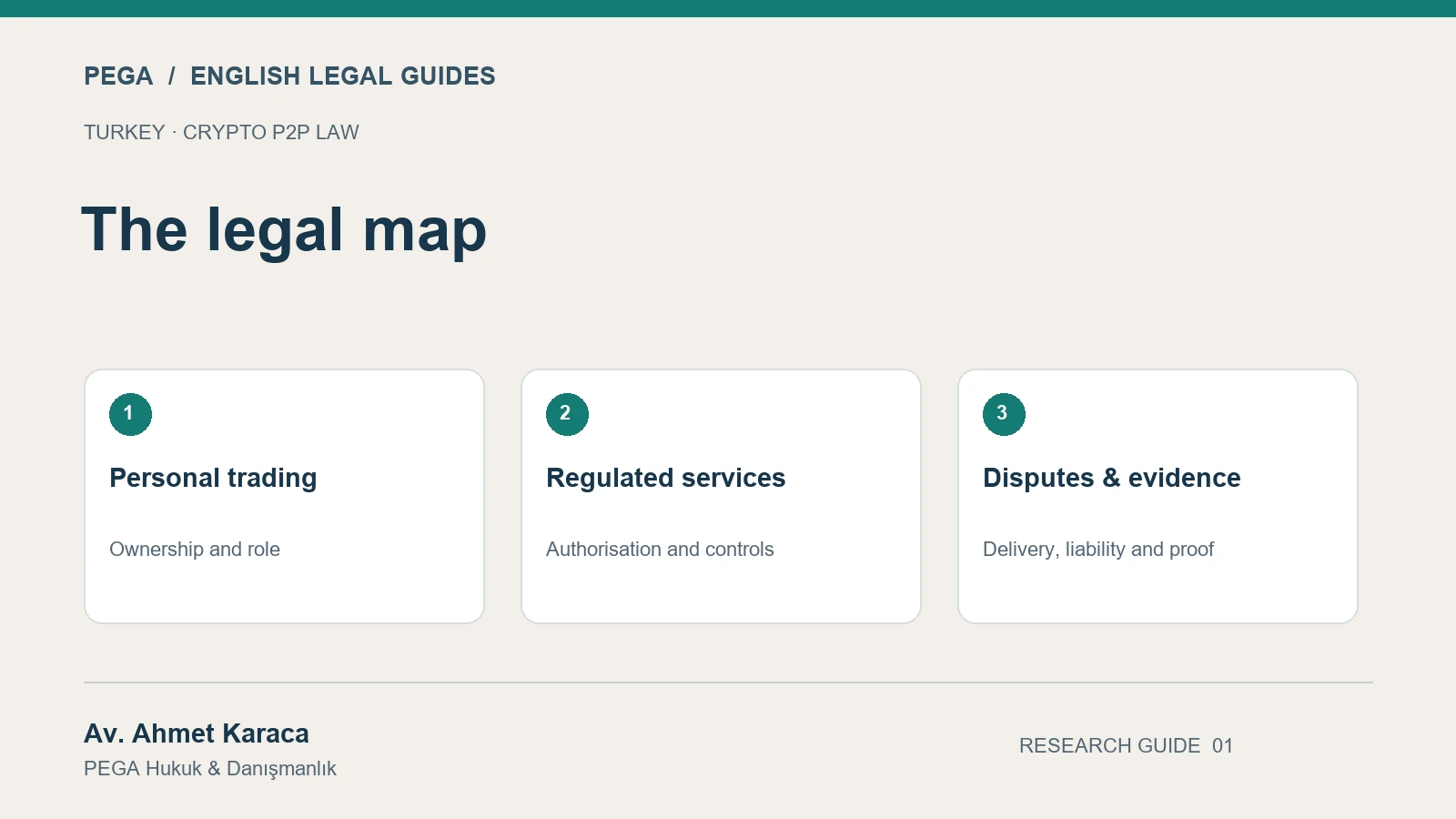
A P2P crypto trade can be a legitimate sale of a person’s own assets, a regulated service supplied to customers, a disputed contract, or one leg of a fraud. Turkish law does not answer all four situations with the same rule. The useful starting point is to identify who owns the value, who controls settlement and what each participant has agreed to do.
This guide explains the legal architecture of peer-to-peer crypto trading in Türkiye, commonly searched as Turkey. It connects the rules on authorisation, payments, anti-money-laundering controls, criminal responsibility, civil recovery and tax records. Separate guides below deal with the decisions that require more than an overview.
Find the guide for your situation
| Your immediate question | Start here | What the guide resolves |
|---|---|---|
| My Turkish bank account was frozen after a USDT sale. | P2P bank freezes and seizure | Identify the authority, measure, clock and evidence needed for review. |
| The bank payer and the crypto buyer are different people. | Triangle fraud and third-party payments | Reconstruct two losses and the person who obtained the crypto. |
| I want to operate a merchant, OTC desk or liquidity business. | P2P merchant and OTC regulation | Distinguish proprietary dealing from supplying a regulated service. |
| My withdrawal has a waiting period or a stablecoin limit. | MASAK transfer rules | Separate withdrawal controls, the Travel Rule and judicial restrictions. |
| I paid but did not receive crypto, or somebody demands a refund. | P2P disputes, refunds and civil claims | Identify the obligation, defendant, delivery evidence and remedy. |
| I need records for income, trading profits or a tax enquiry. | P2P tax and transaction records | Separate gross turnover, proprietary profit and service revenue. |
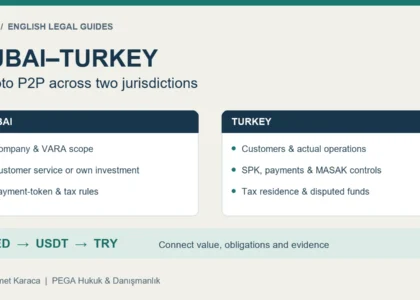
| I operate or trade between Dubai and Turkey. | Dubai–Turkey P2P: licensing, settlement and tax | Connect the business model, customers, fiat payments and tax position across both jurisdictions. |
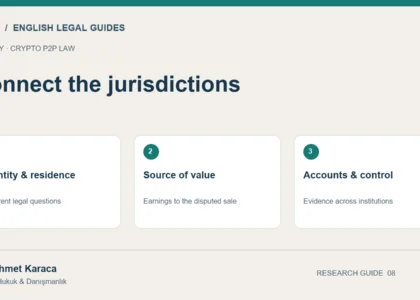
| I am a foreign resident or use accounts in several countries. | P2P trading by foreigners | Separate nationality, residence, income source and applicable jurisdiction. |
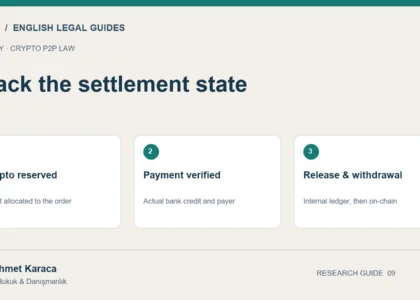
| The platform appeal is pending or escrow was released. | Escrow, platform appeals and settlement | Identify what the platform controls and what its decision cannot determine. |
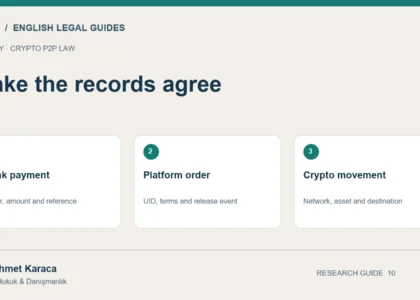
| I need to demonstrate what actually happened. | Build a P2P evidence file | Join bank payments, order records and crypto movements without double counting. |
| I have been contacted as a suspect or received a summons. | P2P investigations and criminal defence | Test knowledge, control and participation against the complete record. |
What is a P2P transaction in legal terms?
“Peer-to-peer” describes a way of finding or trading with a counterparty. It does not identify a single legal relationship. An exchange marketplace can match two users while holding the seller’s crypto in its own ledger. The buyer then pays the seller through a bank. A direct wallet trade can omit the exchange entirely. An OTC desk may quote as principal, arrange someone else’s trade, hold client assets or combine these functions.
Consider a hypothetical sale of 2,000 USDT for an agreed amount of Turkish lira. Four events may occur: the seller lists an offer; the platform reserves crypto; a bank credits lira; the platform releases its reserved balance to the buyer. A public blockchain transaction might occur only later, when the buyer withdraws. The bank receipt and the withdrawal hash therefore cannot, without the order ledger, prove the same obligation was performed.
This distinction becomes decisive when a fraud victim made the bank payment. The seller may have delivered crypto to the platform buyer but never contracted with the bank payer. Identifying the contracting parties, the payment instruction and the recipient of performance is more useful than saying “the transaction was completed”.
Six legal questions to keep separate
| Question | Legal framework | Frequent mistake |
|---|---|---|
| Are you supplying a regulated service? | Capital Markets Law No. 6362 and CMB/SPK crypto communiqués | Treating a merchant badge or tax registration as authorisation |
| Is crypto being used to pay for goods or services? | CBRT payment regulation and, where relevant, Law No. 6493 | Confusing a crypto sale with permission to operate a payment business |
| What customer and transfer controls apply? | Law No. 5549 and MASAK measures | Calling every withdrawal delay a prosecutor’s seizure |
| Did somebody knowingly participate in an offence? | Turkish Penal Code and criminal procedure | Equating receipt into an IBAN with proof of fraudulent intent |
| Who owes delivery, repayment or compensation? | Contract, unjust enrichment, tort and procedural rules | Assuming an exchange appeal or acquittal resolves every civil claim |
| How should income and transactions be recorded? | Applicable tax and accounting rules | Treating all bank credits as profit, or all crypto income as exempt |
A favourable answer in one column does not clear the other five. A real crypto delivery can coexist with unauthorised intermediation. A legally permitted investment can still generate a source-of-funds enquiry. A suspicious payment can justify investigation without proving that the seller committed fraud.
The current regulatory framework and the old P2P warning
Law No. 7518 introduced the crypto service-provider framework into Law No. 6362 in 2024. The CMB’s March 2025 communiqués then developed the establishment, activity, custody and operational rules. In Communiqué III-35/B.2, Articles 5–6, the relevant inquiry is whether the person carries on a regulated service as a regular occupation or commercial or professional activity.
Older commentary often repeats point 6 of the CMB’s September 2024 principle decision about P2P transactions conducted in one’s own name for another person’s account. The CMB’s 2025/15 bulletin expressly records the repeal of that point together with several others. It is historical context, not a current standalone rule. Its repeal also does not grant unrestricted permission: the statute and subsequent communiqués must be applied to the actual activity.
There is no universal “safe” number of trades, advertising limit or turnover figure that turns a service into personal investment. Relevant facts include ownership of the money and crypto, customer mandates, authority over wallets, custody, pricing risk, fees, staffing, marketing and the settlement process. Our merchant and OTC analysis explains how those facts change the classification, including the narrow wording of the own-wallet provision.
The CMB’s Operating Entities List must also be read with its express warning: appearance on that list is not itself confirmation of authorisation. Check the legal entity, permitted service and current decision. A global brand and a Turkish company carrying a similar name need not be the same contracting party.
Buying crypto and paying with crypto are different transactions
The CBRT’s Regulation on the Disuse of Crypto Assets in Payments prohibits direct and indirect use of crypto assets in payments and services facilitating that use. It also contains specific restrictions for payment-service business models and payment and electronic-money institutions. Those provisions should not be compressed into a statement that all crypto ownership or trading is banned.
In Danıştay 10th Chamber, E.2021/3724, K.2025/2776, 28 May 2025, the majority upheld the challenged regulation and distinguished the payment restriction from owning, investing in, buying or selling crypto. The decision records an available appeal; its later finality has not been established for this guide. It is not a ruling that every P2P business model is lawful.
For practical purposes, selling one’s crypto for lira and then making a separate lira payment is a different legal description from offering merchants a system that accepts crypto and automatically settles their invoices in lira. The second arrangement requires assessment of its entire operation. Merely placing a conversion step between customer and merchant does not answer the indirect-payment restriction.
Where an apparently ordinary sale goes wrong
The most dangerous moment is often release. A buyer’s “paid” button, a screenshot of a transfer and a successful bank credit prove different things. The seller should verify the actual credit through the bank, compare the payer with the verified order counterparty and keep the conversation in the platform’s supported channel. If something does not align, preserve it and use the dispute process before irreversible release.
Name matching is a safeguard, not an identity guarantee. Compromised accounts, corporate authority, transliteration and multiple given names require context. A third-party payment is a serious issue, but the explanation “it was my relative” should not be accepted as proof of authority. Nor should an independent payer be sent a refund to a new account nominated in a chat.
Our triangle-fraud guide follows a hypothetical three-party transaction through the seller’s and the payer’s positions. The escrow guide explains why a platform can control reserved crypto while having no ability to reverse a bank credit or decide criminal ownership.
Bank freezes and withdrawal controls follow different clocks
First identify whether the restriction comes from an institution’s compliance review, a MASAK transaction-postponement measure, an account suspension under CMK Article 128/A, a judicial seizure, or another attachment. “MASAK block” is often used informally for several of these. That label is insufficient to identify the authority or remedy.
Law No. 7571 introduced CMK Article 128/A for specified offences. It permits a qualifying account suspension of up to 48 hours and provides a separate seizure and judicial-review process. Expiry of the initial suspension period does not promise access where another valid measure has intervened. The bank-freeze guide sets out the separate procedural clocks and how to identify unrelated funds.
MASAK’s enhanced-measures guidance describes minimum withdrawal waiting periods for the covered transfer routes and limits on stablecoin withdrawals. These controls have their own scope and conditions. They are neither a general ban on holding USDT nor proof that a customer has committed an offence. For exact amounts, scope and documented exceptions, use the dedicated transfer-rules guide.
When can a P2P seller face criminal liability?
A fraud complaint may initially lead investigators to the seller because the seller’s Turkish account is visible in the victim’s payment record. Liability nevertheless requires analysis of a specific offence and the seller’s conduct and mental state. Genuine ownership of the crypto, a contemporaneous order and documented delivery matter. They do not automatically defeat contrary evidence of knowing assistance.
Repeated victim-linked payments, shared credentials, fabricated explanations, unusual compensation and instructions designed to conceal the real transaction can materially change the assessment. In Yargıtay 11th Criminal Chamber, E.2024/3673, K.2024/10848, 30 September 2024, the court upheld convictions despite arguments involving crypto conversion and a small commission. The short ruling does not establish that every commission trader is guilty; it shows why the label “crypto transaction” is not a complete defence.
A further distinction is now necessary. Law No. 7589, Article 13 added TCK Article 158(4), addressing participation limited to supplying specified payment instruments or account-access information for an unjust benefit, with a one-half sentence reduction where its conditions apply. This is not an offence-free account-rental permission or an automatic discount for every P2P seller. The facts, timing, procedural stage and transitional provisions require separate review.
The existing P2P investigation guide develops the evidential method; the broader crypto criminal-procedure guide places the file in its procedural setting. Neither a platform’s approval nor a bank’s initial processing replaces that analysis.
Delivery, restitution and damages are separate questions
When a transaction fails, begin with the promised performance. Was the seller obliged to release an internal platform balance or transfer a particular token on a specified network? Did the claimant direct payment to a third party? Was the recipient authorised? Were there multiple partial payments, cancellations or refunds? A civil claim needs this contractual and evidential foundation.
In a triangle-fraud case, a bank payer and a crypto seller may both have suffered loss. The seller’s delivery to the fraudster does not automatically determine the payer’s restitution rights, while the payer’s complaint does not automatically determine the seller’s criminal guilt. Recovery from the offender, preservation of custodial assets and claims between the other participants must be analysed without promising double recovery.
The refund and civil-claims guide examines breach, unjust enrichment, interim protection and forum selection. The existing crypto-fraud recovery guide addresses the broader tracing and asset-preservation strategy. An internal appeal, a criminal complaint and a civil claim may proceed on different tracks.
A useful record tells the whole economic story
For every disputed sale, join the bank reference, P2P order ID, verified user, agreed rate, token quantity, fees, release event and any later withdrawal. Record original timestamps and time zones before normalising them. Preserve unsuccessful orders and refunds: otherwise gross activity can be mistaken for realised income or a single payment can appear to fund two trades.
For example, repeated sales of the same working capital can produce large bank turnover with a small margin. That is an accounting observation, not a tax exemption. Similarly, receipt of crypto as compensation for work raises questions about the underlying earnings before the later P2P conversion is considered. The tax and records guide separates these issues and explains the limits of older crypto tax decisions.
Foreign-language records add another layer: the bank’s account name may be transliterated differently, a platform may report UTC, and a foreign institution may identify the same person using a different document. The foreign-resident guide explains how to reconcile those differences without treating nationality as proof of risk or innocence.
The first file to assemble when a problem arises
- Identify the event: account restriction, missing delivery, disputed payer, suspicious login or authority contact.
- Record the identifiers: bank reference, order ID, account UID, support ticket, transaction hash and any official file number.
- Preserve native records: complete exports, messages, attachments and restriction notices; keep an untouched copy.
- Explain ownership and control: how the value was acquired, who operated each account and who authorised release.
- Separate confirmed facts from gaps: request the missing internal ledger or institutional record rather than filling the gap with an assumption.
- Direct the request correctly: a platform can review its order; a bank can explain its own review within disclosure limits; a judicial measure needs the appropriate procedural application.
The P2P evidence-file guide supplies the working fields and examples. Never include a seed phrase, private key or one-time authentication code in a support ticket or legal annex. The relevant proof is normally transaction and account evidence, not the ability to spend the assets.
How to read this English collection
The articles are written for people who need to understand a Turkish legal problem in English: individual traders, foreign residents, businesses, advisers and institutions. They retain Turkish statutory abbreviations so a reader can match an explanation to a bank notice or case document. CMK means the Criminal Procedure Code; TCK the Penal Code; SPK the Capital Markets Board; MASAK the Financial Crimes Investigation Board.
Examples are hypothetical unless a named court decision is cited. English summaries are explanatory translations; the Turkish source controls. The collection distinguishes legislation, administrative guidance, platform rules and judicial findings. A lower-court ruling illustrates reasoning within its facts; it is not presented as a universal outcome. The Turkish P2P law collection provides related Turkish-language reading.