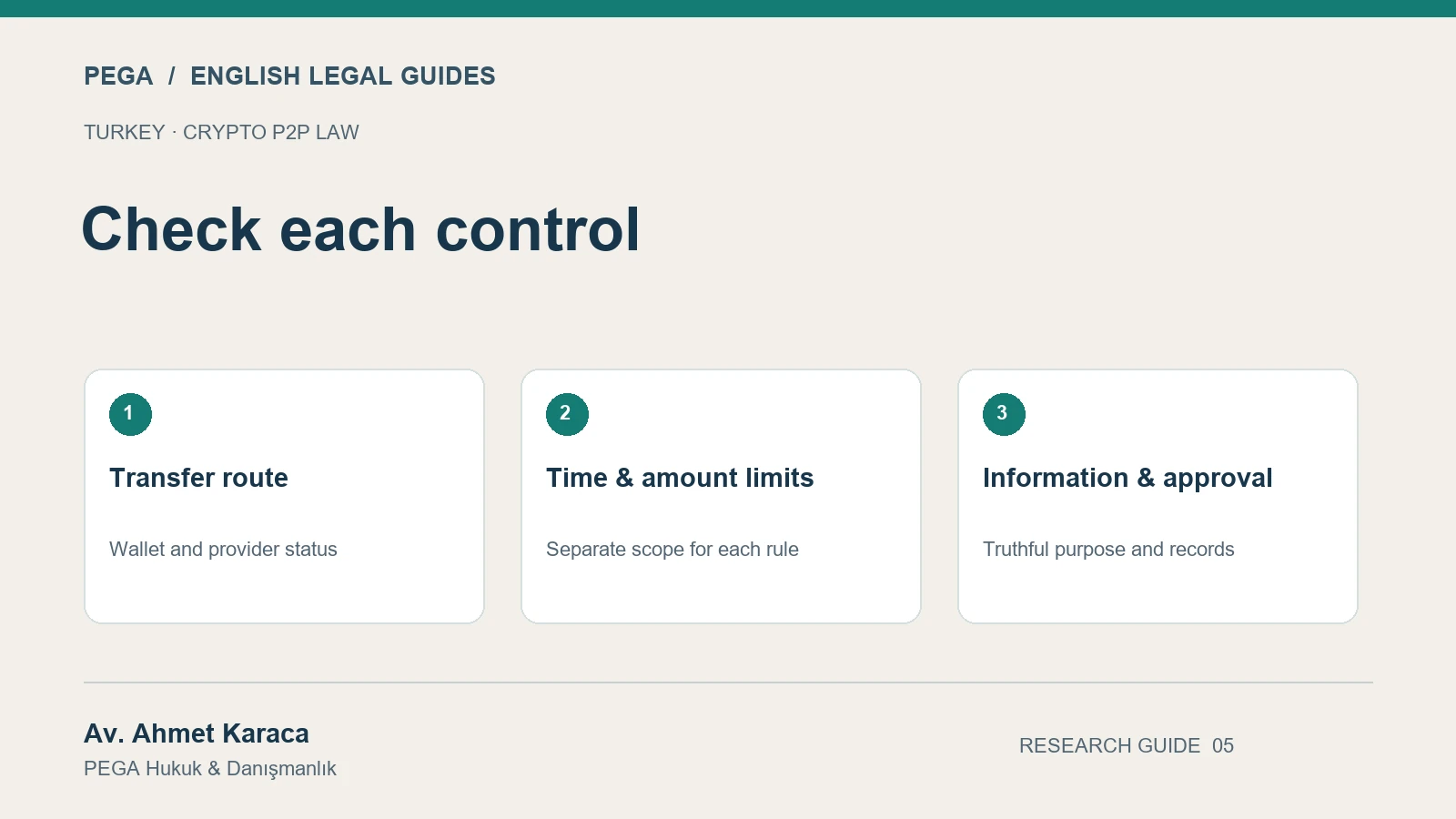
A crypto withdrawal delay is not necessarily a freeze, and a transfer limit is not a tax. Turkey’s MASAK controls involve customer identification, information accompanying transfers, minimum waiting periods for covered routes, stablecoin withdrawal limits and ongoing monitoring. The scope of each rule matters as much as the number attached to it.
This guide explains the measures described in MASAK’s September 2025 enhanced-measures guide, particularly section 4.7, and its crypto service-provider compliance guide. The customer’s platform, transaction route and current implementation should be checked before relying on a countdown or advertised allowance.
The controls at a glance
| Control | Published rule | Critical qualification |
|---|---|---|
| Covered crypto withdrawal | At least 48 hours after the asset’s purchase, swap or deposit | The rule concerns the specified unhosted-wallet or foreign-provider routes, not every event called a transfer. |
| First crypto withdrawal | At least 72 hours under the covered waiting-period rule | This replaces the ordinary minimum for that first withdrawal; it is not 48 plus 72 hours. |
| Stablecoin withdrawals | USD 3,000 equivalent daily and USD 50,000 equivalent monthly | Includes transfers to other platforms; the rule is expressed in dollar-equivalent value. |
| Transfers subject to the Travel Rule | The stated stablecoin limits may be applied at twice those amounts | This is conditional, not an automatic entitlement for every user. |
| Transaction explanation | At least 20 characters describing the nature of the transaction | A plausible-looking phrase is not a substitute for a truthful explanation. |
| Qualifying liquidity, market-making or arbitrage activity | A documented exception to specified time and amount limits may be applied | Requires customer-specific board approval and the prescribed evidence and continuing controls. |
Which routes trigger the 48- or 72-hour waiting rule?
The enhanced-measures guide describes platform-intermediated withdrawals involving a wallet address not registered with a crypto service provider, or a foreign crypto service provider or authorised financial institution that is not required under its own law to share sender and beneficiary information. Transfers to other platforms are included where the stated conditions apply.
It follows that “foreign exchange”, “self-hosted wallet” and “Travel Rule transfer” should not be used interchangeably. The platform needs to classify the actual destination and information-sharing arrangement. The customer should provide accurate beneficiary and wallet information and ask which rule is being applied if the interface is unclear.
The trigger is linked to the relevant asset’s purchase, swap or deposit. It is not simply the account’s age or the date on which the customer first passed identity checks. If several acquisitions or deposits are involved, obtain the institution’s allocation and timing explanation rather than assuming the oldest balance determines the whole withdrawal.
For example, an established customer purchases crypto on Monday at 14:00 and requests a covered withdrawal that afternoon. A 48-hour minimum would not expire merely because Tuesday is a new business day. The exact eligibility time still depends on the platform’s records, the asset event, other controls and whether the first-withdrawal rule applies. This illustration is about elapsed time, not a promise that execution must occur immediately at the minimum.
The stablecoin limits have a different scope
The stablecoin rule concerns assets designed to maintain stable value by reference to another value, right or combination, including official currencies. It should not be reduced to a brand-specific USDT rule. Nor should one assume every token bearing a familiar ticker is the genuine asset: token contract and network identification remain necessary.
The published baseline is USD 3,000 equivalent per day and USD 50,000 equivalent per month for platform-intermediated withdrawals, including transfers to other platforms. For transfers to which the Travel Rule obligation applies, those limits may be doubled. Ask the platform how it determines dollar-equivalent value, the relevant period and amounts already consumed. A token balance and a remaining regulatory allowance are different figures.
Passing one limit does not remove the other. A permitted daily withdrawal may still exceed the remaining monthly allowance. Conversely, having a large monthly allowance does not permit using it all in one day. Multiple identities, borrowed accounts or artificial splitting are not legitimate ways to defeat customer-based controls.
What the Travel Rule does and does not do
The Travel Rule concerns information accompanying qualifying crypto transfers. It enables the sending and receiving institutions to identify the relevant persons and transaction. It is not a public blockchain field that automatically reveals everyone’s legal identity, and an explorer’s wallet label is not a substitute for the required institutional information.
The MASAK sector guide explains the TRY 15,000 threshold and the information requirements, including sender and beneficiary identifiers and, for the relevant threshold category, additional sender-identification information. Lower-value transfers still carry core information requirements; the threshold is not permission for anonymous trading or an exemption from customer due diligence.
For a self-hosted wallet, the platform may request information about the wallet’s owner or beneficiary and the transaction’s purpose under the applicable rules and risk-based controls. Answer from actual knowledge. If you do not control a recipient wallet, do not describe it as your own merely to make a form accept the transfer.
Where the required message information is missing, the receiving provider must request completion; the guide states that the transfer must be returned if the information is not completed. Repeated incomplete messages also require consideration of rejecting or limiting transfers, or ending the relationship with the sending provider. A successful technical broadcast does not prove that the related compliance information was correct. Keep the transfer reference and support correspondence with the on-chain record.
The arbitrage exception is an institutional decision
The guide permits platforms, subject to its conditions, not to apply the specified periods and limits to transfers established to concern liquidity provision, market making or intermarket arbitrage. It requires full customer measures, periodic source-of-assets and bank or other-platform account documentation, prevention of avoidance, and a separate board approval for each customer.
Ongoing monitoring remains required. Where the activity is found not to have the stated character, the time and amount limits must be applied immediately. A customer cannot create the exception by selecting “professional trader”, opening a company or writing “arbitrage” in every description.
Regulatory authorisation is separate. Even a properly documented MASAK exception does not answer whether a business is supplying a CMB-regulated crypto service. The merchant and OTC guide explains this distinction. A platform’s willingness to process a transfer should not be presented to customers as a licence.
Writing a meaningful transaction explanation
The minimum 20-character explanation concerns the nature of the transfer. A useful description is consistent with the actual recipient and the supporting record. For a genuine own-wallet transfer, that may be a move to personal custody; for a documented transaction, it may identify its real economic purpose. Do not use invented trade descriptions, repeat meaningless characters or conceal a third-party beneficiary.
The explanation should agree with the account profile, expected activity, acquisition record and any invoice or agreement. A later bank enquiry becomes harder when the platform form says “personal savings” but messages show settlement for unrelated customers. Preserve what was submitted at the time, including subsequent corrections.
How these rules interact with P2P orders
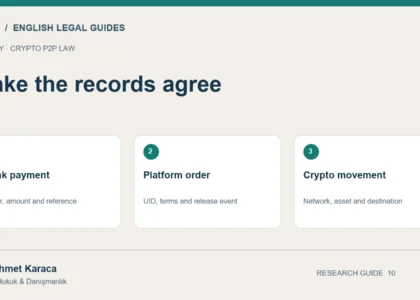
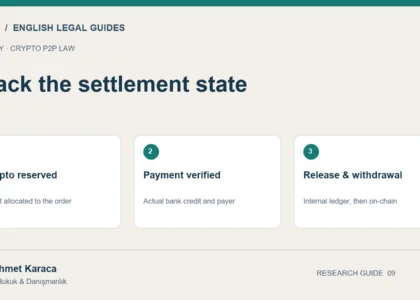
A P2P platform may reserve and release crypto inside its ledger without an immediate on-chain withdrawal. The bank payment, internal release and later external withdrawal should be recorded as separate events. A waiting period applied to the last event does not by itself show that the earlier seller failed to perform the P2P contract.
Similarly, an order marked “complete” does not prove a later withdrawal must be unrestricted. Contractual delivery, customer checks, withdrawal conditions and a possible judicial measure may all require separate analysis. The escrow guide explains how to identify the controlled asset at each step.
If the incoming bank payment came from a different person, the issue is not cured by the withdrawal having passed a MASAK check. The third-party-payment guide addresses that risk. Institutional compliance is one layer of evidence, not a guarantee about every participant’s lawful conduct.
Answering a source-of-funds request coherently
Start with how the value was earned or acquired, then trace it into the crypto that is now being transferred. Depending on the facts, useful records include employment or service documents, sale agreements, bank statements, prior exchange purchases, deposit and withdrawal exports, wallet transactions and tax records. Explain gaps explicitly.
A wallet balance screenshot proves neither the original income nor the complete acquisition chain. A large platform statement may also omit the foreign bank leg. An indexed chronology connecting identifiers is more useful than an unstructured attachment dump. For a practical format, use the P2P evidence-file guide.
When a delay becomes a different legal issue
A MASAK withdrawal rule is distinct from transaction postponement under Law No. 5549, Article 19/A, and from suspension or seizure under CMK Articles 128 and 128/A. The first is a preventive operational control; the others have their own legal conditions and processes. There is no single “MASAK waiting period” covering all of them.
If a restriction continues after an interface countdown, ask whether another measure applies and what documents are required. If an authority or file number is identified, record it. Do not assume the platform is free to release assets solely because the ordinary minimum time has elapsed. The account-freeze guide sets out how to identify the correct remedy.
Questions worth asking the institution
- Which transfer and asset event starts the waiting period?
- Is the destination treated as an unhosted wallet or a provider transfer, and why?
- Which daily and monthly allowance applies, and how much has been used?
- Is further beneficiary, source-of-funds or purpose information missing?
- Does the restriction concern an operational rule, an internal review or an external authority’s measure?
- Which reference should be used for subsequent correspondence?
These questions seek the operational and legal basis without demanding confidential suspicious-transaction reporting details. The broader P2P law guide for Turkey connects the answers to licensing, criminal liability and private-law obligations.