
Crypto fraud rarely begins as a legal problem. It begins with a transfer that looks routine: a stablecoin withdrawal to an “investment account”, a P2P payment released after money appears in a bank account, a wallet connected to a counterfeit website, or a second payment demanded to unlock funds that never existed. By the time the victim searches for crypto asset recovery in Turkey, the money may have crossed several wallets, chains and service providers. The first legal decisions must therefore be made at the speed of an incident response, but supported with evidence that will remain intelligible months later in a prosecutor’s file.
This guide explains how a Turkey-connected crypto fraud matter is investigated and how recovery opportunities are preserved. It is written for foreign individuals, founders, family offices and companies whose case touches Turkey through a victim, bank account, exchange, P2P counterparty, company, suspect or asset. It also addresses the practical questions behind searches such as “crypto scam lawyer Turkey”, “recover stolen USDT in Istanbul”, “freeze a crypto wallet”, “report a fake crypto exchange”, “trace Bitcoin to a Turkish exchange” and “can a Turkish prosecutor seize cryptocurrency?”
The governing idea is simple: a blockchain trace is a map of value movements, not a complete case. Recovery usually depends on joining that map to off-chain evidence—bank records, exchange ledgers, KYC material, device data, correspondence and control of private keys—and then using the correct Turkish or cross-border procedure before the evidence or asset moves beyond practical reach.
The recovery question is larger than “where did the crypto go?”
A public blockchain may show that 80,000 USDT moved from address A to address B and then split across five destinations. It does not, by itself, identify the natural person behind B, explain whether B is a personal wallet or a service deposit address, or prove that every later recipient knew the source of the funds. That distinction is central to both recovery and fairness.
In demanding files, four tracks run in parallel:
| Track | Question | Typical output |
|---|---|---|
| Value reconstruction | What asset moved, on which network, through which transformations? | Transaction schedule, address graph, bridge and swap map |
| Attribution | Which exchange, custodian, project or person controlled the relevant account or address? | Service attribution with confidence level and targeted record request |
| Legal characterisation | Was the conduct fraud, theft, unauthorised access, breach of trust, laundering or a civil dispute? | Fact-specific criminal complaint and alternative legal theories |
| Preservation and control | Who can preserve data, restrict an account or transfer an asset under lawful authority? | Preservation request, prosecutorial application, seizure or interim-relief strategy |
A competent file does not postpone attribution until after a generic complaint has been submitted. Nor does it attach a colourful graph and treat it as proof of identity. The procedural request should be engineered around the point where the public trail meets an entity that has customer, device or internal-ledger records.
Which crypto frauds commonly create a connection with Turkey?
The label “crypto scam” covers very different factual patterns. The distinction matters because it changes the offence analysis, the evidence to preserve and the realistic recovery route.
Investment and relationship-based confidence fraud
The victim is contacted through social media, a messaging application, a dating platform or an apparently professional investment group. Trust is developed before the victim is directed to buy crypto from a legitimate exchange and transfer it to a wallet or website controlled by the fraudsters. A fabricated dashboard displays profits. Withdrawals are blocked unless “tax”, “verification”, “liquidity” or “insurance” payments are made.
The crucial evidence is not the fake account balance. It is the acquisition trail, the withdrawal transaction, the destination address, the communications that induced the payment, the domain and hosting evidence, and any later movement to an identifiable service. A victim should not pay an invented release charge merely because the dashboard shows a larger balance. The supposed profit may be no more than a number in a database controlled by the perpetrator.
Phishing, wallet-drainer and malicious approval incidents
A counterfeit exchange page may capture credentials and one-time codes. A malicious decentralised application may obtain a token approval or signed permission that allows assets to be transferred later. A seed phrase may be exposed through fake support, cloud storage, remote-access software or a compromised device. These incidents require more than following the theft transaction. The investigation must distinguish credential compromise, private-key compromise, smart-contract approval and exchange-account takeover, because each leaves different logs and creates different containment steps.
On an EVM-compatible network, for example, a token transfer initiated under an earlier allowance may not resemble a direct wallet-to-wallet transfer by the victim. The transaction sender, token-transfer event, approved spender and ultimate recipient must be read together. Revoking an allowance may limit future loss, but it does not retrieve completed transfers or cure an exposed seed phrase.
SIM swap and account takeover
A mobile number is transferred to a SIM controlled by the attacker, or the victim’s email and exchange credentials are compromised through another route. The attacker resets authentication, adds a withdrawal address, sells assets and withdraws. Relevant records may sit with the telecom operator, email provider, exchange and bank. The timeline must align the loss of cellular service, password-reset events, IP and device changes, authentication method, address whitelisting, trades and withdrawals.
Liability is not resolved by saying either “the customer shared a code” or “the exchange allowed a withdrawal”. The inquiry concerns the actual security controls, warnings, anomalies, contractual allocation of risk, causal link and the victim’s conduct. Our separate analysis of SIM-swap crypto account losses examines that evidence in detail.
Counterfeit exchanges, recovery fraud and impersonation
Fraudsters clone the visual identity of an exchange, regulator, law firm, police unit or blockchain-analysis company. After the initial theft, a second group—or the same group under a new identity—claims that the funds have been found and asks for an advance fee. A genuine recovery process does not depend on sending crypto to a private “validation wallet”, disclosing a seed phrase, synchronising a wallet through an unknown link or paying a fictional blockchain tax.
Victims should preserve the full URL, email headers, usernames, telephone numbers, wallet addresses, payment instructions and screenshots showing the browser address bar. A cropped screenshot of a logo proves very little; the surrounding technical context can distinguish the real institution from an impersonator.
P2P and triangular fraud
In a classic triangular arrangement, a fraudster deceives victim V into paying trader T’s bank account. T believes the payment relates to a genuine P2P order and releases USDT to a wallet designated by the fraudster. The bank trail ends at T, while the crypto trail may continue elsewhere. The trader can be reported even though the trader never spoke to V and did not retain V’s money as profit.
These cases must not be flattened into “money arrived; crypto left”. The file needs the P2P order ID, listing, chat, payer-name checks, bank receipt, release time, exchange ledger, withdrawal data, destination address, pricing, commission, prior pattern and all communications. Repeated commercial dealing, third-party payments and unexplained destination control can change both regulatory and criminal analysis. A detailed English treatment is available in our guide to P2P investigations, bank freezes and criminal liability in Turkey.
Business email compromise, invoice diversion and ransomware
Companies may acquire and transfer crypto after an invoice, settlement instruction or executive request is falsified. Ransomware incidents add preservation duties concerning the intrusion itself, wallet negotiations and payment path. Corporate files should preserve approval workflows, mail headers, endpoint artefacts, treasury instructions and the identity of the person who authorised the transaction. Treating the wallet trace as the entire incident can destroy the evidence needed to establish how the payment was induced or approved.
Project, founder and treasury disputes
Not every missing token is an external hack. Assets may move under a multisignature threshold, administrator key, upgrade proxy, bridge operator or treasury mandate. A founder departure, vesting dispute, unauthorised mint, liquidity withdrawal or governance conflict may present both commercial and criminal questions. The analysis begins with control rights: who could sign, upgrade, pause, mint, blacklist, bridge, redeem or change the quorum at the relevant time?
What a victim should do in the first hours
Speed matters, but frantic activity can damage the record. The objective is to stop continuing access, preserve the best evidence and identify the first reachable control point.
- Stop sending funds. Do not pay tax, gas, unlock, verification or recovery charges to the same channel.
- Isolate the compromise. From a clean device, secure the primary email account, exchange accounts, mobile account and password manager. If a seed phrase or private key is exposed, plan a move to a newly generated wallet; merely changing an app password does not replace the compromised key.
- Preserve before cleaning. Export chats, emails and exchange statements before deleting applications, resetting devices or closing accounts. Record time zones.
- Notify the relevant service through its official channel. Give precise transaction hashes, addresses, asset, network, amount and timestamps. Ask for preservation and flagging; do not overstate that the service has a legal duty to return funds on a private request.
- Prepare a structured Turkish complaint where Turkey is connected. The complaint should explain the deception, loss and attribution route, not merely list wallet addresses.
- Protect remaining approvals and sessions. Revoke malicious token approvals where appropriate, end active exchange sessions and remove unknown API keys.
- Preserve the fiat leg. Obtain bank transaction details, sender/recipient data available to the client, receipts and any bank communication about blocks or recalls.
The same sequence does not fit every incident. Moving assets can be correct after key compromise but harmful if an investigator needs to image a corporate device or if control of the destination wallet is uncertain. A high-value incident benefits from coordinated legal and technical triage before irreversible steps.
Building an evidence package that a Turkish authority can use
A long narrative with hundreds of screenshots is not a strong evidentiary package. The aim is to make each proposition verifiable and each requested measure operational.
The loss schedule
Create one row for each transfer. Record the date and exact time with time zone, asset, amount, network, originating service or address, destination address, transaction hash, fiat value at a stated valuation method, and the representation that caused the transfer. Never write “sent to Binance” merely because an address has been labelled by a website. Record the basis and confidence of the attribution.
Original records, not only screenshots
Preserve native emails with headers, downloadable exchange statements, CSV files, PDF bank statements, order confirmations, wallet export data and the original image files. Screenshots are useful for preserving transient interfaces, but they should show the relevant URL, account context and time where possible. Keep originals read-only and work from copies.
Provenance, hashing and chain of custody
A hash value can show that a file has not changed since a defined point; it cannot prove that the file was true when created. A proper evidence register records who acquired the item, from which source, by which method, at what time, where it is stored, its hash and every material handling step. The US National Institute of Standards and Technology’s preservation guidance emphasises provenance, integrity and the distinct challenges of digital evidence. These are useful engineering principles even when Turkish procedural law governs admissibility.
A fact-to-request index
For every major assertion, identify the supporting exhibit and the next evidence holder. If the trace reaches an exchange deposit address, the request should identify the precise transaction, asset, chain, address and time, then ask for the credited account, account-opening records, device and IP history, internal transfers, trades, withdrawals, destination details and preservation of linked accounts. Broad demands for “all information about the fraud” are easier to misunderstand and slower to execute.
How blockchain tracing supports recovery
Blockchain analysis is a reproducible reading of ledger data supplemented by carefully assessed attribution. It can establish transaction existence and order, follow value across transparent networks, identify consolidation and dispersal, expose interactions with smart contracts and locate deposit points associated with services. It is strongest when the method and limitations are visible.
UTXO and account-based networks require different reasoning
Bitcoin and similar UTXO systems consume earlier outputs and create new outputs. A transaction may include a recipient output and a change output, but change heuristics are not certainties. Multi-input clustering can be useful, yet collaborative transactions and service architectures can break the assumption that all inputs share one controller.
Ethereum and other account-based systems update balances and states. Token movements often appear in contract events rather than the network’s native-value field. Investigators must inspect contract calls, logs, approvals, routers, liquidity pools, proxies and traces where relevant. A transaction with zero native value can transfer a very large token balance.
Exchanges create an on-chain/off-chain boundary
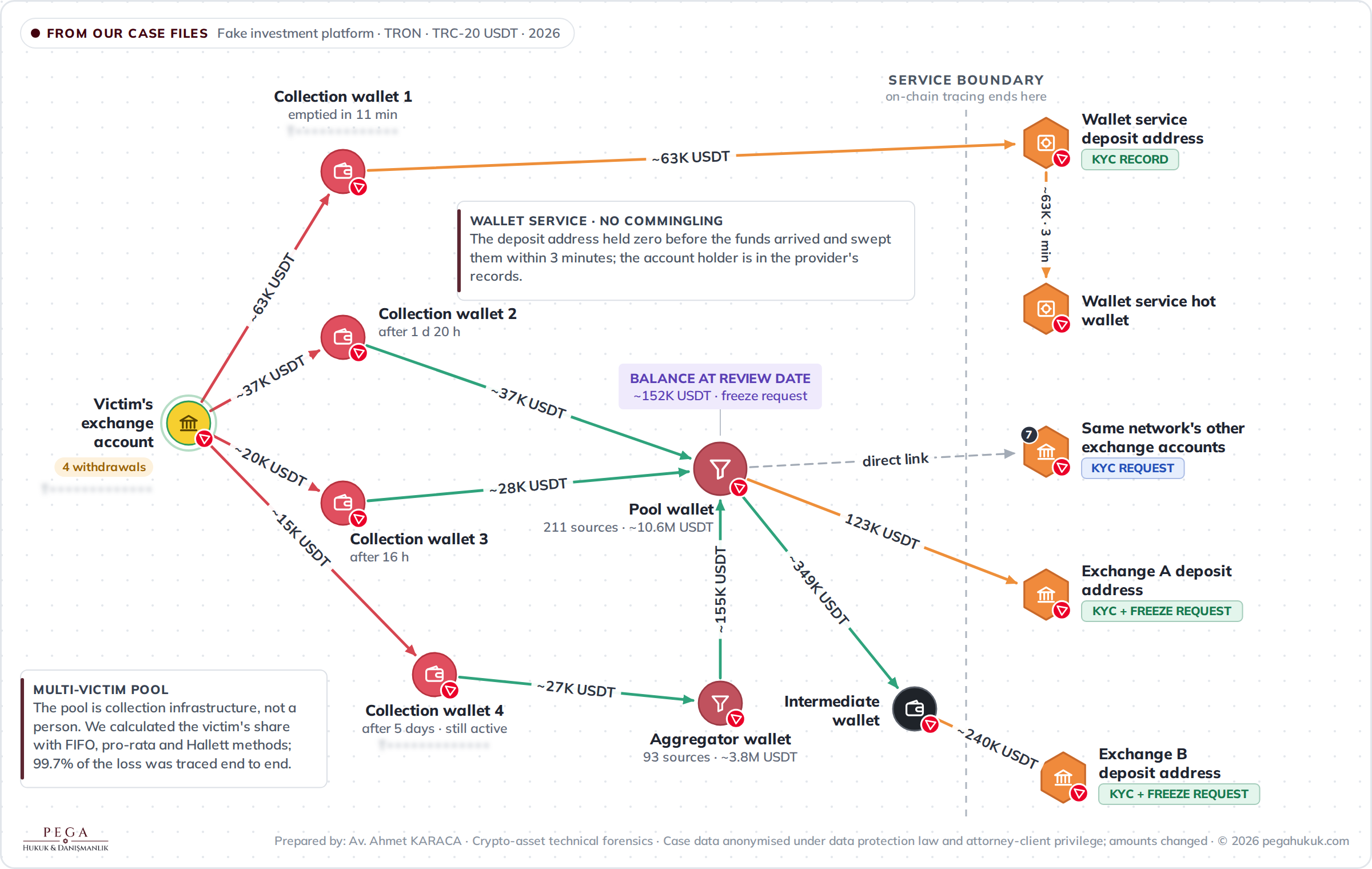
A deposit enters an address controlled by a platform, but the customer’s subsequent trade or internal transfer may occur only in the platform database. The next public withdrawal may be sent from a pooled hot wallet and need not correspond one-to-one with the customer’s earlier deposit. This is why following an exchange’s omnibus wallet as though it were the suspect’s personal wallet produces false conclusions.
The analytical objective is to identify the service and transaction accurately enough for the competent authority to obtain its internal records. Public labels can generate a lead; provider confirmation, records and contextual corroboration build evidence.
Stablecoins can create a different intervention surface
Some stablecoin contracts include issuer-controlled functions capable of restricting addresses or tokens. That technical capacity does not mean a victim can obtain a freeze by sending an email, and it does not replace judicial or law-enforcement process. It does mean that the token contract, issuer, governing terms, chain and present location of the asset should be identified promptly. If the funds have already been swapped into another asset or bridged to another representation, the intervention analysis changes.
Bridges, swaps and chain hopping
A bridge is not a blank space in the trace. The originating transaction, bridge contract or service, event data, destination-chain mint or release, amount, fees and timing may allow the path to be correlated. Aggregators can route through several venues, and a displayed “swap” may contain multiple contract interactions. The report should distinguish what is directly observed from what is inferred through amount-and-time correlation.
Mixers and privacy-enhancing techniques
A mixer weakens simple one-to-one transaction tracing, but it does not erase evidence outside the mixing mechanism. Entry and exit timing, denomination, address behaviour, downstream consolidation, gas funding, exchange touchpoints, device records and seized service data may remain relevant. Any proposed match should carry an explicit confidence level and alternative explanations. Our technical article on demixing and tracing funds through crypto mixers explains why an analytical lead is not the same as courtroom attribution.
Official international practice supports this combined model. Europol’s analysis of criminal finance describes both the investigative value of cryptocurrency records and the challenges created by changing criminal methods. Public US forfeiture cases likewise show blockchain analysis being combined with exchange information and other evidence; the relevant lesson is methodological, not that Turkish procedure follows US forfeiture law.
Criminal complaint and investigation in Turkey
A complaint may be submitted to the competent public prosecutor or law-enforcement unit. The factual pattern may engage fraud, aggravated fraud, theft committed through information systems, unauthorised access or interference, misuse of bank or credit cards, breach of trust, money laundering, participation and other provisions. The correct legal characterisation depends on how access or consent was obtained, what was represented, who controlled the property and what each participant knew.
For example, a transfer technically authorised by a victim after deception is not factually identical to an attacker signing with a stolen private key. A P2P trader who received a bank payment from a deceived victim presents a different question from the person who designed the deception and controlled the final wallet. Article numbers should not substitute for this factual separation.
The complaint should usually include:
- a concise chronology of inducement, acquisition and transfer;
- a loss table with verifiable transaction identifiers;
- the relationship between bank, exchange and blockchain records;
- known identities, accounts, domains, telephone numbers and wallets;
- the evidentiary basis and confidence for service attribution;
- specific preservation, record-production, search, seizure or examination requests;
- translations necessary to make foreign communications usable; and
- an explanation of urgency and dissipation risk.
Under the Turkish Criminal Procedure Code, seizure of assets, search of digital systems and collection of provider records are judicial or prosecutorial measures governed by statutory conditions. Law No. 7571 also introduced Article 128/A, a tailored mechanism for suspending certain accounts in investigations of specified offences committed through information systems, subject to its scope, notification and decision framework. It should not be described as a universal private “48-hour freeze right”. The full facts and legal basis must be matched to the available measure.
MASAK, banks and the difference between a compliance restriction and seizure
Clients often say that “MASAK froze the account” when the only confirmed fact is that a bank or exchange has restricted use. Several mechanisms can produce similar screens: internal fraud controls, customer due diligence, a suspicious-transaction process, a public prosecutor’s order, a court seizure, an enforcement measure or the postponement mechanism under Article 19/A of Law No. 5549.
Article 19/A permits the postponement of transactions within its legal conditions and for a maximum period expressed in business days. It does not mean every restriction must end automatically at the same point, because another lawful basis may exist. The first recovery or defence task is to identify the authority, reference, scope, asset, date and current status. Our Turkish guide to MASAK and prosecutorial account restrictions separates these mechanisms.
MASAK’s role also matters on the service-provider side. Crypto-asset service providers are obliged entities and must perform customer identification, monitoring, suspicious-transaction reporting, information production and compliance duties. The official crypto-asset service-provider guide addresses the Travel Rule and enhanced measures. A private victim’s request and a competent authority’s request are not interchangeable, but precise private notification can help preserve an actionable lead.
Can a Turkish court or prosecutor freeze or seize cryptocurrency?
Crypto assets are not beyond seizure merely because they are represented through distributed-ledger records. The workable measure depends on control.
| Where the asset is | Practical control point | Evidence needed |
|---|---|---|
| Account at a Turkish regulated platform | Platform account and custody architecture | Customer attribution, balance, internal ledger and authority’s order |
| Account at a foreign exchange | Foreign legal entity or relevant affiliate | Precise service attribution, preservation and cross-border process |
| Self-hosted wallet | Person or device controlling keys; sometimes smart-contract controls | Control evidence, device/key recovery route and lawful seizure method |
| Issuer-administered token | Holder plus any issuer contract capability | Correct token contract, chain, address and legally sufficient request |
| DeFi protocol position | Wallet, governance/admin rights, protocol and underlying assets | Position tokens, contract state, redemption path and control analysis |
An address can be watched, but a public blockchain does not obey a court order. Implementation occurs through the person, device, custodian, exchange, issuer or contract mechanism capable of controlling the asset. A court order framed around the wrong entity or wrong chain may be legally serious but operationally ineffective.
Cross-border evidence and foreign victims
A foreign victim can have a meaningful Turkish case even if the initial contact occurred abroad. A Turkish bank beneficiary, exchange account, company, resident suspect, device or part of the criminal result may create a domestic investigative connection. Jurisdiction and venue should be explained through concrete facts rather than assumed from the use of a Turkish-language service or a Turkish telephone number.
Cross-border work has two different speeds. Informal or provider-facing notification may preserve data or alert a compliance team. Compelled disclosure, seizure and admissible evidence may require a Turkish order, mutual legal assistance or the foreign jurisdiction’s process. The Budapest Convention provides a framework for cybercrime and electronic-evidence cooperation. Its 24/7 Network supports expedited preservation, while subsequent formal procedures may be needed to obtain the material as evidence.
A useful cross-border request identifies the correct legal entity, not only the consumer brand. It accounts for data-retention periods, time zones, affiliates, transfer type and the difference between a deposit address, an omnibus wallet and an internal account. Translations should preserve technical identifiers exactly; a transaction hash must not be “translated” or reformatted.
Asset recovery routes: criminal, civil and contractual
Recovery is not a single lawsuit. The routes may complement or compete with one another.
Recovery through the criminal process
A criminal investigation can identify suspects, compel records and support seizure or confiscation within the governing conditions. A victim’s restitution position must be tracked; seizure preserves an asset but does not automatically establish final ownership or immediate return. Competing victims, good-faith third parties and conversion into other assets can complicate distribution.
Civil claims and interim measures
Depending on the relationship and forum, a victim may consider claims based on contract, tort, unjust enrichment, ownership or platform duties, together with provisional relief. A civil court still needs an identifiable defendant, jurisdiction, a cognisable claim and an enforceable target. A wallet label alone rarely answers those questions.
Claims involving exchanges, banks or telecom operators
Institutional liability is fact-specific. The relevant issues can include contractual status, consumer or commercial character, security standard, transaction monitoring, authentication, warnings, anomaly response, instructions, causation and contributory conduct. A platform’s role as a neutral custodian in one transaction does not make it liable for the external deception that caused the customer to withdraw; conversely, “blockchain transactions are irreversible” does not answer whether the institution’s own security or contractual duties were breached.
Negotiated return and compliance-led resolution
Occasionally funds reach an account whose holder is not the organiser: a P2P trader, mule, payment recipient or business drawn into the chain. A lawful return can sometimes be arranged, but informal repayment should not be improvised. The parties need to consider ownership, competing claims, active restraints, criminal exposure, documentation and whether payment to one claimant could prejudice another.
Valuation, restitution and the problem of a moving asset
Crypto claims require a declared valuation method. Purchase price, value at transfer, value at discovery, value at seizure and present value may differ radically. Token quantity should remain the primary immutable datum where available; fiat valuation should state the exchange or reference market, currency, timestamp and price convention. Fees, swaps, partial recoveries and forks should be recorded rather than hidden inside a single rounded figure.
Where the claim concerns return of the asset itself, the legal basis and practical ability to return the same token need examination. Where monetary damages are sought, the relevant valuation date is a legal issue, not a charting preference. A well-built schedule allows the court to apply its chosen rule without reconstructing the entire chain.
How an expert-grade crypto fraud report should read
The report should enable another competent analyst to reproduce the key findings. It should not conceal judgment behind software screenshots or a proprietary risk score.
A robust structure is:
- Mandate and questions. Define whether the report traces value, assesses attribution, reconciles accounts or evaluates a particular hypothesis.
- Materials received. List files, statements, devices, exports and public sources, with integrity information.
- Technical environment. Identify networks, token contracts, decimals, relevant forks and observation dates.
- Method. Explain explorers, node data, parsing, clustering or tracing rules and validation.
- Findings. Separate directly observed facts, service attributions, analytical inferences and client-supplied statements.
- Transaction schedule and visual map. Use exact hashes and readable flow charts; never rely on colour alone.
- Alternative explanations. Address exchange pooling, change outputs, smart-contract routing and other innocent or competing hypotheses.
- Actionable endpoints. Specify the evidence holder and records that could confirm or refute attribution.
- Limitations. State incomplete data, privacy mechanisms and confidence levels.
In repeated casework across victim files, platform records, bank restrictions and P2P disputes, the decisive improvement is often not a more dramatic graph. It is a cleaner boundary between observation and inference. Courts and investigators can work with uncertainty when it is explained; hidden uncertainty damages the entire report.
Common recovery mistakes
- Waiting for a perfect report before notifying a reachable service. Preservation and analysis can proceed in parallel.
- Calling every recipient the thief. Service wallets, merchant accounts and innocent counterparties require separate attribution.
- Using the wrong network. The same-looking address may exist on several networks; the token contract and chain are essential.
- Relying on screenshots without originals. The record becomes difficult to authenticate and search.
- Publishing wallet addresses publicly. This may alert perpetrators, expose victims or contaminate strategy.
- Paying a private recovery agent for a guaranteed freeze. No private actor can guarantee a prosecutor’s, court’s, exchange’s or issuer’s decision.
- Confusing a risk label with proof. Exposure metrics and sanctions-screening alerts are investigative signals, not automatic findings of guilt or ownership.
- Ignoring the bank leg. P2P and fiat on-ramp evidence may be the shortest route to a person.
- Assuming seizure equals return. Preservation, adjudication, confiscation and restitution are different stages.
What foreign clients should prepare before instructing Turkish counsel
A useful first package is concise. Provide identity and contact details; a one-page chronology; a table of losses; transaction hashes copied as text; wallet addresses; exchange and bank names; native statements; relevant communications; police or case references from other countries; and any urgent information about where the funds are now. State what is known, suspected and unknown.
For a company, also identify decision-makers, affected systems, insurers, auditors, data-protection contacts and the person authorised to preserve devices. For a foreign-language record, retain the original and use a controlled translation. Explain how Turkey connects to the matter. This allows jurisdiction, conflict checks, preservation and technical analysis to begin without turning an initial meeting into an exercise in sorting screenshots.
How long does crypto recovery in Turkey take?
No responsible answer can promise a uniform period. A service may preserve data quickly, yet formal production can take longer. A transparent trail may be reconstructed in days, while identification through multiple foreign providers may take months. A seized asset may remain under restraint until ownership and criminal proceedings are resolved.
The factors that most influence time are the delay before reporting, quality of identifiers, present asset location, number of chains and services, domestic or foreign status of evidence holders, existence of identifiable suspects, procedural workload and whether other victims or claims exist. Urgency should be expressed through concrete dissipation and retention risks, not adjectives.
Can stolen crypto really be recovered?
Sometimes. Public ledgers can preserve a trail long after the event, and regulated intermediaries can create identification and control points. Official cases in several jurisdictions demonstrate that complex cryptocurrency flows can be traced and assets seized. They do not establish that every trace will lead to a controllable asset or that every victim will be repaid.
The recovery probability usually improves when three facts coincide: the trail is documented accurately, the funds touch an entity capable of identifying or controlling them, and the competent authority receives a precise request in time. It declines when the only available evidence is a fake dashboard, the transfer identifiers are missing, funds remain in inaccessible self-hosted wallets, or action begins after long delay.
A proportionate strategy for small, large and institutional losses
Not every case warrants the same expenditure. A smaller loss may justify a focused complaint, evidence pack and service notifications. A high-value cross-chain case may justify node-level verification, multilingual preservation, forensic imaging, foreign counsel and coordinated civil and criminal measures. An institutional incident may also require regulator, insurer, customer and data-breach workstreams.
Proportionality is not a reason to submit weak work. It is a reason to identify the smallest reliable set of steps capable of changing the outcome. An early scoping memorandum can separate essential tracing from attractive but non-actionable detail.
The questions that determine the next move
Before selecting a remedy, the file should answer:
- Was the transaction made from an exchange account or a self-hosted wallet?
- Were credentials, a seed phrase, a private key or a token approval compromised?
- Which legal entity operated the relevant platform account?
- Is the displayed loss supported by an actual on-chain or internal-ledger transfer?
- Where is the last confidently attributable asset or account?
- Does a Turkish bank, exchange, person, company, device, victim or harmful result connect the file to Turkey?
- Which evidence may disappear under a provider’s retention policy?
- Is there an existing foreign complaint, freeze, insolvency or competing victim claim?
- What fact would the next record request prove?
Those questions prevent a common failure: treating technical motion as legal progress. A thousand traced transactions do not help if none identifies an evidence holder or controllable asset. Conversely, one well-documented deposit to a regulated platform can justify a precise and useful procedural request.
From incident to an intelligible recovery file
The strongest Turkey-connected crypto fraud matters are built as a single evidentiary system. The victim’s representation and reliance explain why the transfer occurred. Bank and exchange records establish acquisition and account control. The blockchain shows how value moved. Provider records bridge addresses to customers and devices. Procedural applications preserve the evidence and, where legal conditions exist, the assets. Valuation and ownership work prepare the matter for restitution or judgment.
That integration is what experienced crypto work looks like in practice. It does not assume that every wallet is anonymous, every compliance alert is correct or every loss is recoverable. It turns a technically complex event into propositions that a Turkish prosecutor, court, bank, exchange or foreign authority can verify and act upon.
Related Pega Hukuk analysis
- Blockchain Forensics in Turkey: Wallet Tracing and Digital Evidence
- Crypto Criminal Investigations in Turkey: MASAK, P2P and Defence
- Crypto Lawyer in Istanbul, Turkey: Legal, Regulatory and Forensic Guide
- Kripto Para Mağdurları Ne Yapmalı?
- Phishing and Crypto Exchange Liability in Turkey
Official sources
- Turkish Penal Code No. 5237
- Turkish Criminal Procedure Code No. 5271
- Law No. 7571, including Criminal Procedure Code Article 128/A
- MASAK: obligations under the anti-money-laundering framework
- Council of Europe: Convention on Cybercrime
- NIST: Digital Evidence Preservation
- Europol: Cryptocurrencies—Tracing the Evolution of Criminal Finances
- FATF: Asset Recovery
İlgili çalışma alanı: Blockchain ve Kripto Varlık Hukuku — Kripto varlık sahibi bireyler, yatırımcılar, kripto varlık hizmet sağlayıcıları ve blockchain girişimleri.
Related English guides on Turkish P2P law
Use these guides for the transaction-specific questions:
FBI IC3 2025 data and incident-specific evidence guides
For source-linked complaint statistics and practical evidence checklists, see our analysis of the FBI IC3 2025 Annual Report. The collection separates investment scams, invoice diversion, account takeover, wallet phishing and false recovery offers. Its statistics describe reports to IC3; they do not establish a recovery probability for a Turkey-connected case.