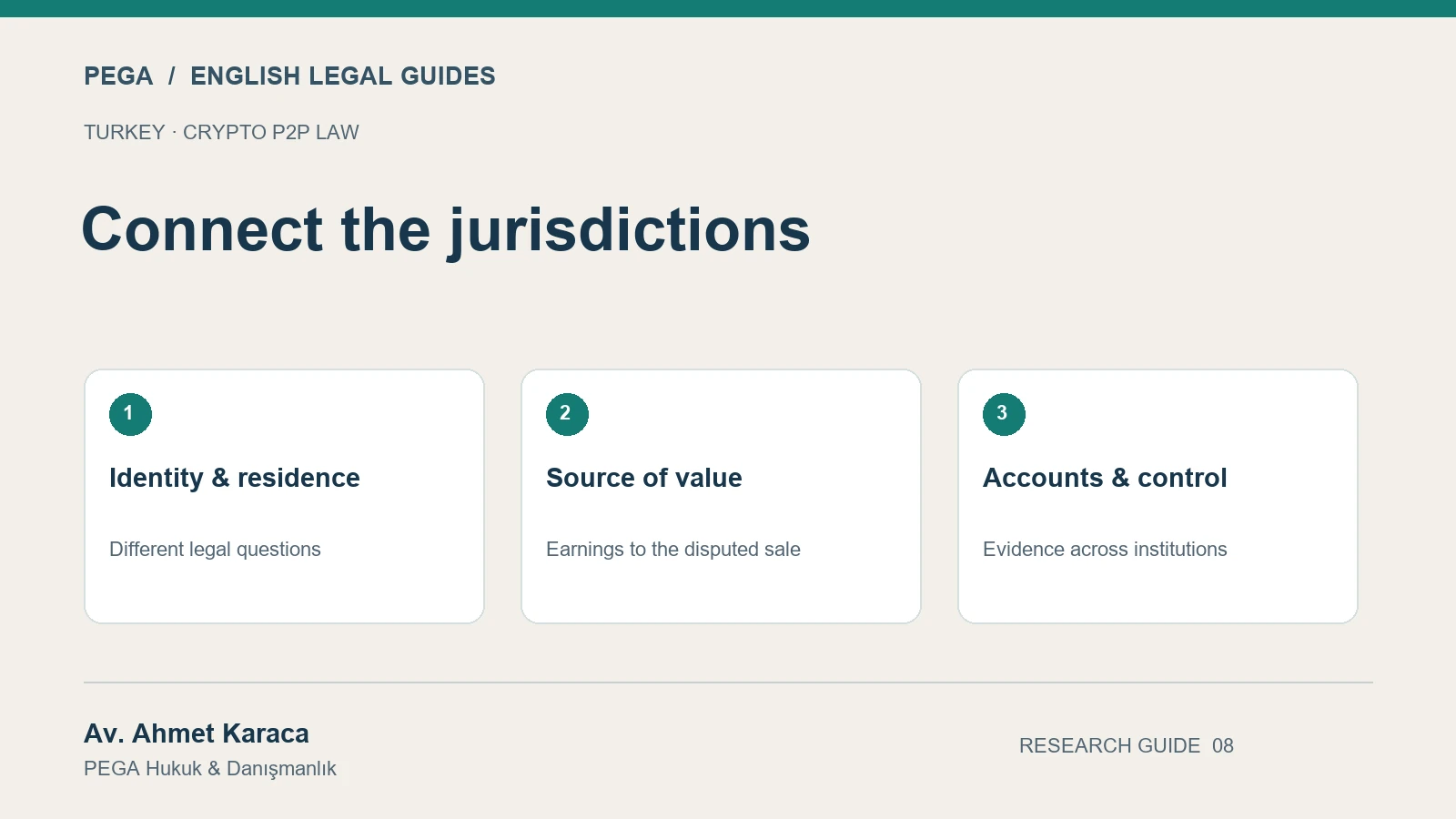
A foreign national using P2P crypto in Turkey may need to answer several institutions at once: a Turkish bank asks about the source of funds, a foreign platform asks about residence, and an investigator asks why a third person paid for a USDT order. One explanation will not resolve all three unless it accurately connects the relevant facts.
This guide is for foreign residents, visitors and people with accounts or income in more than one country. It explains how to separate nationality, residence, income source, transaction control and jurisdiction. It does not assume that a foreign passport either creates wrongdoing or removes Turkish legal obligations.
Four questions that are often confused
| Question | Why it matters | What it does not establish |
|---|---|---|
| What is your nationality? | Identity documents and potentially applicable foreign rules | Automatic guilt, exemption or access to every service |
| Where do you reside? | Customer profile, provider targeting and territorial rules | By itself, the tax treatment of every receipt |
| Where and how was the value earned? | Source-of-funds and tax analysis | The answer is not simply the exchange’s registered address |
| Who controlled the accounts and instructions? | Attribution, authority and criminal responsibility | Registration in a person’s name does not prove every act was theirs |
A resident permit is relevant documentation but should not be used as shorthand for every legal classification. Similarly, a bank account opened years ago may still contain an outdated occupation, address or expected-activity profile. Explain material changes accurately rather than creating a second account to avoid review.
Scenario: converting documented savings into lira
Imagine a foreign resident who accumulated salary savings abroad, bought USDT, moved it between their own wallets and later sold part of it through P2P for living expenses. A Turkish bank sees only incoming transfers from several individuals. Without the earlier records, legitimate savings can look like unexplained business receipts.
The useful explanation follows the value from its origin: employment or other acquisition evidence; foreign bank credits; exchange purchase; wallet or exchange transfers; the particular P2P sale; and the Turkish bank receipt. Link actual amounts and dates. If several assets were exchanged along the way, identify the conversions and fees instead of drawing a misleading one-to-one line.
The source chain and the legality of a payment arrangement remain different. Selling a crypto holding for lira does not establish permission to pay rent directly in crypto or operate a conversion service for other residents. The main P2P law guide explains the CBRT payment restriction and the service-provider perimeter.
Reconciling names across alphabets and documents
A bank may display a shortened name, a platform may use passport transliteration, and a supporting contract may be in another alphabet. Preserve each original version. Use a short identity concordance showing the document, name as displayed, relevant identifier and reason the records refer to the same person. Avoid publishing full identity numbers or circulating documents beyond the parties who need them.
A transliteration difference must not be used to excuse an actual third-party payment. “Similar spelling” and “different beneficial payer” are different findings. If the bank sender is a relative, employer or unrelated person, the relationship and authority need their own evidence; a translated passport does not fix the mismatch.
Where a platform requires same-name payment, follow its supported process for discrepancies. Do not borrow a local person’s account because onboarding is difficult. The triangle-fraud guide explains how that shortcut can connect an otherwise ordinary sale to a victim’s payment.
Scenario: a freelancer receives crypto and later sells it
A software professional performs work, receives a token payment and converts it into lira. There are at least two events: remuneration for the work and disposal or conversion of the token. The P2P order proves only the latter. It cannot establish that the original work income was correctly documented or taxed.
Keep the service contract, invoice or other applicable income document, evidence of performance, the payment instruction, receipt and valuation, and the later sale. Explain where the work was performed and the relevant residence facts. A foreign client, overseas wallet or foreign platform does not automatically make every part of the income foreign-source.
The P2P tax and records guide discusses this classification and the conditional foreign-source-income exemption introduced in 2026. Eligibility requires the statutory and administrative conditions, including the required timely certificate process; it cannot be inferred from nationality alone.
Using a foreign platform and targeting Turkish residents
Under Capital Markets Law Article 99/A, foreign platforms’ activities directed at persons resident in Turkey can constitute unauthorised crypto service-provider activity. The statute lists indicators such as a Turkish workplace, Turkish-language website and relevant marketing to Turkish residents. III-35/B.2, Article 9 addresses overseas services obtained on the customer’s own initiative within its conditions.
These are not blanket statements that every foreign user’s trade is criminal or that any overseas website can freely solicit Turkish customers. Identify the platform entity and the actual service. A Turkish company associated with a global brand may have different terms, products and regulatory status from the global P2P venue.
The CMB’s Operating Entities List expressly warns that inclusion alone is not authorisation. A merchant badge is a separate platform status. For a person operating a desk, accepting customer funds or arranging settlement for others, the merchant and OTC analysis is necessary even if the company is incorporated abroad.
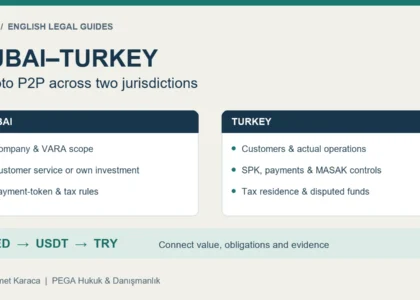
For a Dubai company, OTC desk or AED–TRY settlement arrangement, our Dubai–Turkey P2P guide explains how business operations, payment obligations and tax connections interact across both jurisdictions.
Sanctions and institutional restrictions need precise identification
Some users encounter restrictions because a bank, service, person or transaction falls within a sanctions regime or an institution’s risk policy. Nationality alone is an inadequate explanation of the legal position. Equally, a genuine need to move savings does not authorise transactions prohibited under an applicable regime.
A meaningful assessment identifies the relevant jurisdiction, the exact person or entity, ownership or control where the regime requires it, the service, the transaction date and the actual prohibition or institution policy. Record the source and date of screening. Similar names and commercial wallet labels require verification; do not treat an unexplained “high risk” score as a judicial finding.
This guide does not provide a current country-by-country sanctions list or a route around restrictions. Those rules change and must be checked for the specific transaction. If an institution identifies a sanctions issue, preserve the notice and obtain the exact legal and factual basis that can lawfully be disclosed.
If a Turkish bank restricts the account
Ask whether the measure is an institutional review or an authority-imposed restriction, and request the date, reference, amount and scope within disclosure limits. Do not assume that a delay is caused by nationality. It could concern a particular payer complaint, inconsistent source information, a withdrawal rule or a criminal order.
Prepare one indexed explanation in clear Turkish where needed, supported by original foreign-language records and appropriate translations. Keep names and amounts consistent across both languages. A translator should not silently “correct” a transaction date or replace an ambiguous term with a stronger allegation.
The P2P bank-freeze guide distinguishes MASAK transaction postponement, CMK 128/A suspension and seizure. If the bank identifies a criminal file, the procedural response is separate from the customer-service correspondence.
If police or a prosecutor contacts you
Preserve the notice and verify the authority through reliable official channels. Identify whether you are being contacted as a complainant, witness or suspect, and obtain the file reference where available. Do not assume that a request for information is a finding of guilt or that a platform appeal has already cleared the issue.
If you cannot adequately understand or express yourself in Turkish, raise the need for interpretation and legal assistance before giving an account you cannot verify. Review the recorded statement carefully. A convenient English summary given informally by another participant is not a reliable substitute for understanding the actual procedural document.
Chronology matters more than a rehearsed narrative. Explain what you knew before release, how you acquired the assets, who controlled each account and which records are missing. Do not speculate about the victim’s motives or invent a relationship with the bank payer. The P2P investigation guide addresses the underlying evidential tests.
Getting evidence from abroad
A Turkish user export may omit foreign bank details, internal exchange transfers or historical device records. Request preservation promptly through the institution’s proper channel, identifying the account UID, order, transaction, dates and dispute reference. Keep confirmation of receipt. Preservation does not guarantee disclosure or freezing.
Formal production of another person’s identity, login or banking records may require a competent authority and an international cooperation route. A private lawyer’s request and a binding judicial instruction have different effects. Do not promise that an overseas platform must disclose its entire customer file directly to a counterparty.
For the documents you can obtain, retain the original format and provenance. Record whether a foreign certificate, translation, legalisation or other authentication is needed for the particular use. Requirements vary by document and procedural route; there is no universal rule that every screenshot needs an apostille.
A compact cross-border dossier
- An identity and name-concordance page, with unnecessary identifiers redacted in working copies.
- A residence timeline relevant to the period and issue being examined.
- A source-of-value chain from earnings or acquisition to the disputed P2P sale.
- The bank, platform and wallet records joined by stable identifiers.
- Original timestamps and explicit time-zone conversions.
- The applicable platform entity and terms, not only the brand name.
- Official notices, support correspondence and a list of missing institutional records.
- Accurate translations tied to the originals rather than standalone rewritten narratives.
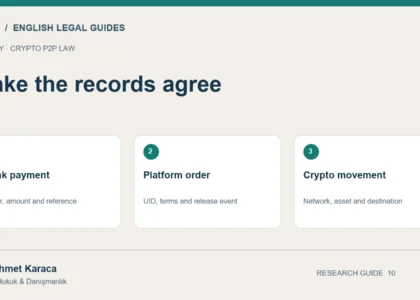
The transaction-evidence guide supplies the reconciliation method. The purpose is to make the file intelligible to an institution or court without concealing adverse facts or claiming more than the documents establish.
Helping family members is a separate factual question
A resident may occasionally help a relative convert assets, or may operate a regular settlement service for a wider community. The word “help” does not decide the legal character. Document ownership, instructions, compensation and frequency, and assess whether the arrangement has become a service for others.
Sharing banking or exchange credentials creates additional control and attribution problems. A bank may see the named customer while a different person operates the account. In an investigation, the file must establish actual control; in a regulatory review, it must establish the true service. Keeping those questions separate is the foundation of a reliable Turkish P2P legal assessment.