
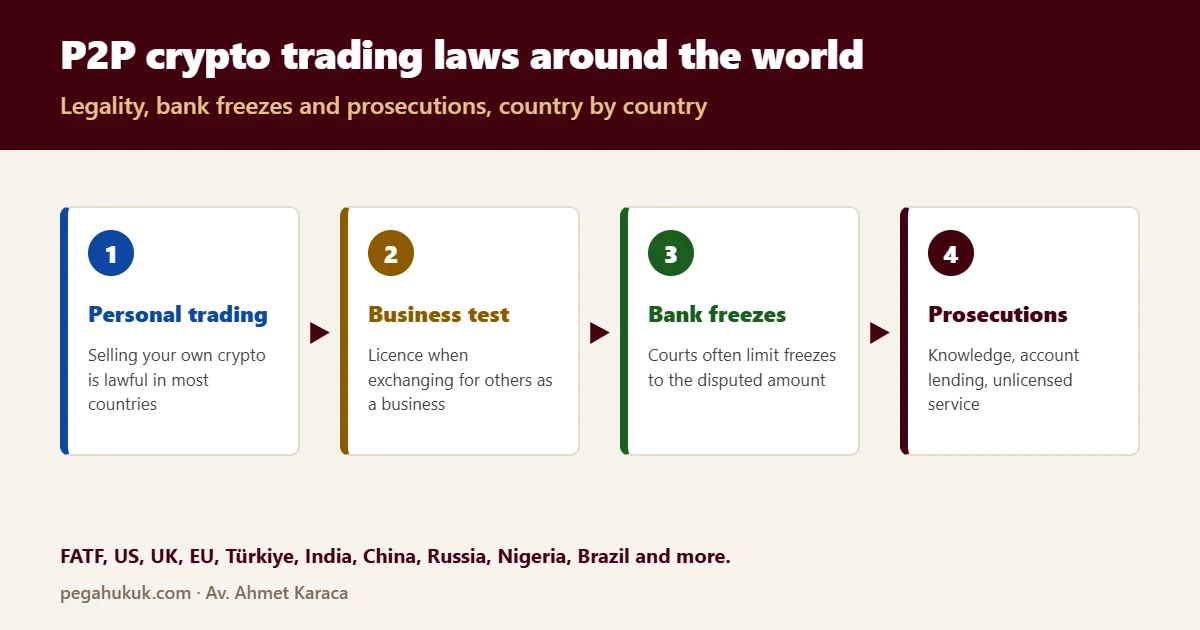
In almost every major jurisdiction, an individual who sells their own crypto to another person, on a P2P ad board or directly, is not committing an offence by doing so. The legal line is crossed when the activity becomes a business carried on for other people without the licence or registration that country requires, when the trader receives money they know or should know comes from crime, or when they let others use their bank or exchange account. The most common real-world consequence is not prosecution but a bank-account freeze after a buyer pays with a fraud victim’s money. (Position as of October 2026.)
Last updated: · Prepared by: Av. Ahmet Karaca, Istanbul Bar Association (Registration No. 92414) · Verify on the Bar register
- FATF treats a P2P transaction as a transfer made without any regulated intermediary; a natural person who exchanges crypto for others as a business is itself a virtual asset service provider (FATF Updated Guidance, October 2021, ¶37 and ¶58–60).
- The same basic line, trading one’s own crypto versus providing an exchange service to others as a business, runs through the rules of the United States (FinCEN 2019), the United Kingdom (FCA, April 2026), the EU (MiCA Art. 3), India (S.O. 1072(E) of 2023), Brazil (Law 14.478/2022), Argentina (CNV RG 1058/2025) and Pakistan (Virtual Assets Act 2026); Türkiye reaches a similar result by licensing crypto-asset service providers as institutions (Capital Markets Law Art. 3(1)(cc) and 109/A).
- MiCA recital 22 does not exclude P2P trading; the express person-to-person carve-out is in the EU Transfer of Funds Regulation 2023/1113, Art. 2(4)(b).
- Courts in India and Nigeria have limited or lifted freezes on crypto traders’ accounts, the Lahore High Court has held that a P2P sale is not by itself evidence of fraud, and the UK Financial Ombudsman has ordered funds returned to a seller who proved a genuine trade while rejecting a complaint from a customer who let someone else use his account.
- Several countries now deal expressly with people who let others use their accounts: Russia (Criminal Code Art. 187 parts 3–6, 2025), the Philippines (RA 12010, 2024), the UAE (Decree-Law 10/2025), Thailand (Technology Crime Decree, 2023) and China (Anti-Telecom and Online Fraud Law, 2022). Türkiye took a different route in 2026: TCK 158/4 treats handing over one’s account as participation in fraud but halves the penalty.
- Every on-chain transfer of USDT, BTC or ETH is recorded on a public blockchain, and a P2P escrow release inside an exchange is recorded in the exchange’s own ledger, which the exchange can be asked to produce; that visibility, which FATF itself highlights, is what allows a seller to prove where the crypto went and investigators to find the real fraudster.
What does “P2P crypto trading” mean in law?
In everyday use, P2P (peer-to-peer) crypto trading means buying or selling crypto directly with another person rather than with an exchange’s order book. Most of it happens on exchange ad boards such as Binance P2P, OKX P2P or Bybit P2P: a seller posts a price, a buyer pays in local currency by bank transfer or mobile money, and the platform releases the seller’s crypto, usually USDT, from escrow once the seller confirms receipt. Smaller volumes move through Telegram groups, OTC desks and face-to-face trades.
The law uses the term more narrowly. The Financial Action Task Force (FATF), the global standard-setter for anti-money-laundering rules, defines P2P transactions as virtual asset transfers “conducted without the use or involvement of a VASP or other obliged entity”, giving as an example transfers between two unhosted wallets whose users act on their own behalf (FATF Updated Guidance, October 2021, ¶37). FATF adds that services which merely market themselves as P2P platforms are a different thing: if a virtual asset service provider (VASP) is involved, the transaction is not P2P in the regulatory sense (footnote 10).
The difference has practical consequences. When a trade runs through a P2P board operated by a licensed or registered exchange, the exchange holds identity records, order logs, chat messages and the escrow ledger. Those records are exactly what a seller later needs to prove good faith, and exactly what police need to identify a fraudster. A purely wallet-to-wallet trade arranged on a messaging app leaves only the bank transfer and the blockchain record.
When does selling your own crypto become a regulated business?
Across the jurisdictions reviewed here, the trigger for licensing is not the act of selling crypto but doing it as a business for other people. The wording varies; the underlying test is the same.
| Source | How the line is drawn |
|---|---|
| FATF Updated Guidance (2021), ¶58–60 | A natural person can be a VASP. “As a business” excludes activity on a very infrequent basis for non-commercial reasons. |
| United States, FinCEN FIN-2019-G001, §4.1 | P2P exchangers “engaged in the business of buying and selling” convertible virtual currency are money transmitters; activity “on an infrequent basis and not for profit or gain” is exempt. |
| United Kingdom, FCA (22 April 2026) | Trading P2P “by way of business” requires registration under reg. 14A of the Money Laundering Regulations 2017; personal P2P transactions do not. |
| European Union, MiCA Art. 3(1)(15) | A crypto-asset service provider provides services “to clients on a professional basis”; only authorised entities may do so (Art. 59). |
| India, S.O. 1072(E), 7 March 2023 | Exchange between virtual digital assets and fiat is a PMLA reporting-entity activity when done “for or on behalf of another natural or legal person in the course of business”. |
| Brazil, Law 14.478/2022, Art. 5 | A VASP is a legal entity that executes services “on behalf of third parties”. |
| Argentina, CNV General Resolution 1058/2025 | Persons exchanging virtual assets and fiat “for themselves, that is, personally … whatever the amount” are outside the definition; small individual providers below UVA 35,000 a month need not register. |
| Pakistan, Virtual Assets Act 2026, s.50 | No person may “by way of business” provide virtual asset services without a PVARA licence. |
| Türkiye, Capital Markets Law No. 6362, Art. 3 and 109/A | Crypto-asset service providers are licensed institutions (platforms and custodians); a person who operates as one without a licence faces three to five years’ imprisonment. |
What makes a trader look like a business is also similar everywhere: continuous trading for profit, a spread or commission charged to strangers, multiple accounts or employees, holding customer money, and advertising. Volume alone is rarely decisive. Argentina says so expressly (“whatever the amount”), and the UK regulator has stressed that personal P2P trading needs no registration.
A second, separate question is whether the platform itself is regulated. FinCEN treats a site that only lets buyers and sellers find each other, with settlement outside the platform, as not a money transmitter; FATF tells countries to look at “the underlying activity, not the label” (¶91). In practice most large P2P boards are run by exchanges that hold the crypto in escrow, and those exchanges are licensed, registered or under enforcement in many of the countries below.
P2P crypto laws by country: comparison table
| Country | Personal P2P sale of own crypto | Doing it as a business | Typical freeze mechanism | Notable enforcement or ruling |
|---|---|---|---|---|
| United States | Lawful; infrequent, non-profit activity exempt | Money transmitter: FinCEN MSB registration and AML programme | Bank de-risking; civil forfeiture | 18 U.S.C. §1960 convictions of LocalBitcoins traders (2018–2024); Paxful pleaded guilty (2025) |
| United Kingdom | Lawful; no registration for personal trades | FCA registration (MLRs 2017 reg. 14A); FSMA regime from 25 Oct 2027 | Bank restriction and closure; Financial Ombudsman review | FCA P2P crackdowns, 22 Apr and 10 Sep 2026 |
| European Union | Lawful; TFR carve-out for person-to-person transfers made without a CASP | MiCA authorisation as a CASP | National criminal procedure | MiCA transition ended 1 Jul 2026; AMLR from 10 Jul 2027 |
| Türkiye | Lawful | SPK licence; unlicensed activity 3–5 years (Art. 109/A) | CMK 128/A: suspension of up to 48 hours, then judicial seizure | Court of Cassation sets aside dismissals that skip exchange records |
| India | Not banned (Supreme Court, 2020) | FIU-IND registration under PMLA | Police-requested freezes through the national cybercrime portal | High Courts limit freezes to the disputed amount (2023–2026) |
| China (mainland) | Crypto business is illegal financial activity; personal contracts void | Prohibited | Card restrictions under the Anti-Telecom Fraud Law | USDT sellers convicted for concealing criminal proceeds |
| Russia | Tolerated until licensed intermediaries become mandatory (1 Jul 2027) | Bank of Russia register under Law 282-FZ (2026) | Bank anti-fraud blocks; “dropper” databases | Criminal Code Art. 187 parts 3–6 (from 5 Jul 2025) |
| Pakistan | Lawful (Lahore High Court, 2026) | PVARA licence; unlicensed service up to 5 years | FIA account freezes | Pre-arrest bail for Binance P2P merchants (2026) |
| Nigeria | Lawful; naira P2P curtailed on major exchanges since 2024 | SEC registration under the Investments and Securities Act 2025 | Court-ordered EFCC freezes | Federal High Court released accounts not linked to crime (2024) |
| South Africa | Lawful | FSCA CASP licence; FICA duties for traders | Bank freezes and anti-dissipation applications | Wessels v Capitec (2024): P2P trader cannot rely on Binance’s KYC |
| Kenya | Not addressed expressly | VASP Act 2025: companies only; unlicensed business up to 5 years | Preservation orders (Assets Recovery Agency) | Binance accounts frozen in 2026 investigation |
| UAE | Foreign stablecoins only to buy other virtual assets | VARA (Dubai), CMA or CBUAE licence | AML law; account-use offence | VARA fines on 19 unlicensed firms (2025) and on MEXC (2026) |
| Brazil | Lawful | Central Bank authorisation (Res. 519–521/2025) | Pix cautionary block up to 72 hours; MED refund | MED excludes funds that reached a good-faith third party |
| Argentina | Lawful whatever the amount | CNV PSAV registration above UVA 35,000/month | — | CNV may seek blocking of unregistered providers |
| Singapore | Lawful; selling own bitcoin is not a payment-service business (2023) | MAS licence (PSA 2019; DTSP regime from 30 Jun 2025) | — | Charges announced against P2P sellers for not checking the source of funds (8 May 2025) |
United States, United Kingdom, European Union and Canada
United States
Federal law treats a natural person who buys and sells convertible virtual currency as a business as a money transmitter. FinCEN’s 2019 guidance says such a P2P exchanger “must comply with BSA regulations as a money transmitter acting as principal”, which means registering as a money services business, running an anti-money-laundering programme and filing suspicious activity reports. The same guidance exempts a person acting “on an infrequent basis and not for profit or gain” (FIN-2019-G001, §4.1).
The criminal cases show where prosecutors draw the line. Each of the individual P2P prosecutions listed below involved an aggravating feature: cash, an undercover agent who said the money was drug proceeds, known criminal customers, a separate fraud, or instructions to hide the purpose of wires from banks. Most were brought under 18 U.S.C. §1960 (operating an unlicensed money transmitting business); Costanzo was convicted of money laundering.
| Case | Facts | Outcome |
|---|---|---|
| United States v. Tetley (C.D. Cal.) | LocalBitcoins trader, bitcoin for cash; sold to an undercover agent posing as a drug dealer | 12 months and a day (2018); forfeiture of 40 BTC, cash and gold |
| United States v. Campos, No. 18CR3554-H (S.D. Cal.) | More than 1,000 customers, no KYC | 2 years (8 April 2019); $823,357 forfeited |
| United States v. Rockcoons, No. 17cr3690-AJB (S.D. Cal.) | Over 1,000 trades, commissions up to 36%; committed a separate land fraud while on release | 21 months (28 May 2019), also for wire fraud |
| United States v. Yusko (E.D. La.) | Told clients not to disclose the purpose of wires to banks | 1 year and a day (21 January 2022) |
| United States v. Costanzo, No. CR-17-00585-PHX-GMS (D. Ariz.) | Advertised on a P2P bitcoin website, charged 7–10% and did not learn customers’ identities; sold to undercover agents posing as drug dealers | Jury convicted on five money-laundering counts (28 March 2018) |
| United States v. Rodriguez, No. 23-cr-20474 (S.D. Fla.) | $5.05 million exchanged; clients included a drug trafficker and a money launderer | 57 months (2024) |
At platform level, Paxful Holdings pleaded guilty in December 2025 to conspiracies under the Travel Act, to operate an unlicensed money transmitting business and to violate the Bank Secrecy Act; it was sentenced on 10 February 2026 to a $4 million criminal penalty, and FinCEN imposed a separate $3.5 million civil penalty describing Paxful as a “peer-to-peer (P2P) trading platform”. Its co-founder Artur Schaback pleaded guilty in July 2024 to conspiracy to fail to maintain an effective AML programme; in February 2026 he was reported to be awaiting sentence.
United Kingdom
A firm or sole practitioner that exchanges crypto for money “by way of business” is a cryptoasset exchange provider and must be registered with the Financial Conduct Authority (Money Laundering Regulations 2017, reg. 14A). In its first P2P crackdown on 22 April 2026, carried out with HMRC and a regional organised crime unit at eight London premises, the FCA stated that personal P2P transactions do not require registration, that no firm was registered solely for P2P trading, and that unregistered P2P traders “are doing so illegally”. A second action followed on 10 September 2026, announced on 17 September. A broader authorisation regime under the Financial Services and Markets Act is expected to apply from 25 October 2027.
For individual sellers the more frequent problem is a bank closing or restricting an account after a buyer’s payment is reported as fraud. Decisions of the Financial Ombudsman Service show a consistent test, discussed in the freezes section below.
European Union
The Markets in Crypto-Assets Regulation (MiCA, Regulation 2023/1114) regulates crypto-asset service providers, defined as entities providing services “to clients on a professional basis” (Art. 3(1)(15)); only authorised entities may provide those services (Art. 59). A person selling their own crypto does not provide a service to clients. A P2P marketplace that brings together third-party buying and selling interests “in a way that results in a contract” can fall within the definition of operating a trading platform (Art. 3(1)(18)). The transitional period for providers operating under national regimes ended on 1 July 2026 at the latest (Art. 143(3)).
Contrary to a claim often repeated online, MiCA recital 22 does not mention P2P; it excludes only services provided “in a fully decentralised manner without any intermediary”. The express exclusion of person-to-person transfers is in the Transfer of Funds Regulation (EU) 2023/1113, which does not apply to “a person-to-person transfer of crypto-assets carried out without the involvement of a crypto-asset service provider” (Art. 2(4)(b)). Where a provider is involved and the transfer exceeds EUR 1,000 to or from a self-hosted address, the provider must assess whether the customer owns or controls that address (Arts. 14(5) and 16(2)). From 10 July 2027 the Anti-Money Laundering Regulation 2024/1624 will prohibit providers from keeping anonymous crypto-asset accounts (Art. 79).
Canada
FINTRAC treats dealing in virtual currency, meaning exchange or transfer services, as a money services business activity where the business has a place of business in Canada, with registration and large virtual currency transaction reporting duties.
Türkiye
Since Law No. 7518 (Official Gazette, 2 July 2024) amended the Capital Markets Law No. 6362, Turkish law defines crypto assets as intangible assets created and stored electronically using distributed ledger or similar technology that can represent value or rights (Art. 3(1)(bb)). Crypto-asset service providers are platforms, custodians and other institutions designated by the Capital Markets Board (SPK) (Art. 3(1)(cc)). A person who operates as a crypto-asset service provider without a licence faces three to five years’ imprisonment and a judicial fine (Art. 109/A), and a foreign platform targeting Turkish residents is treated as unlicensed (Art. 99/A). Selling one’s own crypto to another person is not, in itself, a licensed activity; the difference between a seller and an unlicensed service provider is examined in our guide to P2P merchants and OTC desks in Turkey.
Crypto may not be used to pay for goods and services (Central Bank regulation of 16 April 2021). MASAK rules impose a travel rule and waiting periods on certain withdrawals, explained in Turkey’s crypto transfer rules.
Two procedural provisions dominate P2P files. First, under Article 128/A of the Criminal Procedure Code (added by Law No. 7571, in force since 25 December 2025), a bank, payment institution or crypto-asset service provider may suspend an account for up to 48 hours where there is reasonable suspicion of certain offences, including aggravated fraud committed through information systems or banks (TCK 158/1-f) and by impersonating officials (158/1-l); the account holder may apply to the prosecutor, who decides within 24 hours, and any seizure needs a judge’s decision or, in urgent cases, a prosecutor’s order approved by a judge within the statutory time limits. Second, Article 158 of the Penal Code punishes fraud committed through information systems or banks with four to ten years’ imprisonment, and since Law No. 7589 (Official Gazette, 31 July 2026) a new paragraph 4 halves the penalty where a person’s participation in the fraud is limited to giving others, for gain, the information or tools needed to use their own or another person’s bank, brokerage, payment or crypto-asset account. The provision presupposes intentional participation; a seller who sold their own crypto without knowing the payment was fraudulent is not a participant at all.
The Court of Cassation (Yargıtay) has repeatedly quashed, in the interest of the law, decisions of criminal judgeships of peace that upheld non-prosecution decisions in crypto fraud files resting on the premise that crypto cannot be traced. In a December 2024 decision its 11th Criminal Chamber described the reasoning that offenders could not be identified because the crypto moved outside the regulated financial system as flawed reasoning and incomplete investigation, and held that investigators should have established whether the platform had a representative in Türkiye and, if necessary through international letters rogatory, obtained the account holder’s identity and the fate of the money (11th Criminal Chamber, E. 2024/2829, K. 2024/14948, 9 December 2024). Our analysis of Court of Cassation decisions relevant to P2P sellers sets out the case law in detail (Turkish version).
India, China, Russia, Pakistan and the rest of Asia-Pacific
India
Crypto trading is not prohibited in India. In Internet and Mobile Association of India v. Reserve Bank of India, (2020) 10 SCC 274, the Supreme Court set aside the central bank’s 2018 instruction barring regulated entities from serving crypto businesses as a disproportionate restriction, observing that virtual currency trading is not banned under any law. Since March 2023, exchanging virtual digital assets for fiat “for or on behalf of another … in the course of business” makes a person a reporting entity under the Prevention of Money Laundering Act (S.O. 1072(E), 7 March 2023). FIU-IND issued compliance notices to nine offshore exchanges, including Binance, in December 2023 and to 25 more in October 2025. For tax purposes, the Central Board of Direct Taxes says that in a P2P trade the buyer deducts the 1% tax at source under section 194S (Circular No. 13 of 2022).
India also has a large and fast-growing body of case law on bank freezes in cyber-fraud cases, several of them involving crypto traders, summarised in the freezes section.
China (mainland)
A notice issued by the People’s Bank of China and seven other agencies on 6 February 2026 (Yinfa [2026] No. 42), which replaced the 2021 notice, classifies crypto-related business activities, including exchange between fiat and crypto, information intermediation and pricing services, as illegal financial activities; offshore providers may not serve mainland users in any form, and banks and payment institutions may not provide accounts or settlement for such business. Contracts for crypto investment contrary to public order are void and the investor bears the loss.
For individual USDT sellers (“U merchants”) the criminal exposure comes from three provisions of the Criminal Law: Article 287-2 (assisting information network crimes), whose 2019 judicial interpretation presumes knowledge where the price or method of a transaction is “clearly abnormal”; Article 312 (concealing criminal proceeds), reinterpreted in August 2025; and Article 191 (money laundering), whose August 2024 interpretation names transfers “through virtual asset transactions” as a laundering method. The Anti-Telecom and Online Fraud Law (in force 1 December 2022) separately prohibits helping others launder money through virtual-currency trading and lending bank or payment accounts, and allows card functions to be restricted.
Russia
Federal Law No. 176-FZ added parts 3 to 6 to Article 187 of the Criminal Code, in force since 5 July 2025, criminalising the transfer of a payment instrument or access to it for unlawful transactions and making unlawful transfers on another person’s instructions for reward, with penalties of up to three years and, for some parts, up to six. Russian banks apply Bank of Russia criteria that flag accounts with many counterparties or high daily turnover, and practitioners report that legitimate P2P sellers are regularly caught by the same signals used to find “droppers”. A comprehensive crypto law, Federal Law No. 282-FZ of 4 August 2026, will require crypto circulation to be organised by entities on the Bank of Russia’s register from 1 July 2027. The Supreme Court has held that the 2025 amendments do not apply retroactively and that the earlier wording required proof that the person understood the criminal nature of the scheme (case No. 44-УДП26-14-К7, reported September 2026).
Pakistan
The Virtual Assets Act 2026 (Act XIII of 2026) requires a licence from the Pakistan Virtual Assets Regulatory Authority for anyone providing virtual asset services “by way of business”, with up to five years’ imprisonment for wilful unlicensed service. In a judgment reported on 30 July 2026, the Lahore High Court confirmed pre-arrest bail for three petitioners who said they were P2P merchants who had released USDT on Binance P2P, in a case brought by a buyer who later claimed fraud, holding that P2P trading and receiving money in a bank account do not, by themselves, constitute evidence of fraud, and that the central bank’s 2018 circular did not criminalise private P2P transactions.
The Philippines
The Anti-Financial Account Scamming Act (Republic Act No. 12010, 20 July 2024) treats “using, borrowing or allowing the use of a financial account” to move proceeds of crime as money muling, punishable by six to eight years’ imprisonment and fines (s.4(a) and s.16(a)), and lets institutions hold disputed funds for up to 30 days unless a court extends the period (s.7). E-wallets are covered.
Singapore
Singapore is the clearest example of P2P sellers being charged for failing to check where their money came from. On 8 May 2025 the Singapore Police Force announced that charges would be brought under section 55A of the Corruption, Drug Trafficking and Other Serious Crimes (Confiscation of Benefits) Act, assisting another to retain benefits of criminal conduct, against a woman who allegedly received S$20,000 “for a Peer-to-Peer sale transaction in cryptocurrency” while “failing to take reasonable steps to ascertain the source of the money”, and a man who allegedly transferred crypto worth at least S$96,000 “without taking reasonable steps to ascertain the identity and physical location of the counterparty”; the offence carries a fine of up to S$50,000, up to three years’ imprisonment, or both. Providing digital payment token services as a business requires a licence under the Payment Services Act 2019; the first conviction, in January 2021, concerned a person who bought bitcoin with scam victims’ money for a 10% commission. In Rio Cristofle v Tan Chun Chuen Malcolm [2023] SGHC 66 the High Court treated profit, number of transactions and the person’s role as the indicators of “carrying on a business”, and held that a person who sold bitcoin they already held was not running a payment-service business.
Thailand, Vietnam, South Korea and Ukraine
Thailand’s 2023 emergency decree on technology crime punishes opening or lending an account for use in technology crime with up to three years’ imprisonment, lets banks hold a suspect account for seven days, and since an April 2025 amendment requires digital asset operators to suspend accounts and wallet addresses flagged by the authorities; Bybit, OKX and three other unlicensed platforms were blocked in Thailand from 28 June 2025. Vietnam’s Law No. 71/2025/QH15 on the Digital Technology Industry, in force since 1 January 2026, recognises digital assets as property; under a five-year pilot market created by Government Resolution No. 05/2025/NQ-CP of 9 September 2025, crypto trading is to run through providers licensed by the Ministry of Finance, and Decree 284/2026/NĐ-CP of July 2026 provides fines for domestic investors who trade outside licensed providers once the pilot regime applies to them. In South Korea, an amendment passed on 12 March 2026 and effective from October 2026 requires virtual asset exchanges to monitor voice-phishing flows and freeze accounts where such fraud is suspected. Ukraine’s Law No. 2074-IX on virtual assets has been adopted but will not enter into force until the related Tax Code amendment is passed; its central bank capped person-to-person card transfers at UAH 150,000 a month between October 2024 and March 2025 to counter “drop” accounts.
Hong Kong
Following consultation conclusions published in December 2025, Hong Kong is preparing legislation to license virtual asset dealing, including OTC desks, under its anti-money-laundering ordinance; the government has said the bill will go to the Legislative Council by the end of 2026.
Nigeria, South Africa, Kenya, Ghana and the UAE
Nigeria
Nigeria leads the Chainalysis 2026 domestic P2P sub-index. After its February 2021 letter ordering banks to close accounts of crypto traders, the Central Bank of Nigeria issued guidelines on 22 December 2023 allowing banks to open accounts for virtual asset service providers licensed by the Securities and Exchange Commission. The Investments and Securities Act 2025 brings virtual and digital assets within the definition of securities. In 2024 Binance removed the naira from its P2P market and then left the naira market, and KuCoin suspended naira P2P after the SEC signalled concerns about P2P trading.
Courts have been willing to check freezes. In CBN v Rise Vest Technologies Ltd, FHC/ABJ/CS/822/2021 (25 October 2021), the Federal High Court discharged an order freezing accounts used for crypto trading because a circular is not law. After the EFCC obtained an order freezing 22 accounts of suspected Bybit and KuCoin users and USDT sellers (FHC/ABJ/CS/543/2024), six accounts were later released on the agency’s own application because their funds were not linked to unlawful activity.
South Africa
Crypto assets have been a financial product since 2022, and crypto-asset service providers need an FSCA licence. A leading South African P2P judgment is Wessels v Capitec Bank Ltd and Others [2024] ZAGPPHC 390 (22 April 2024). A fraud victim had paid R934,115 in 23 transfers to a part-time trader who sold USDT on Binance P2P. The High Court held that a crypto trader is an accountable institution under the Financial Intelligence Centre Act and “cannot delegate his obligations to identify his client” to Binance, and that repeated payments just below R50,000 were a red flag. It nevertheless dismissed the application to freeze the trader’s assets, because no intention to dissipate them was shown, leaving the victim to sue.
Kenya and Ghana
Kenya’s Virtual Asset Service Providers Act 2025 (Act No. 20 of 2025) prohibits carrying on virtual asset business without a licence, allows only companies to be licensed and punishes individuals with fines of up to KSh 10 million and up to five years’ imprisonment; existing providers have until about November 2026 to comply. Ghana passed its Virtual Asset Service Providers Act (Act 1154) in December 2025, requiring all persons conducting virtual asset activities to be licensed or registered.
United Arab Emirates
Under the Central Bank’s Payment Token Services Regulation (Circular No. 2/2024), selling or buying payment tokens “by way of business” is a licensable service, only dirham payment tokens may be used to pay for goods and services, and foreign stablecoins such as USDT may be used only to buy other virtual assets. In Dubai, every virtual asset activity requires a VARA licence, and VARA has fined unlicensed firms, including MEXC in June 2026, for providing broker-dealer or exchange services in the emirate. The AML Decree-Law No. 10 of 2025 extends liability to those who “should reasonably have known” the origin of funds and introduces an offence of knowingly allowing a third party to use one’s bank or VASP account for unlawful conduct.
Brazil, Argentina and Mexico
Brazil
Law 14.478/2022 defines a virtual asset service provider as a legal entity acting on behalf of third parties, adds a specific offence of fraud using virtual assets (Penal Code Art. 171-A, four to eight years) and increases money-laundering penalties where virtual assets are used. Central Bank Resolutions 519, 520 and 521 of November 2025, in force since 2 February 2026, created the authorisation regime and treat stablecoin purchases and sales and transfers to or from self-custodied wallets carried out by virtual asset service providers as foreign-exchange operations. For P2P sellers paid by Pix, two rules matter: the receiving bank may impose a cautionary block of up to 72 hours (Pix Regulation, Art. 39-B), and the special refund mechanism (MED) does not apply where funds reached the account of a terceiro de boa-fé, a good-faith third party (Art. 41-B).
Argentina
Law 27.739 (March 2024) defines virtual asset service providers as those acting “as a business” for others, and CNV General Resolution 1058/2025 (in force 26 May 2025) states that persons exchanging virtual assets for fiat for themselves are outside the regime “whatever the amount”. Individual providers below UVA 35,000 a month need not register; others must register with the CNV or stop operating.
Mexico
Article 17 fraction XVI of Mexico’s anti-money-laundering law (added in 2018 and amended in July 2025) makes the habitual and professional offering of virtual asset exchange through platforms by non-financial entities a “vulnerable activity” with reporting thresholds, which leaves casual personal P2P trades outside the reporting duty.
Why do banks freeze accounts after P2P sales, and what do courts say?
The typical sequence is the same in Istanbul, Mumbai and Lagos. A fraudster tricks a victim into sending money to an account, but the account belongs to an honest P2P seller who has just sold USDT to the fraudster. The victim reports the fraud; the bank, a police cybercrime unit or a prosecutor freezes the seller’s account; and the seller, who released real crypto, appears in the file as the recipient of stolen money. The triangle scheme section explains why criminals use this structure, and our guide to a bank account frozen after a P2P crypto sale sets out what a seller can do.
Courts have answered the problem in similar ways.
| Jurisdiction and ruling | Holding |
|---|---|
| India: K. Sathvik Reddy v. Union of India, Telangana High Court, W.P. No. 26276 of 2023 (21 December 2023) | A seller who sold USDT through Binance had his account frozen on a notice to produce documents; the notice was set aside as illegal. |
| India: Mohammed Saifullah v. RBI, Madras High Court, W.P. No. 25631 of 2024 (10 September 2024) | An entire account cannot be frozen “without quantifying the amount and period”; the freeze was replaced by a lien of ₹2.5 lakh. |
| India: Headstar Global v. State of Kerala, 2025:KER:39285 (2 June 2025); Kartik Yogeshwar Chatur v. Union of India, 2025:BHC-NAG:12612-DB (20 November 2025); Malabar Gold & Diamond v. Union of India, 2026 SCC OnLine Del 297 (16 January 2026) | Police may seize evidence under s.106 of the new criminal procedure code (BNSS) but may not debit-freeze accounts; attachment needs a magistrate’s order under s.107. The Karnataka High Court took the opposite view in a judgment reported in August 2026, so the question is unsettled. |
| India: Yadhuvir Singh Manhas v. Kotak Mahindra Bank, Delhi High Court (13 January 2026) | For a full-time P2P crypto trader whose account was frozen at the request of police in Bihar, Tamil Nadu, Haryana and Delhi, the lien was limited to the disputed amounts and the balance released. |
| Nigeria: CBN v Rise Vest (2021) and the EFCC freeze FHC/ABJ/CS/543/2024 | A circular cannot justify a freeze; accounts whose funds were not linked to crime were released. |
| Pakistan: Lahore High Court (reported 30 July 2026) | Receiving payment for a P2P sale is not, by itself, evidence of fraud. |
| Brazil: Pix Regulation Art. 41-B | The fraud refund mechanism excludes funds that reached a good-faith third party. |
| Türkiye: CMK Art. 128/A | Suspension by the institution of up to 48 hours; seizure of the proceeds requires a judge’s decision or a prosecutor’s order confirmed by a judge within short statutory deadlines. |
The UK Financial Ombudsman Service shows the evidential side of the same problem. It accepts that banks may restrict and close accounts after fraud reports, but what decides whether the money is returned is evidence of entitlement. In DRN-5586209 (2025) the ombudsman found that the customer “has shown she was legitimately engaged in buying and selling USDT” and ordered the funds returned with interest; in DRN-4757520 (2024) Barclays had to cover the seller’s loss because it had told him the incoming payments would be credited, the ombudsman noting that a seller whose crypto had already been transferred would struggle to recover the funds if they were returned to source. In DRN-4933758 (2024) the complaint failed because the seller’s screenshots and chats were not accepted as proof, and in DRN-4730155 (2024) it failed because the customer admitted letting someone else route payments through his account.
In India, a standard operating procedure of the Ministry of Home Affairs dated 2 January 2026 reportedly limits liens to the disputed sum and provides a grievance route, and in August 2026 the Supreme Court directed the Reserve Bank to issue a standard procedure on mule accounts. Türkiye’s CMK 128/A follows a similar logic: a short institutional suspension of up to 48 hours, after which only the proceeds of the offence may be seized, and only by a judge or by a prosecutor’s order that a judge must confirm.
When are P2P traders prosecuted? Patterns from the case law
Reading the US, Chinese, South African, Pakistani, Russian and Turkish cases together, prosecutions of P2P traders rest on one of four theories.
- Unlicensed business. The trader runs an exchange service for others without registration: the US §1960 cases, the UK FCA actions, Türkiye’s Art. 109/A, Kenya’s and Pakistan’s new statutes.
- Knowledge of criminal proceeds. The trader knew, or in some systems should have known, that the buyer’s money came from crime: China’s Articles 312 and 191, the UAE’s “should reasonably have known” standard, and money-laundering offences generally.
- Account lending. The person let others use their account or acted on their instructions: Türkiye’s TCK 158/4, Russia’s Article 187 parts 3–6, the Philippines’ RA 12010 and the UAE’s new offence.
- Participation in the fraud itself. The trader is part of the scheme that deceived the victim, as in aggravated-fraud prosecutions under TCK 158/1-f.
Singapore adds a fifth theory with a lower threshold: on 8 May 2025 police announced that P2P sellers would be charged with assisting others to retain criminal benefits for allegedly failing to take reasonable steps to ascertain the source of the payment or the identity of the counterparty.
The defences that succeed are also similar. Courts and ombudsmen look for a real trade (an order record on the platform, matching amounts and times, a released escrow), for the absence of red flags (a market price rather than an “abnormal” one, no instructions from third parties, no structuring below thresholds), and above all for evidence of where the crypto went. Chinese courts presume knowledge from a clearly abnormal price or method; South Africa’s Wessels court treated payments just below a reporting threshold as a red flag; the Lahore High Court and the UK ombudsman accepted ordinary trades evidenced by records. The same facts that protect a seller also identify the fraudster: the buyer’s exchange account, and the wallet that received the USDT.
The third-party payment (“triangle”) scheme behind most P2P cases
In the triangle scheme, three people are involved but only one is dishonest. The fraudster places a buy order with an honest P2P seller, and at the same time persuades a victim, through a fake investment, a fake sale or an impersonation call, to send money to the seller’s bank account. The seller sees the payment, releases the USDT to the fraudster and is left holding the victim’s money; the fraudster disappears with the crypto.
The scheme is run at scale. A January 2024 UNODC report on East and Southeast Asia describes “high-speed money laundering ‘motorcade’ teams specializing in underground USDT – fiat currency exchanges” and the mass recruitment of mule bank accounts that “can be purchased for as little as US $30”; one blockchain analysis it cites linked 17.07 billion USDT to underground currency exchanges and other crimes in a single year. TRM Labs estimated that Chinese-language escrow and underground banking networks handled more than $103 billion in 2025. Europol’s EMMA 9 money-mule action in 2023 identified 10,759 money mules, led to 1,013 arrests and involved crypto exchanges among more than 2,800 participating institutions.
For the seller this has a practical consequence: the victim and the honest seller are both harmed by the same person. The fastest way to resolve the file is to identify the buyer’s exchange account and follow the USDT, not to argue about the seller’s character. Our Turkish-law analysis of the P2P triangle fraud explains how responsibility is divided under Turkish law.
Why blockchain tracing decides P2P cases
A bank transfer is visible only to the banks involved until they answer a court’s request. A transfer of USDT on TRON or Ethereum, or of bitcoin, is recorded on a public blockchain that anyone with the right tools can examine at once. FATF itself notes that the visibility of P2P transactions on public ledgers “might support financial analysis and law enforcement investigations” (Updated Guidance, ¶38).
In a P2P file, tracing answers three questions. Did the seller actually deliver crypto, and to whom? Where did the buyer move it next? And which regulated exchange did it reach, so that a prosecutor can ask that exchange for the account holder’s identity and freeze the balance? Blockchain analytics firms report that launderers now avoid exchanges precisely because exchanges can freeze funds. Tether, which issues USDT, can freeze tokens at a given address, including addresses in a so-called cold wallet: a hardware or offline wallet is still a public address on the blockchain and can be followed.
At PEGA Hukuk & Danışmanlık we have acted in more than a hundred P2P files in Türkiye, for sellers accused of fraud and for victims. In those files the decisive document is usually a technical report that maps the bank payment to the platform order and then follows the crypto on the blockchain to the exchange where the real fraudster can be identified. Without it, courts tend to look only at whose bank account received the money, and the honest account holder carries the risk. Our Turkish guide to how crypto transfers are traced explains the method.
Records every P2P trader should keep, in any country
- The platform order record for each trade: order number, time, amount, price and counterparty display name.
- The platform chat, kept inside the platform; avoid moving the conversation to messaging apps.
- Bank statements showing the payer’s full name for each credit, and a note of any trade where the payer’s name did not match the buyer’s verified name.
- The escrow release record and, for on-chain deliveries, the transaction hash (TXID) and receiving address.
- Evidence of the source of the crypto sold: purchase records or deposit history.
- A simple trade log reconciling bank credits, platform orders and crypto releases.
- Copies of any notices from banks, platforms or police, with dates.
Two habits create risk in every jurisdiction reviewed: accepting payment from a third party whose name differs from the buyer’s verified identity, and letting anyone else use your bank or exchange account. A detailed evidence template under Turkish law is in our P2P evidence-file guide.
Common misconceptions about P2P crypto law
“P2P crypto trading is banned.” In most countries reviewed it is not. India’s Supreme Court, the Lahore High Court, the UK FCA and Argentina’s CNV have all indicated that personal trading is not prohibited. Mainland China is the main exception. In Türkiye, Article 6 of the Capital Markets Board’s 2024 principle decision on crypto platforms (i-SPK.35.B.1), which dealt with certain P2P arrangements, is still cited online as a ban; it was repealed, as announced in the Board’s Bulletin No. 2025/15 of 13 March 2025.
“MiCA excludes P2P.” MiCA recital 22 concerns fully decentralised services. The P2P carve-out is in the Transfer of Funds Regulation, Art. 2(4)(b).
“The platform’s KYC protects me.” Not necessarily. In Wessels v Capitec the High Court held that a South African trader could not delegate his own identification duties to Binance.
“A frozen account means I am accused.” A freeze is a precautionary measure on the money; courts in India, Nigeria and Türkiye have distinguished between the account holder and the suspect.
“Crypto sent to a cold wallet cannot be traced.” Every address, including a hardware wallet’s, is on the public blockchain. USDT held there can be frozen by the issuer.
Frequently asked questions
Is P2P crypto trading legal?
In most countries, yes. An individual selling their own crypto to another person is generally acting lawfully. A licence or registration is required when the activity becomes a business carried on for other people, and mainland China prohibits crypto business activities altogether.
Do I need a licence to sell crypto on Binance P2P?
Not for occasional personal sales in most jurisdictions. Regular trading for profit, especially with a spread charged to strangers, can make you a money transmitter in the United States, a cryptoasset exchange provider in the United Kingdom or an unlicensed service provider in Türkiye, Kenya or Pakistan.
Why was my bank account frozen after I sold USDT?
Usually because the buyer paid you with money taken from a fraud victim, who then reported the payment. The freeze is aimed at the money, not necessarily at you. Gather the order record, chat, bank statement and crypto release record, and identify which authority imposed the freeze.
Can a bank freeze my whole account over one disputed payment?
Courts in India have repeatedly held that only the disputed amount should be held, Nigerian courts have released accounts not linked to crime, and Türkiye’s CMK 128/A limits an institution’s own suspension to 48 hours before judicial control. Local rules differ, so the legal basis of each freeze must be checked.
Can I be prosecuted for selling crypto to a scammer?
Prosecution generally requires that you knew, or in some systems should have known, the money was criminal, or that you ran an unlicensed business or lent your account. Clear trade records and an ordinary market price are the strongest protection.
What is a P2P triangle scam?
A fraudster buys crypto from an honest seller while tricking a victim into paying the seller. The fraudster receives the crypto; the victim loses the money; and the seller’s account is frozen because it received the victim’s payment.
Does the EU’s MiCA regulation apply to P2P trades?
MiCA regulates crypto-asset service providers serving clients professionally. An individual selling their own crypto is not such a provider, and the Transfer of Funds Regulation excludes person-to-person transfers made without a provider.
Can USDT be frozen if it has been moved to a cold wallet?
Yes. A cold wallet is an address on the public blockchain like any other, and Tether can freeze USDT held at a specific address when asked by law enforcement.
What evidence proves I am a genuine P2P seller?
The platform order and chat, a bank statement matching the payment to the order, the escrow release record or transaction hash, and proof of where your crypto came from. A blockchain tracing report showing where the buyer moved the crypto is often decisive.
Related guides
- Crypto P2P Law in Turkey: The Complete Legal Guide
- Turkish Court of Cassation Decisions in P2P Crypto Cases
- Bank Account Frozen After a P2P Crypto Sale: Why It Happens and How Sellers Get It Released
- Bank Account Frozen After a P2P Crypto Trade in Turkey
- P2P Triangle Fraud in Turkey: Third-Party Payments and Liability
- Crypto P2P Investigations in Turkey: Bank Freezes, Criminal Liability and Defence
- Kripto P2P Yargıtay kararları (Turkish)
- Kripto P2P hukuku (Turkish pillar guide)
Sources
- FATF, Updated Guidance for a Risk-Based Approach to Virtual Assets and Virtual Asset Service Providers, October 2021, ¶37–39, ¶58–60, ¶90–91, ¶105–106 — fatf-gafi.org
- FinCEN, FIN-2019-G001, Application of FinCEN’s Regulations to Certain Business Models Involving Convertible Virtual Currencies, 9 May 2019, §4.1 and §5.1 — fincen.gov
- US Department of Justice releases: United States v. Tetley (C.D. Cal., 2018); United States v. Campos, No. 18CR3554-H (S.D. Cal., 2019); United States v. Rockcoons, No. 17cr3690-AJB (S.D. Cal., 2019); United States v. Costanzo, No. CR-17-00585-PHX-GMS (D. Ariz., 2018); United States v. Yusko (E.D. La., 2022); United States v. Rodriguez, No. 23-cr-20474 (S.D. Fla., 2024) — justice.gov
- US Department of Justice, Paxful Holdings sentencing release, 10 February 2026; FinCEN, assessment of civil money penalty against Paxful, 9 December 2025 — justice.gov; fincen.gov
- Money Laundering, Terrorist Financing and Transfer of Funds Regulations 2017 (SI 2017/692), reg. 14A — legislation.gov.uk
- Financial Conduct Authority, “FCA leads first crackdown on illegal crypto trading”, 22 April 2026; “FCA and partners continues crackdown on illegal crypto trading”, 17 September 2026 — fca.org.uk
- Financial Ombudsman Service decisions DRN-4591059, DRN-4757520, DRN-4933758, DRN-4730155 (2024) and DRN-5586209 (2025) — financial-ombudsman.org.uk
- Regulation (EU) 2023/1114 (MiCA), recital 22 and Arts. 3, 59, 141, 143; Regulation (EU) 2023/1113 (Transfer of Funds), Arts. 2(4), 3(13), 14(5), 16(2); Regulation (EU) 2024/1624 (AMLR), Arts. 19, 79, 90 — publications.europa.eu
- FINTRAC, Money services businesses — fintrac-canafe.canada.ca
- Capital Markets Law No. 6362, Arts. 3, 35/B, 99/A, 109/A (as amended by Law No. 7518, Official Gazette 2 July 2024); Criminal Procedure Code No. 5271, Art. 128/A (Law No. 7571, Official Gazette 25 December 2025); Turkish Penal Code No. 5237, Art. 158 (para. 4 added by Law No. 7589, Official Gazette 31 July 2026) — mevzuat.gov.tr
- Yargıtay (Turkish Court of Cassation), 11th Criminal Chamber, E. 2024/2829, K. 2024/14948, 9 December 2024 — karararama.yargitay.gov.tr
- Internet and Mobile Association of India v. Reserve Bank of India, (2020) 10 SCC 274; Ministry of Finance notification S.O. 1072(E), 7 March 2023 — egazette.gov.in; CBDT Circular No. 13 of 2022
- K. Sathvik Reddy v. Union of India, Telangana High Court, W.P. No. 26276 of 2023, 21 December 2023 — tshc.gov.in; Mohammed Saifullah v. RBI, Madras High Court, W.P. No. 25631 of 2024, 10 September 2024; Headstar Global Pvt. Ltd. v. State of Kerala, 2025:KER:39285; Kartik Yogeshwar Chatur v. Union of India, 2025:BHC-NAG:12612-DB; Malabar Gold & Diamond Ltd. v. Union of India, W.P.(C) 4198/2025, 2026 SCC OnLine Del 297; Yadhuvir Singh Manhas v. Kotak Mahindra Bank, Delhi High Court, 13 January 2026
- People’s Bank of China and seven agencies, Yinfa [2026] No. 42, 6 February 2026 — csrc.gov.cn; Supreme People’s Court and Supreme People’s Procuratorate judicial interpretations Fashi [2019] No. 15, [2024] No. 10 and [2025] No. 13 — court.gov.cn; Anti-Telecom and Online Fraud Law, 2 September 2022
- Russian Federation, Federal Law No. 176-FZ (2025) amending Criminal Code Art. 187; Federal Law No. 282-FZ of 4 August 2026; Bank of Russia Order No. ОД-2506 of 5 November 2025 — garant.ru
- Pakistan, Virtual Assets Act 2026 (Act XIII of 2026), ss.50 and 54 — senate.gov.pk; State Bank of Pakistan, BPRD Circular Letter No. 10 of 2026 — sbp.org.pk; Lahore High Court, Hammad Ali and others v. The State, judgment reported 30 July 2026
- Republic of the Philippines, Republic Act No. 12010 (Anti-Financial Account Scamming Act), 20 July 2024 — lawphil.net
- Singapore Police Force, releases of 29 January 2021 and 8 May 2025 — police.gov.sg; Rio Cristofle v Tan Chun Chuen Malcolm [2023] SGHC 66
- Viet Nam, Law No. 71/2025/QH15 on the Digital Technology Industry and Government Resolution No. 05/2025/NQ-CP of 9 September 2025; Thailand, Emergency Decree on Measures for Prevention and Suppression of Technology Crimes B.E. 2566 (2023) and Amendment No. 2 (2025); Financial Services Commission (Korea), release of 12 March 2026 — fsc.go.kr; National Bank of Ukraine, Board Resolution No. 102 of 27 August 2024 — bank.gov.ua
- Central Bank of Nigeria, letter BSD/DIR/PUB/LAB/014/001 (5 February 2021) and circular FPR/DIR/PUB/CIR/002/003 (22 December 2023); Federal High Court Abuja, CBN v Rise Vest Technologies Ltd, FHC/ABJ/CS/822/2021, 25 October 2021, and FHC/ABJ/CS/543/2024
- Wessels v Capitec Bank Limited and Others (2024/030523) [2024] ZAGPPHC 390, 22 April 2024 — saflii.org
- Kenya, Virtual Asset Service Providers Act 2025 (Act No. 20 of 2025) — kenyalaw.org; Ghana, Virtual Asset Service Providers Act 2025 (Act 1154) — bog.gov.gh
- Central Bank of the UAE, Payment Token Services Regulation, Circular No. 2/2024 — CBUAE rulebook; Dubai VARA, Virtual Assets and Related Activities Regulations 2023 and regulatory notices of 7 October 2025 and 22 June 2026 — vara.ae
- Brazil, Lei nº 14.478/2022 — planalto.gov.br; Banco Central do Brasil, Resoluções BCB nº 519, 520 e 521 (10 November 2025) and Pix Regulation (Resolução BCB nº 1/2020), Arts. 39-B and 41-B — bcb.gov.br
- Argentina, Ley 27.739 and CNV Resolución General 1058/2025 — argentina.gob.ar; Mexico, LFPIORPI Art. 17 fr. XVI — diputados.gob.mx
- UNODC, Casinos, Money Laundering, Underground Banking, and Transnational Organized Crime in East and Southeast Asia, January 2024 — unodc.org
- Chainalysis, 2026 Global Crypto Adoption Index, 23 September 2026; TRM Labs, 2026 Crypto Crime Report, 10 January 2026; European Banking Federation, EMMA 9 results, December 2023
Update note: 27 October 2026 — First publication. Covers FCA actions of 22 April and 10 September 2026, the Paxful sentence of 10 February 2026, China’s notice of 6 February 2026, Russia’s Law 282-FZ of 4 August 2026, Pakistan’s Virtual Assets Act 2026, Türkiye’s TCK 158/4 (Law 7589) and the Lahore High Court judgment reported on 30 July 2026.
Legal advice and representation
Facing a P2P freeze or investigation linked to Türkiye?
For tracing the USDT you sold, a technical report linking the bank payment to the platform order, and representation before Turkish prosecutors and courts, you can retain Av. Ahmet Karaca for legal advice and representation.
Av. Ahmet Karaca · +90 531 336 09 81 · ahmet@pegahukuk.com
Av. Ahmet Karaca
Av. Ahmet Karaca is a lawyer registered with the Istanbul Bar Association (Registration No. 92414, TBB No. 234456) who works in crypto-asset law, blockchain law and information technology law at PEGA Hukuk & Danışmanlık in Kartal, Istanbul. He is a graduate of Marmara University Faculty of Law and has completed certificate programmes at Duke University (Blockchain/DeFi), Politecnico di Milano (AI & Legal Issues) and Lund University (AI & Law). He teaches a blockchain law course on Udemy and writes a column for Haberler.com.
Profile and publications · LinkedIn · Istanbul Bar register
This guide was prepared by Av. Ahmet Karaca, who reviewed its legal accuracy. When citing: pegahukuk.com — Av. Ahmet Karaca.