
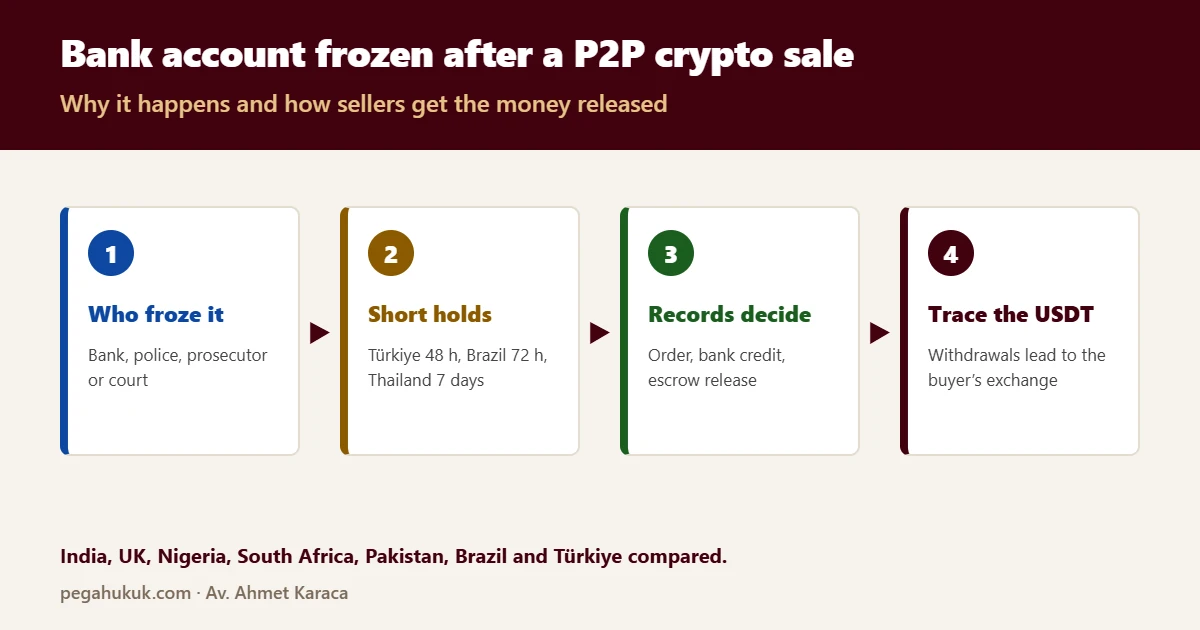
Your account was most likely frozen because the buyer paid you with a fraud victim’s money and the victim reported the transfer. The freeze usually targets that money, not you. Courts in India and Nigeria have narrowed or lifted freezes on crypto traders’ accounts, mostly because the freeze lacked a legal basis or no link to crime was shown; Pakistan’s Lahore High Court has held that a P2P sale is not by itself evidence of fraud; and the UK Financial Ombudsman has ordered money released to a seller who proved a genuine trade, but not where the evidence fell short or the account had been lent. The outcome turns on the platform order, the bank credit, the platform’s record of the escrow release and, once the buyer withdrew the crypto, its record on the blockchain. (Position as of October 2026.)
Last updated: · Prepared by: Av. Ahmet Karaca, Istanbul Bar Association (Registration No. 92414) · Verify on the Bar register
- In the third-party (“triangle”) scheme a fraudster buys USDT from an honest seller and has a deceived victim pay the seller’s account, so the victim’s complaint freezes the seller while the fraudster keeps the crypto.
- Türkiye’s CMK Art. 128/A, in force since 25 December 2025, lets a bank, payment service provider or crypto-asset service provider suspend an account for up to 48 hours on reasonable suspicion of certain cyber-enabled offences, including fraud through information systems or banks; within that period the proceeds may be seized only by a judge or by a prosecutor’s order that a judge must confirm, although ordinary seizures and banks’ own restrictions can last longer.
- Indian High Courts have repeatedly cut whole-account freezes down to liens on the disputed amount, such as ₹2.5 lakh of a ₹9.69 lakh balance (Madras High Court, 2024).
- The UK Financial Ombudsman ordered Chase to repay £599.70 with 8% interest to a seller who showed she “was legitimately engaged in buying and selling USDT” (DRN-5586209).
- Singapore police announced on 8 May 2025 that P2P sellers would be charged for allegedly failing to take reasonable steps to ascertain the source of the money or the identity of the counterparty, and on 21 May 2026 Türkiye’s Court of Cassation, on the complainant’s appeal, quashed a regional appeal court’s decision upholding the acquittal of a USDT recipient who could produce neither information nor an invoice for the commercial basis he claimed.
- An escrow release inside the exchange is in the exchange’s own records, and once the buyer withdraws the USDT each on-chain transfer is on a public blockchain, so the USDT can be followed at once to the exchange where it landed, which can be asked to identify the account holder, without waiting for banks to answer.
Why was my bank account frozen after a P2P crypto sale?
In most cases the account was frozen because the buyer’s payment came from someone else: a fraud victim who was tricked into paying your account and later reported the transfer.
On Binance P2P, OKX P2P, Bybit P2P and similar boards, the platform holds the seller’s USDT in escrow, the buyer pays by bank transfer and the seller releases the USDT once the money arrives. The platform knows who the buyer is; the seller’s bank sees only who sent the money.
In the third-party (“triangle”) scheme the fraudster opens a buy order but does not pay. He persuades a victim, through a fake investment, a fake online sale or a call impersonating police or bank staff, to transfer money to the account shown in your order. You release the USDT and the fraudster moves it on. When the victim reports the transfer, the only account in the victim’s bank records is yours.
Criminal networks run the scheme at scale: a January 2024 UNODC report on East and Southeast Asia describes “high-speed money laundering ‘motorcade’ teams specializing in underground USDT – fiat currency exchanges” and mule bank accounts that “can be purchased for as little as US $30”.
Two other triggers appear in the decisions. A buyer may receive the USDT and then falsely report a scam; the UK Financial Ombudsman called one such report “implausible” (DRN-5586209). Or the bank’s own monitoring may flag a high-volume account without any complaint. Our analysis of P2P triangle fraud under Turkish law explains how responsibility is divided.
Who froze the account, and under what law?
A freeze may come from your own bank, from police acting through the bank, from a prosecutor or from a court, and the way out depends on which of them acted and under what rule.
| Country | Who acts first | Legal basis | Limit or remedy |
|---|---|---|---|
| Türkiye | Bank, payment service provider or crypto-asset service provider | Criminal Procedure Code (CMK) Art. 128/A | Up to 48 hours; within that period the proceeds may be seized by a judge, or by a prosecutor’s order that a judge must confirm |
| India | Bank, on police instructions through the national cyber-fraud system (CFCFRMS) | BNSS ss.106–107 | The Kerala, Bombay and Delhi High Courts require a magistrate’s order for a debit freeze; the Karnataka High Court disagrees |
| United Kingdom | The bank | Account terms and conditions | Complaint to the bank, then the Financial Ombudsman Service |
| Brazil | Receiving bank (Pix) | Pix Regulation, Art. 39-B | Cautionary block of at most 72 hours |
| Nigeria | EFCC | Federal High Court freeze order | Pending investigation; in a 2024 case, six accounts the EFCC itself cleared were released |
| Philippines | Bank or e-wallet provider | Republic Act No. 12010, s.7 | At most 30 days unless a court extends |
| Thailand | Banks and payment operators; since 2025 also digital asset operators | Technology Crime Decree B.E. 2566 (2023), amended 2025 | Hold of up to seven days; the victim must file a police complaint within 72 hours |
| South Korea | Banks; virtual asset exchanges from October 2026 | Telecom Financial Fraud Refund Act | Objection with objective evidence (2024 amendment, as reported) |
| Kenya | Assets Recovery Agency, through the High Court | Preservation order under the Proceeds of Crime and Anti-Money Laundering Act | Lapses 90 days after gazettement unless forfeiture is sought |
Where a statute gives banks or other institutions their own power to hold money, as in Türkiye, Brazil, Thailand and the Philippines, the hold is short and anything longer needs an authority or a court; in the United Kingdom the bank acts under its account terms, subject to review by the Financial Ombudsman.
Does a frozen account make you a suspect?
Not by itself: a freeze is a precautionary measure on the money, and whether the holder is a suspect depends on what the holder knew and did.
The Delhi High Court held in Malabar Gold & Diamond Ltd. v. Union of India (16 January 2026) that a blanket freeze on the account of a person who is neither accused nor a suspect breaches the constitutional rights to carry on a trade and to life and personal liberty. Russia’s Supreme Court has reportedly required proof, under the pre-2025 wording of its payment-instrument offence, that the person understood the criminal nature of the scheme (case No. 44-УДП26-14-К7). In Türkiye the Court of Cassation reversed the convictions of two defendants who had received no money directly from any victim, whose intercepted calls showed no communication with the victims and on whose phones nothing incriminating was found (11th Criminal Chamber, E. 2024/2576, K. 2024/7696, 5 June 2024).
A freeze can nonetheless be the first step of a criminal case: practitioners in China note that unfreezing does not end criminal exposure, and Singapore police have announced charges against sellers alleged to have failed to check the source of the money or the identity of the counterparty (see below).
How do Indian courts treat freezes on crypto traders’ accounts?
Indian High Courts have repeatedly held that an account cannot be frozen on a bare notice and that a hold must be limited to the disputed amount, and the Kerala, Bombay and Delhi High Courts have held that a debit freeze needs a magistrate’s order.
Victims’ reports feed the Citizen Financial Cyber Frauds Reporting and Management System (CFCFRMS), which follows the money layer by layer and sends lien or freeze instructions to each bank on the trail, catching the P2P seller in the first layer.
| Case | Court and date | Holding |
|---|---|---|
| K. Sathvik Reddy v. Union of India, W.P. No. 26276 of 2023 | Telangana High Court, 21 December 2023 | A seller of USDT through Binance had his account frozen on a notice to produce documents; the notice was set aside as illegal. |
| Mohammed Saifullah v. Reserve Bank of India, W.P. No. 25631 of 2024 | Madras High Court, 10 September 2024 | No whole-account freeze “without quantifying the amount and period”; the ₹9.69 lakh balance was released subject to a ₹2.5 lakh lien. |
| Kartik Yogeshwar Chatur v. Union of India, 2025:BHC-NAG:12612-DB | Bombay High Court (Nagpur Bench), 20 November 2025 | Police have no power to debit-freeze under s.106 BNSS; banks may mark a lien on disputed amounts. The Kerala (Headstar Global, 2025) and Delhi (Malabar Gold, 2026) High Courts agree. |
| Yadhuvir Singh Manhas v. Kotak Mahindra Bank | Delhi High Court, 13 January 2026 | A full-time crypto trader, not an accused, had his account frozen at the request of police in Bihar, Tamil Nadu, Haryana and Delhi after P2P transactions were flagged; liens were kept only on the notified amounts. |
| Arjun Kuruveetil Peethambaran v. Police Inspector, 2026:GUJHC:32081 | Gujarat High Court, reported 9 June 2026 | Freezing a whole account over ₹1,100 was disproportionate; replaced by a ₹1,100 lien. |
| State of Karnataka v. JAR Gold Retail Pvt. Ltd. | Karnataka High Court, reported 16 August 2026 | Contrary view: police may debit-freeze under s.106 and then report to the magistrate, leaving the High Courts divided. |
A Ministry of Home Affairs procedure of 2 January 2026 reportedly limits liens to the disputed sum and creates a grievance route to district officers, and on 4 August 2026 the Supreme Court reportedly directed the Reserve Bank of India to issue a standard procedure on mule accounts within four weeks. For a seller, the realistic first goal is to turn a full freeze into a lien on the reported credit, with platform records explaining the rest of the balance.
When does the UK Financial Ombudsman order the money released?
The Financial Ombudsman Service accepts that a bank may restrict or close an account after a fraud report, but it orders the money released where the seller proves entitlement with records that match the payment.
Registration is not the issue for personal trades: the UK regulator said on 22 April 2026 that personal P2P transactions need no registration, while trading “by way of business” does.
| Decision | Bank | Finding | Result |
|---|---|---|---|
| DRN-5586209 (2025) | Chase | The seller showed she “was legitimately engaged in buying and selling USDT”; the buyer’s fraud report was “implausible” | £599.70 returned with 8% interest |
| DRN-4757520 (2024) | Barclays | Barclays had told the seller that incoming payments would credit; returning them to the payer would have left him struggling to recover the money “as the cryptocurrency had already been transferred” | Barclays to cover the losses |
| DRN-4591059 (2024) | Chase | Closure justified after reports from two payers, but the balance should have been released sooner | £50 compensation plus 8% interest on the balances held |
| DRN-4933758 (2024) | Chase | Screenshots, invoices and chats were not accepted as proof of entitlement | Complaint rejected |
| DRN-4730155 (2024) | Wise | The customer had let someone else route payments through his account | Complaint rejected |
The test is evidential. Matching names, amounts and times across the platform order, the chat and the bank credit succeed; screenshots alone may not; reports from several payers weigh against the customer; third-party use of the account is fatal.
What do courts and rules in Africa, Pakistan and Brazil say?
Elsewhere, courts have discharged freezes that lacked a legal basis and released accounts not linked to crime, while a South African court has held that a trader’s own duty to identify his client cannot be passed to the platform.
Nigeria. In CBN v Rise Vest Technologies Ltd (FHC/ABJ/CS/822/2021, 25 October 2021) the Federal High Court reportedly discharged a freeze of crypto-trading accounts because a central bank circular is not law. After the EFCC obtained a Federal High Court order freezing 22 accounts of suspected Bybit and KuCoin users and USDT sellers (FHC/ABJ/CS/543/2024), six were reportedly released on the EFCC’s own application because their funds were not linked to unlawful activity.
South Africa. In Wessels v Capitec Bank Ltd and Others [2024] ZAGPPHC 390 a victim paid R934,115 in 23 transfers to a part-time trader selling USDT on Binance P2P. The High Court (Gauteng Division, Pretoria) held that, because South Africa’s Financial Intelligence Centre Act treats crypto traders as accountable institutions, the trader “cannot delegate his obligations to identify his client” to Binance, and that repeated transfers just under R50,000 should have been reported as suspicious; it nevertheless refused an order restraining the trader’s assets because no intention to dissipate them was shown.
Pakistan. In Hammad Ali and others v The State (reported 30 July 2026) the Lahore High Court confirmed pre-arrest bail for three petitioners who said they were Binance P2P merchants, holding that P2P trading and receiving money in a bank account do not, by themselves, constitute evidence of fraud, forgery or electronic crime.
Brazil. The Pix fraud refund mechanism (MED) does not apply where the funds went to a terceiro de boa-fé, a good-faith third party (Art. 41-B). Since 1 July 2026, however, a MED block must be topped up whenever new money reaches the receiving account, up to the amount claimed (Art. 41-D), so continuing to trade through a blocked account can enlarge the hold.
How does Türkiye (Turkey) handle the freeze under CMK Article 128/A?
Since 25 December 2025, Article 128/A of the Criminal Procedure Code (CMK), added by Law No. 7571, has let a bank, payment service provider or crypto-asset service provider suspend an account for up to 48 hours on reasonable suspicion of certain cyber-enabled offences; within that period the proceeds of the offence may be seized only by a judge, or by a prosecutor’s written order that a judge must confirm.
The offences are theft through information systems (Penal Code Art. 142/2-e), fraud through information systems, banks or credit institutions or by posing as a public official or bank employee (Art. 158/1-f and l), and misuse of bank or credit cards (Art. 245).
| Stage | Who acts | Time limit and effect |
|---|---|---|
| Suspension | Bank, payment service provider or crypto-asset service provider | Up to 48 hours; the prosecutor is notified immediately and the account holder is informed |
| Application to lift | The account holder applies to the prosecutor | Decision within 24 hours |
| Seizure | A judge; in urgent cases, the prosecutor by written order | An urgent order goes to the judge within 24 hours and the judge decides within 48 hours, otherwise it lapses |
| Objection to seizure | The account holder | Within two weeks of learning of the judge’s decision, to the judgeship that made it, for review by the next criminal judgeship of peace (CMK Art. 268) |
| Return | Prosecutor or court | Seized proceeds belonging to the victim are returned during the investigation or trial |
The 48-hour window is the moment to apply to the prosecutor with the platform order, the bank statement and the release record. Because an institution that suspends an account under the article is not civilly liable for doing so, the seller’s remedy against the suspension itself lies in the criminal file; a block kept after 48 hours without a seizure order no longer rests on Article 128/A. Our guide to a P2P bank account freeze in Türkiye covers each time limit.
Three decisions of the 11th Criminal Chamber of the Court of Cassation (Yargıtay) frame these files:
- E. 2024/2829, K. 2024/14948 (9 December 2024): in the interest of the law, the Chamber quashed a criminal judgeship of peace’s rejection of an objection to a non-prosecution decision; it called flawed the prosecutor’s reasoning that the perpetrators could not technically be identified because the crypto purchase had not passed through supervised financial institutions such as banks, and held that investigators should have established whether the platform had a representative in Türkiye and, if necessary through international letters rogatory, obtained the account holder’s identity and the fate of the money.
- E. 2024/2576, K. 2024/7696 (5 June 2024): convictions were reversed for two defendants who had received no money directly from any victim, whose intercepted calls showed no communication with the victims and on whose phones nothing incriminating was found.
- E. 2026/1957, K. 2026/5736 (21 May 2026): on the complainant’s appeal, the Chamber quashed the regional appeal court’s decision upholding the acquittal of a person who had received USDT bought with the victim’s money, and sent the file back to the trial court. He said the USDT was payment for a service provided through his company but could produce neither information nor an invoice, so the Chamber held that he had taken part in the offence and should have been convicted. The USDT had been traced from one cold wallet to his own cold wallet.
Prosecutors therefore may not close a file by calling crypto untraceable, and receiving money somewhere in the chain, without more, did not sustain a conviction; but in the 2026 case the Chamber held that a recipient who could not document the commercial basis he claimed had taken part in the offence. The Court of Cassation decisions on P2P files are analysed separately.
When can an honest seller face criminal charges?
A seller is prosecuted not for selling crypto but for knowing, or in some systems failing to check, that the payment was criminal; for letting others use the account; for running an unlicensed exchange business; or for taking part in the fraud.
Failure to check. On 8 May 2025 Singapore police announced that charges of assisting another to retain benefits from criminal conduct (CDSA s.55A) would be brought against a woman who allegedly received S$20,000 “for a Peer-to-Peer sale transaction in cryptocurrency” while failing to take reasonable steps to ascertain the source of the money, and against a man who allegedly transferred crypto worth at least S$96,000 under a Peer-to-Peer sale “without taking reasonable steps to ascertain the identity and physical location of the counterparty”; the offence carries a fine of up to S$50,000, up to three years’ imprisonment, or both. For the offence of assisting information-network crime, China presumes knowledge where the price or method of a transaction is clearly abnormal (2019 judicial interpretation, Art. 11(3)); in one reported case a USDT seller whose bank cards, supplied to others, had already been frozen over fraud funds was convicted of concealing criminal proceeds on the finding that he “should have known” the buyer’s payment was criminal.
Account lending. The Philippines treats “using, borrowing or allowing the use of a Financial Account” for criminal proceeds as money muling, punishable by six to eight years (Republic Act No. 12010). Thailand punishes letting others use an account for technology crime with up to three years. Since 5 July 2025 Russia has punished handing over a payment instrument for unlawful transactions and making transfers on another’s instructions for reward (Criminal Code Art. 187, parts 3–4). In Türkiye, where a person’s participation in fraud is limited to giving others, to obtain an unjust benefit, payment cards or the information or tools needed to use their own or another person’s bank, brokerage, payment or crypto-asset account, the penalty is halved (Penal Code Art. 158/4, added by Law No. 7589, Official Gazette 31 July 2026); the provision presupposes intentional participation in the fraud.
Unlicensed business. The US prosecutions of individual P2P traders under 18 U.S.C. §1960 announced by the Department of Justice, such as Tetley, Campos, Rockcoons, Rodriguez and Yusko, each involved an aggravating feature: cash, undercover agents posing as drug dealers, criminal clients, a separate fraud or, in United States v. Yusko, telling clients not to disclose the purpose of their wires to banks.
The facts that protect a seller are the facts that disprove knowledge: a market price, a buyer whose verified name matches the payer, no third-party instructions, no structuring, platform records and a traceable crypto delivery.
What should you do in the first 48 hours and the first week?
In the first 48 hours, identify the measure and secure the records; in the first week, put a reconciled evidence file before the authority handling the case and ask it to pursue the buyer’s exchange account.
- Identify the measure. Ask the bank in writing whether the block is its own decision or follows a police, prosecutor or court request, and obtain the reference.
- Stop trading through the account. Do not open new orders or route money elsewhere while the measure runs.
- Export the platform records. Download the order history, the disputed order page, the in-app chat, the buyer’s verified name and the escrow release record; screenshots are only a back-up.
- Record the blockchain side. For on-chain deliveries, note the transaction hash (TXID), the network and the receiving address.
- Use the short formal window. In Türkiye, apply to the prosecutor during the 48-hour suspension; in Brazil the Pix block lasts at most 72 hours; in Thailand, a bank hold lasts up to seven days unless the police order a further freeze; in India, use the grievance route or seek a lien limited to the disputed amount.
- Reconcile. For each disputed credit, line up the bank credit (payer, amount, time), the platform order (number, buyer, price, time) and the crypto release. A mismatch you explain does far less damage than one the investigator finds.
- File a written statement within the week. Send it, with the evidence, to the authority holding the file, and ask that the platform be required to disclose the buyer’s identity and that the USDT be traced to the exchange where it landed.
What evidence proves a genuine P2P sale?
A genuine sale is proved by records that tie together the platform order, the bank credit and the crypto delivery, together with proof of where your crypto came from.
- The platform order record: number, time, amount, unit price and the buyer’s verified name.
- The full in-platform chat, exported from the platform.
- A bank-issued statement showing each payer’s full name, amount, time and reference.
- A note of any trade in which the payer’s name differed from the buyer’s verified name.
- The escrow release record and, for on-chain deliveries, the TXID and receiving address.
- The source of the crypto sold: purchase records or deposit history.
- Evidence that the price matched the market at the time, such as other advertisements on the board.
- Every notice from the bank, platform, police or prosecutor, with dates.
Quality matters. In DRN-4933758 screenshots and chats were not accepted, and in DRN-4591059 the Ombudsman accepted that a seller could not obtain statements from buyers he did not know personally, so the platform’s own records carry the weight. See our guide to building a P2P evidence file.
What should you not do after a freeze?
Do not pay anyone outside the official process, do not split or reroute transfers, and do not let anyone use your account: each makes an innocent seller look like part of the scheme.
Do not refund to an IBAN supplied by a stranger. People claiming to be the victim, the buyer, a bank officer or a police officer may ask for the money to be returned to a new account. That payment does not appear in the official file, does not lift the freeze and may be a second fraud. Any return should go through the bank or authority handling the complaint; and, as the Ombudsman noted in DRN-4757520, once the crypto has been released a seller whose payment is sent back to the payer may struggle to recover anything.
Do not split transfers or use relatives’ accounts. Some widely read online advice tells P2P sellers to split payments into smaller amounts or spread them across accounts to stay below bank monitoring. That looks like structuring: in Wessels repeated payments just below R50,000 were a red flag, Chinese law presumes knowledge from an abnormal method of transaction, and Russian banks reportedly flag cards with more than 10 individual counterparties or 30 transactions a day, exactly the pattern splitting creates. A relative whose account is used also enters the file.
Do not lend or rent your account. Account lending is punished in its own right in the Philippines, Thailand and Russia, is prohibited by China’s anti-telecom-fraud law and in Türkiye is treated as participation in fraud with a halved penalty (Penal Code Art. 158/4); in DRN-4730155 it defeated the complaint outright.
Do not leave the platform or release against a third-party payment. Keep the conversation inside the platform and delete nothing. If the payer’s name differs from the buyer’s verified name, do not release; raise it through the order’s appeal function.
Why is tracing the USDT you released the fastest way out?
Because the bank side of a P2P trade stays hidden until each bank answers an official request, while the crypto side is recorded in the exchange’s own ledger and, once withdrawn, on a public blockchain that can be followed at once to the exchange where the real fraudster can be identified and the funds frozen.
An investigator following a victim’s money through banks must ask each bank in turn and wait for each answer; until then the P2P seller is the last visible name in the file. A USDT transfer on TRON or Ethereum is written to a public ledger that anyone with the right tools can read immediately. FATF, the global anti-money-laundering standard-setter, notes that this visibility “might support financial analysis and law enforcement investigations”.
The platform’s records show whether the seller released the crypto; tracing on the blockchain then answers two questions: where did the buyer move it, and which exchange did it reach? The last matters most, because exchanges hold identity, login and withdrawal records and can freeze balances when an authority asks. Elliptic reports that virtual asset service providers such as exchanges were the first stop for 76% of scam proceeds in 2024 and 80% in the first half of 2025.
A cold wallet does not end the trail. A hardware or offline wallet is still a public address; transfers into and out of it can be followed, and USDT held there can be frozen by its issuer, Tether. FATF’s March 2026 report on stablecoins and unhosted wallets recommends that issuers keep the ability to freeze tokens and that authorities agree arrangements for rapid freezing. Türkiye’s Court of Cassation rejected the “crypto cannot be traced” reasoning in 2024, and its May 2026 decision concerned USDT traced from one cold wallet to another.
For the seller, a trace shows that the money bought real crypto that went to someone else; for the victim, it points to where the money may still be recovered.
PEGA Hukuk & Danışmanlık has acted in more than a hundred P2P files in Türkiye. In those files, a technical report that links the bank payment to the platform order and follows the crypto on the blockchain to the receiving exchange is usually decisive; without it, the file tends to stop at whoever’s account received the money.
Frequently asked questions
Why was my bank account frozen after selling USDT on Binance P2P?
Usually because the buyer paid you with a fraud victim’s money and the victim reported the transfer. The victim’s bank sees only your account, so the complaint lands on you although you delivered real crypto. Less often, the buyer falsely reports a scam, or bank monitoring flags the account.
How long can a bank keep my account frozen on its own?
Under the statutory short-hold rules, only briefly: up to 48 hours in Türkiye under CMK Art. 128/A, 72 hours for a Pix cautionary block in Brazil, seven days in Thailand and up to 30 days in the Philippines. Longer holds rest on a prosecutor’s or court’s order, a specialised agency or, as in the United Kingdom, the bank’s own account terms, which the Financial Ombudsman can review.
Can my whole balance be frozen over one disputed payment?
Courts increasingly say no. Indian High Courts have replaced whole-account freezes with liens on the disputed amount, such as ₹2.5 lakh of a ₹9.69 lakh balance in Mohammed Saifullah, and in Nigeria accounts not linked to crime have been released. The argument is strongest when platform records show the rest came from unrelated trades.
Should I send the money back to the person who says they were scammed?
Not outside the official process. A request to pay a new account supplied by a stranger may be a second fraud and will not lift the freeze. Any return should go through the bank or authority handling the complaint; as the UK Ombudsman noted in DRN-4757520, once the crypto has been released a seller whose payment is returned to the payer may struggle to recover anything.
Can I be charged for selling crypto to a scammer?
Generally only if you knew, or in some countries should have known, that the money was criminal, lent your account or ran an unlicensed exchange business. Singapore police announced in May 2025 that P2P sellers would be charged for allegedly not taking reasonable steps to check the source of the money or the identity of the counterparty; Pakistan’s Lahore High Court held that receiving payment for a P2P sale is not, by itself, evidence of fraud.
Can USDT moved to a cold wallet still be traced or frozen?
Yes. A cold wallet is an ordinary address on the public blockchain, so every transfer into and out of it can be followed, and Tether can freeze USDT held at a specific address. A decision of Türkiye’s Court of Cassation of 21 May 2026 concerned USDT traced from one cold wallet to another.
I am the fraud victim. Can the seller’s frozen account get my money back?
Sometimes. In Türkiye seized proceeds belonging to the victim can be returned during the investigation or trial, and in Wessels Capitec recovered about R467,000 of the R934,115 for the victim. But Brazil’s refund mechanism excludes good-faith recipients, and the Wessels court refused to restrain the trader’s assets. Tracing the crypto to the fraudster’s exchange account is usually more promising.
Related guides
- P2P Crypto Trading Laws Around the World: A Country-by-Country Legal Guide
- Court of Cassation Decisions on P2P Crypto Cases in Türkiye
- Bank Account Frozen After a P2P Crypto Trade in Türkiye
- P2P Triangle Fraud in Türkiye: Third-Party Payments and Liability
- How to Build a P2P Crypto Evidence File in Türkiye
- Crypto P2P Law in Türkiye: The Complete Legal Guide
Sources
- Criminal Procedure Code No. 5271, Art. 128/A (Law No. 7571, in force 25 December 2025) and Art. 268; Turkish Penal Code No. 5237, Arts. 142/2-e, 158/1-f and l, 158/4 (Law No. 7589, Official Gazette 31 July 2026), 245 — mevzuat.gov.tr
- Yargıtay, 11th Criminal Chamber: E. 2024/2829, K. 2024/14948 (9 December 2024); E. 2024/2576, K. 2024/7696 (5 June 2024); E. 2026/1957, K. 2026/5736 (21 May 2026) — karararama.yargitay.gov.tr
- Financial Ombudsman Service, decisions DRN-5586209, DRN-4757520, DRN-4591059, DRN-4933758, DRN-4730155
- Financial Conduct Authority, “FCA leads first crackdown on illegal crypto trading”, 22 April 2026 — fca.org.uk
- India: K. Sathvik Reddy v. Union of India, W.P. No. 26276 of 2023 — tshc.gov.in; Mohammed Saifullah v. RBI, W.P. No. 25631 of 2024; Headstar Global Pvt. Ltd. v. State of Kerala, 2025:KER:39285; Kartik Yogeshwar Chatur v. Union of India, 2025:BHC-NAG:12612-DB; Malabar Gold & Diamond Ltd. v. Union of India, 2026 SCC OnLine Del 297; Yadhuvir Singh Manhas v. Kotak Mahindra Bank, Delhi High Court, 13 January 2026; Arjun Kuruveetil Peethambaran v. Police Inspector, 2026:GUJHC:32081; State of Karnataka v. JAR Gold Retail Pvt. Ltd., Karnataka High Court, 2026
- India: Ministry of Home Affairs, standard operating procedure of 2 January 2026; Supreme Court, In Re: Victims of Digital Arrest Related to Forged Documents (suo motu), directions of 4 August 2026
- Federal High Court, Abuja: CBN v Rise Vest Technologies Ltd, FHC/ABJ/CS/822/2021; FHC/ABJ/CS/543/2024
- Wessels v Capitec Bank Limited and Others [2024] ZAGPPHC 390 — saflii.org
- Lahore High Court, Hammad Ali, Asad Amjad and Muhammad Athar v The State, judgment reported 30 July 2026
- Banco Central do Brasil, Pix Regulation (Resolução BCB nº 1/2020), Arts. 39-B, 41-B, 41-D — bcb.gov.br
- Assets Recovery Agency v Yves & another [2024] KEHC 12619 (KLR) — kenyalaw.org
- Republic Act No. 12010 (Anti-Financial Account Scamming Act), 20 July 2024 — lawphil.net
- Thailand, Emergency Decree on Measures for Prevention and Suppression of Technology Crimes B.E. 2566 (2023) and Amendment No. 2 B.E. 2568 (2025)
- Financial Services Commission (Korea), release of 12 March 2026 — fsc.go.kr
- Russian Federation, Federal Law No. 176-FZ (2025) amending Criminal Code Art. 187 — publication.pravo.gov.ru; Supreme Court, case No. 44-УДП26-14-К7
- China, Anti-Telecom and Online Fraud Law (2022) — 12371.cn; Supreme People’s Court and Supreme People’s Procuratorate, Fashi [2019] No. 15 — court.gov.cn
- Singapore Police Force, release of 8 May 2025 — police.gov.sg
- US Department of Justice releases: United States v. Tetley (C.D. Cal., 2018); United States v. Campos, No. 18CR3554-H (S.D. Cal., 2019); United States v. Rockcoons, No. 17cr3690-AJB (S.D. Cal., 2019); United States v. Rodriguez, No. 23-cr-20474 (S.D. Fla., 2024) — justice.gov; United States v. Yusko (E.D. La.), sentencing release of 21 January 2022 — justice.gov
- FATF, Updated Guidance on Virtual Assets and VASPs, October 2021, ¶38 — fatf-gafi.org; Targeted Report on Stablecoins and Unhosted Wallets, 3 March 2026 — fatf-gafi.org
- UNODC, Casinos, Money Laundering, Underground Banking, and Transnational Organized Crime in East and Southeast Asia (2024) — unodc.org
- Elliptic, The State of Crypto Scams 2025 — elliptic.co
Update note: 31 October 2026 — First publication. Covers CMK Art. 128/A, the Court of Cassation decision of 21 May 2026, Indian rulings to August 2026, Brazil’s Pix rule of 1 July 2026 and South Korea’s exchange freeze duty.
Legal advice and representation
Account frozen after a P2P sale linked to Türkiye?
For matching the frozen payment to the platform order, tracing the USDT you released to the receiving exchange, and applications to Turkish prosecutors and courts to release the balance, you can retain Av. Ahmet Karaca for legal advice and representation.
Av. Ahmet Karaca · +90 531 336 09 81 · ahmet@pegahukuk.com
Av. Ahmet Karaca
Av. Ahmet Karaca is a lawyer registered with the Istanbul Bar Association (Registration No. 92414, TBB No. 234456) who works in crypto-asset law, blockchain law and information technology law at PEGA Hukuk & Danışmanlık in Kartal, Istanbul. He is a graduate of Marmara University Faculty of Law and has completed certificate programmes at Duke University (Blockchain/DeFi), Politecnico di Milano (AI & Legal Issues) and Lund University (AI & Law). He teaches a blockchain law course on Udemy and writes a column for Haberler.com.
Profile and publications · LinkedIn · Istanbul Bar register
This guide was prepared by Av. Ahmet Karaca, who reviewed its legal accuracy. When citing: pegahukuk.com — Av. Ahmet Karaca.