On this page
- What the 2025 IC3 employment figures measure
- How an apparent job becomes a demand for your money
- Check the payment demand rather than the job title
- What to do if you have already paid
- Build a loss schedule from real transfers
- A different danger: receiving and forwarding other people’s money
- Be cautious about the second offer of help
- Sources and scope
A supposed employer says your earnings are ready, but you must first deposit cryptocurrency to finish a task, clear a balance or unlock withdrawal. Stop before making another payment. A rising balance on a website is not evidence that wages exist or that you can withdraw them.
The FBI describes this pattern in its warning about work-from-home scams: simple online activities, a confusing payment structure, deposits sent by the worker and an interface displaying unavailable earnings. The practical questions are where your real money went, what induced you to send it and whether further access to your accounts is at risk.
What the 2025 IC3 employment figures measure
| Scope | Complaints | Reported losses |
|---|---|---|
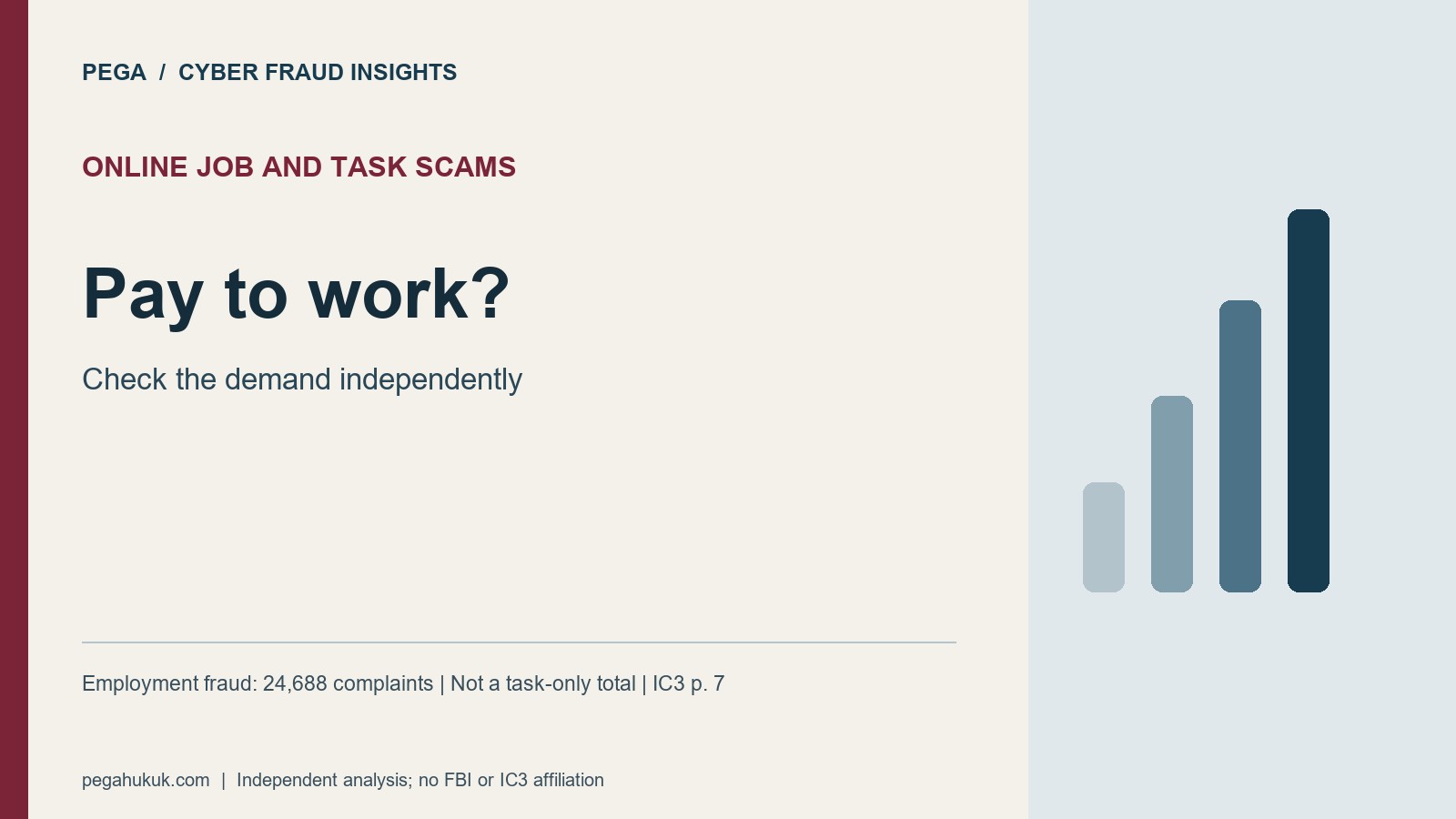
| Employment crime type overall | 24,688 | $362,934,762 |
| Employment complaints with a cryptocurrency nexus | 10,338 | $288,199,807 |
Source: 2025 IC3 Annual Report, pages 7–8, and pages 54–55. The second row is a subset, not an additional total. Neither row is a count of task scams alone. The employment category includes different schemes, and a cryptocurrency nexus means the complaint contains a reference to virtual currency. These are IC3 reports, not a global measure of job fraud. See our IC3 statistics guide for the wider methodology.
How an apparent job becomes a demand for your money
The opening offer may be for restaurant ratings, product promotion or “optimization.” A recruiter sends a platform link; completed clicks appear to produce commissions. The FBI identifies cryptocurrency payments to the supposed employer and minimal recruitment checks among the warning signs. Those details are especially concerning when no independently verifiable business explains the work and payment arrangements.
A small real payout does not settle that question. The FTC’s examination of task scams explains that initial payments can build trust before larger deposits are demanded. Group chats with supposed successful workers can reinforce the story. The earlier payout establishes that one transfer happened; it does not establish that the displayed balance is backed by money.
Pressure often focuses on what you supposedly stand to lose: an unfinished set of tasks, a withheld commission or the balance already shown. The useful response is to separate the two figures. Your actual exposure comes from verified outgoing payments, adjusted for real receipts. The platform’s claimed earnings are a separate, unverified representation.
Check the payment demand rather than the job title
| What you are told | What to check | Why it matters |
|---|---|---|
| “Complete one more deposit to withdraw.” | Who receives the deposit, and why must your own money fund access to pay? | A payment demand is not evidence that the claimed earnings exist. |
| “This is a famous company’s recruitment program.” | Contact the company through an independently located official channel. | A logo, similar domain or copied employee profile can impersonate a real business. |
| “Other workers withdrew successfully.” | Distinguish a verifiable receipt from a message or dashboard image. | Group statements do not independently verify the platform’s finances. |
| “Your account will be penalized if you stop.” | Preserve the exact threat, alleged rule and payment instructions. | The demand helps explain the pressure behind a later transfer. |
No single label proves fraud. A genuine wage dispute, a platform fee dispute and a fabricated job can involve different facts and remedies. The combination of invented work, unverifiable earnings and repeated payments required to release them deserves immediate scrutiny. Do not pay another deposit merely to test whether the next withdrawal will succeed.
What to do if you have already paid
- Stop further transfers and contact the payment provider. Give your bank, exchange or other provider the actual transaction references and explain the suspected job scam. Ask what intervention or account protection is available. A request does not guarantee reversal, and a provider may need legal process before disclosing another customer’s information.
- Preserve access to evidence without continuing the tasks. Save the recruitment message, full conversation, platform address, account identifier, task history, withdrawal refusals and every fresh payment demand. Do not send more money just to keep an account open or obtain a screenshot.
- Protect exposed accounts. If you supplied a password, authentication code, identity document or remote access, record what was disclosed and tell the relevant institution. Use a trusted route to change compromised credentials and revoke suspicious sessions. For a fake support or login link, see our account takeover guide.
- Report a clear chronology. The FBI requests IC3 reports with associated transaction information. Include local police or prosecutorial reporting where relevant; overseas reporting does not replace the procedures available in the country connected to the payment.
Build a loss schedule from real transfers
Use one row for each outgoing payment. Record its date and time zone, original asset and amount, payment provider, recipient details and reference. Alongside it, identify the message that prompted that transfer. Label deposits, alleged taxes and alleged unlocking fees as the sender described them, without accepting that a real debt existed.
For cryptocurrency, preserve the network, asset, transaction hash, sending and receiving addresses and exchange withdrawal record. An address alone is not enough where the same format may exist on different networks. Record any actual repayment separately. Avoid counting both the bank payment used to buy cryptocurrency and the later transfer of that same cryptocurrency as two separate losses.
A simple hypothetical illustrates the distinction. If a person buys $1,000 of cryptocurrency and sends it to the task platform, those two steps ordinarily describe one $1,000 funding path, before separately identified fees or valuation differences. A $15,000 balance displayed by the platform does not turn that transfer into a verified $15,000 loss. Any claimed contractual entitlement needs its own legal and evidential assessment.
A different danger: receiving and forwarding other people’s money
Some false jobs ask workers to receive funds into a personal account and pass them onward while keeping a commission. The FBI’s money mule guidance identifies this as a separate warning pattern and recognizes that participants can have different levels of awareness.
If that has happened, stop forwarding funds, tell the bank what occurred and preserve the instructions and account records. Do not independently “refund” money to a new destination supplied by the recruiter. Your own knowledge, conduct and the source of the funds require individual assessment; appearing as an account holder neither proves innocence nor establishes knowing involvement.
Be cautious about the second offer of help
After a loss, a new contact may claim to recover the money for a deposit, tax or release fee. The FBI’s work-from-home warning also cautions against paid cryptocurrency recovery schemes. Verify the identity, scope and basis of any proposed service independently, and read our guide to fake recovery firms and impersonated authorities.
Where a Turkish bank account, exchange or other Turkish connection is supported by the records, the relevant legal route depends on that evidence and the parties involved. Our guide to crypto fraud and asset recovery in Turkey explains the separate roles of tracing, reporting and legal measures. An identifiable transfer is a starting point for enquiries, not a recovery guarantee.
Sources and scope
FBI, 2025 IC3 Annual Report, pages 7–8, 54–55 and 61–62; FBI/IC3, Work-From-Home Scams, June 4, 2024; FTC, Paying to Get Paid, December 2024; and FBI, Money Mules. The verification matrix and hypothetical loss calculation are editorial analysis, not additional FBI statistics.