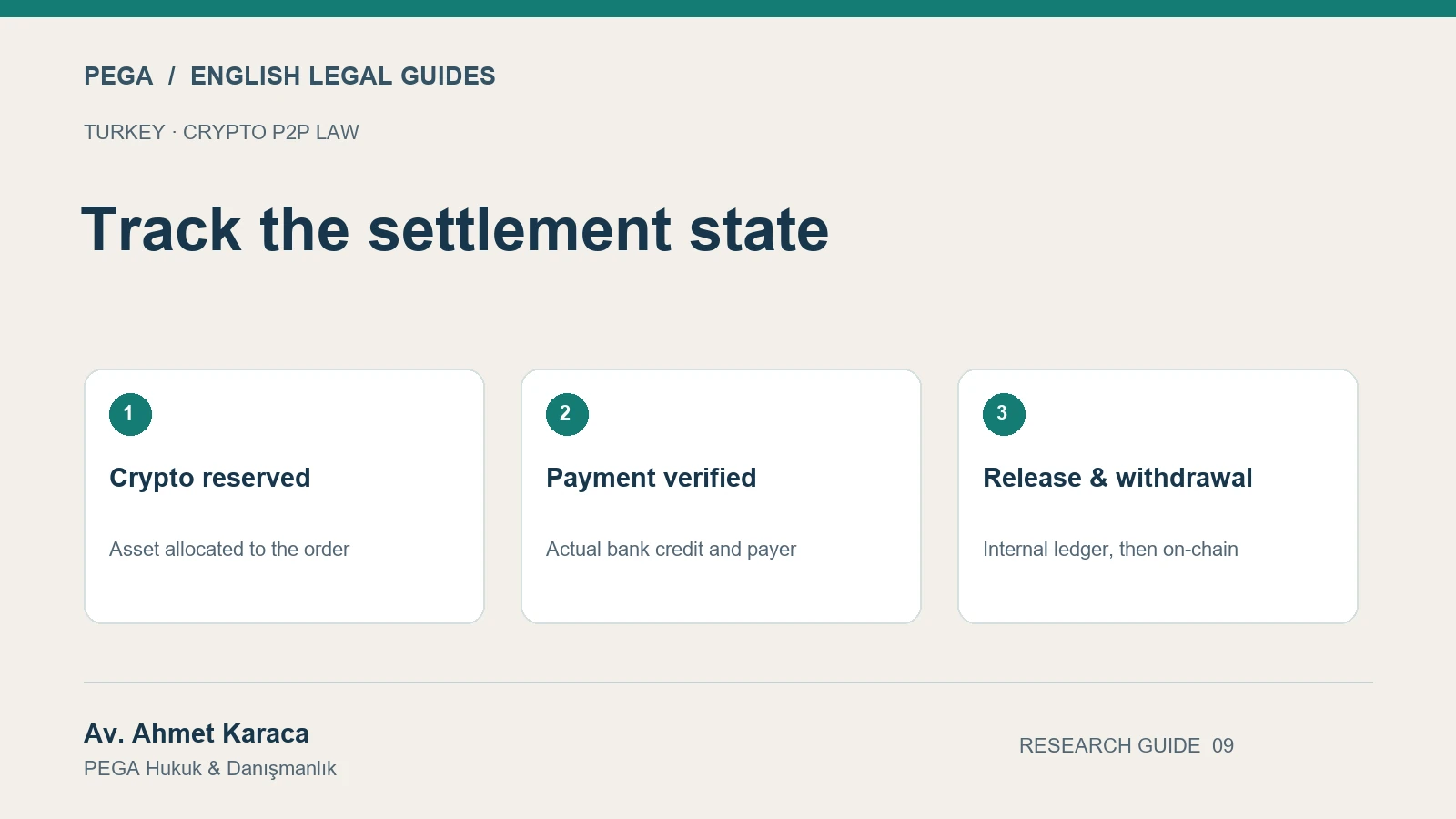
P2P escrow usually protects a defined crypto balance during an order. It does not automatically protect the bank payment, verify the payer’s lawful source of funds, or bind a Turkish court. Before relying on it, identify who controls the asset and what happens at each stage of settlement.
This guide follows a trade from advertisement to appeal. It distinguishes exchange-hosted escrow, internal account credits, direct wallet settlement and purported escrow services. Platform-specific rules must be checked for the exact entity and product; a familiar brand name alone is insufficient.
Follow the trade through its states
| State | What may be under platform control | What remains unproved |
|---|---|---|
| Advertisement published | Offer and user profile | That a particular payer has contracted or funded an order |
| Order opened; crypto reserved | The seller’s platform balance allocated to the order | Receipt of bank money and its lawful origin |
| Buyer marks “paid” | Order status and submitted evidence | That the seller’s bank has actually credited the payment |
| Crypto released | An internal credit to the buyer, depending on the system | The later withdrawal, wallet owner or payer’s authority |
| Buyer withdraws | The withdrawal process until execution | The identity controlling the destination merely from the address |
| Appeal decided | The platform’s order or account action within its powers | A final judicial determination of criminal or civil liability |
A dispute often turns on confusing adjacent states. “Paid” can be the buyer’s assertion rather than a bank-confirmed event. “Released” can be an off-chain ledger movement rather than an on-chain transfer. “Completed” can be a contractual platform status while a separate bank complaint remains unresolved.
Exchange escrow, smart contracts and a stranger’s wallet
In exchange-hosted P2P, the platform may control the relevant keys and keep the order’s reserve in its own accounting system. Its internal records determine which customer balance was debited and credited. An explorer cannot reveal that entire ledger.
A smart-contract arrangement requires a different examination: deployed contract, network, release conditions, administrator powers, upgradeability and who can sign or override a decision. The word “decentralised” does not establish that the software is immutable or that no person can control release.
A request to send crypto to a wallet described in a chat as “escrow” proves none of these safeguards. Verify the provider and mechanism before transferring. An unknown person’s address is not made safe by a logo, screenshot or promise of arbitration. If fraud has already occurred, use the asset-recovery guide to identify preservation opportunities.
Confirming payment without trusting a screenshot
The seller should inspect their own bank’s record for the credited amount, sender, reference and timing. A forged receipt can reproduce an order number and a correct amount. A genuine transfer instruction can still be pending or sent to the wrong account. An image sent by the buyer should be treated as evidence to compare with the bank, not the bank’s confirmation itself.
Compare the payer with the verified buyer under the applicable trading rules. The OKX P2P transaction rules illustrate the importance of payment-account identity. Other platforms, entities and products may use different dispute processes and deadlines; preserve the version applicable when the order was placed.
If there is a mismatch or uncertainty, use the supported appeal process while preserving the reserved asset. Do not rely on a counterparty’s threat that a complaint or poor rating will follow unless you release immediately. A time-sensitive order deserves a timely documented response, not an irreversible action based on pressure.
If you paid and the seller will not release
Keep the order open where the platform’s rules and interface permit, and use its appeal process promptly. Preserve the bank-native receipt, payment account ownership, beneficiary details, reference and credited or completed status available from your bank. State the exact order and the performance requested. Do not submit a second payment simply because a counterparty says the first is “stuck”.
Ask whether the issue is a name mismatch, wrong beneficiary, partial payment, late payment, unavailable reserve or another alleged breach. Each requires different evidence. If the order was cancelled after payment, preserve the cancellation time and the status of both the bank transfer and the crypto reserve.
A platform can assess its order and act within its contractual and technical powers. If the recipient denies any obligation or the platform cannot obtain performance, a civil delivery or repayment claim may require separate consideration. The support process does not necessarily pause legal limitation periods or replace a court prerequisite.
If you released crypto but the payment is missing
Record when and how release was authorised. Was it the seller’s confirmation, a platform decision, an API action or an account-compromise event? Obtain the bank’s record distinguishing no payment from a pending transfer, returned payment or subsequent restriction.
Notify the platform with the order ID and request preservation of release and account records. If a security compromise is suspected, secure the account through the legitimate provider process while preserving evidence of the relevant logins and changes. Do not erase the application or reset the device before considering evidence preservation.
If the buyer’s internal balance remains with the platform, its practical options may differ from a case where assets have already left. A private notice does not guarantee a freeze. The evidence-file guide identifies the records that connect release to withdrawal and account control.
How to make an appeal reviewable
A useful submission has a short chronology, a precise disputed proposition and indexed evidence. For example: “Order X required TRY 54,000 from the verified buyer; the attached bank record shows TRY 54,000 from a different named sender at 11:06; release has not occurred; please review under the payment-identity rule.” The example is a format, not a statement to copy where the facts differ.
Attach the complete relevant record, not a cropped image that hides the sender or timestamp. Preserve originals privately and redact unrelated transactions only in a clearly identified copy where appropriate. State what you can and cannot confirm. If the bank cannot verify receipt yet, say so rather than claiming final non-payment.
Keep the case number and each platform response. If the platform asks for a screen recording, use its official channel and avoid exposing authentication secrets, private keys or unrelated personal records. A legitimate evidence request should never require your seed phrase.
What a platform decision proves
A reasoned decision may establish what the platform observed, which rule it applied and how it moved the reserve. Preserve it. Its evidential weight depends on the data considered and the issue decided. A short “appeal closed” message may say little about payment authority or criminal intent.
An appeal outcome does not bind a bank payer who was deceived outside the platform, and it is not a Turkish acquittal or a final civil judgment. In a triangle fraud, the platform may have confirmed that a seller received the order amount without knowing that the sender intended to purchase something entirely different.
Conversely, losing an internal appeal does not automatically establish criminal guilt. Obtain the reasoning and preserve contradictory bank or platform records. A legal challenge must address the actual obligation and evidence, not merely repeat that the platform’s result was unfair.
The Turkish legal framework around platform terms
The framework introduced by Law No. 7518 requires relevant platforms to establish internal mechanisms for customer objections and complaints. It also addresses customer agreements and service-provider responsibility. Statutory duties and applicable mandatory rules must be assessed alongside contractual terms.
Authorisation is not a state guarantee that the counterparty will perform. A platform’s terms cannot be assumed to eliminate every statutory responsibility by describing users as independent counterparties. At the same time, responsibility for a particular loss requires identifying the relevant provider, obligation, breach and causation.
For a foreign platform, determine the contracting entity, governing-law and forum provisions, actual targeting and available enforcement route. A global help page should not be treated as proof that a Turkish group company operates the same P2P service. The cross-border guide explains why this matters.
A released balance can still be subject to withdrawal controls
After delivery into the buyer’s platform balance, a withdrawal may encounter customer checks, MASAK waiting periods or stablecoin limits, a security hold, or an authority’s restriction. Identify which applies. A delay at that stage does not automatically prove the seller failed to release escrow.
Preserve the internal credit separately from the withdrawal request and eventual transaction hash. If a platform bundles fees or consolidates withdrawals in one on-chain transaction, obtain the customer-specific record. A large outgoing hot-wallet transaction is not necessarily the buyer’s individual transfer.
Order terms that reduce factual disputes
Clear terms should identify the asset and network where relevant, quantity, price, accepted payment account, payer-identity requirement, timing, treatment of fees and partial payments, release condition and supported dispute process. They should agree with platform rules and applicable law.
Do not use terms purporting to transfer all legal risk to an unknown payer, authorise false bank descriptions or guarantee that a private indemnity defeats a seizure. If a trader regularly drafts terms for customers, that may also be evidence relevant to the business-model analysis.
The central discipline is to preserve each state change and the evidence supporting it. Escrow can reduce a defined settlement risk when used correctly. Understanding its boundary is what prevents a platform status from being mistaken for a complete legal answer. The main P2P law guide connects that answer to the wider Turkish framework.