On this page
You can report cyber-enabled fraud to the FBI’s Internet Crime Complaint Center even if you are not a US citizen or you live outside the United States. IC3’s official FAQ expressly permits reports from citizens of other countries and reports about subjects overseas. Filing provides information for analysis and possible referral; it does not guarantee an investigation, a reply, a freeze or compensation. Contact your bank and the appropriate local authorities separately when money or evidence is at risk.
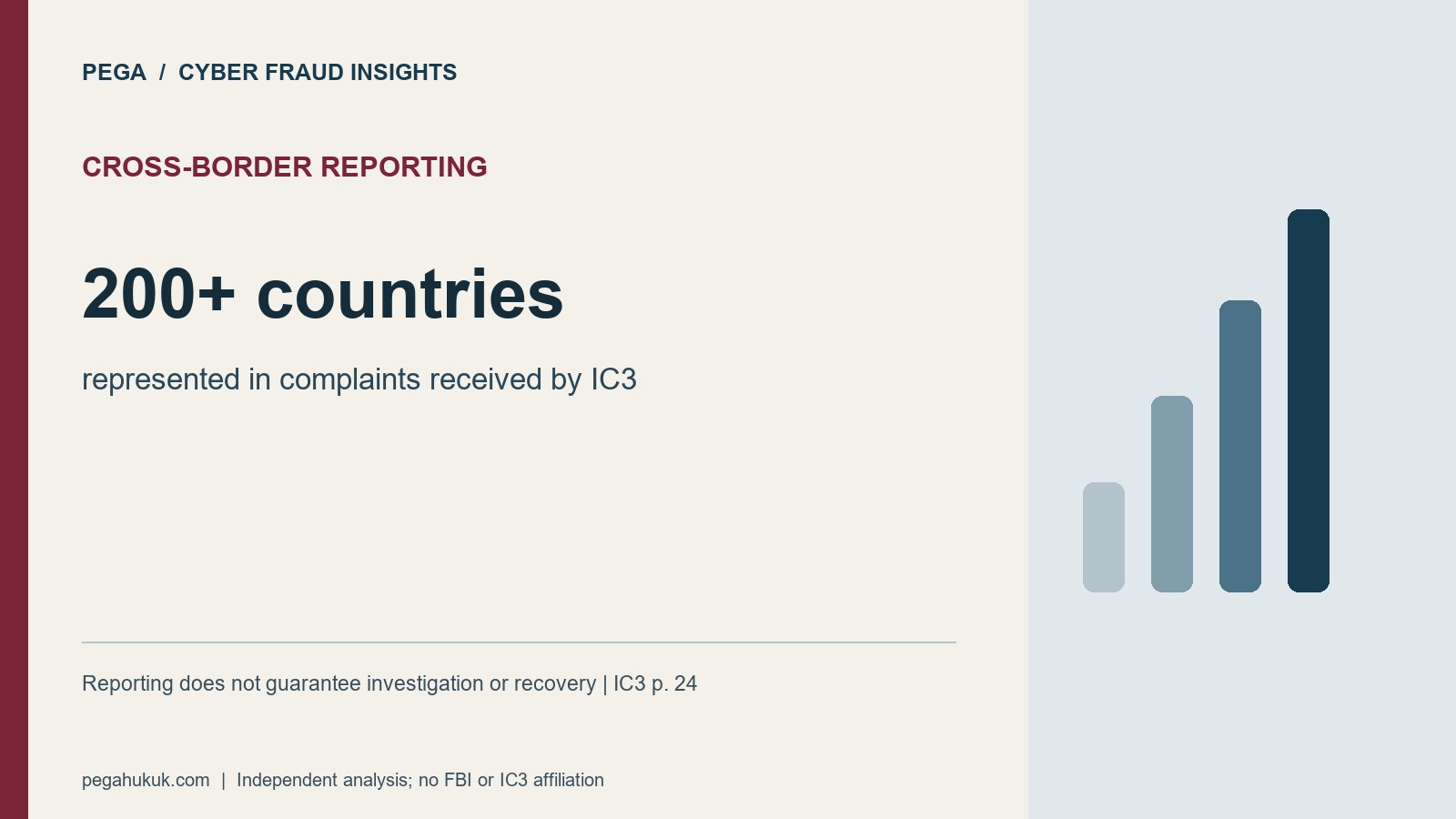
The international dimension is visible in the 2025 IC3 Annual Report, page 24: complaints came from more than 200 countries, accounting for almost $1.6 billion of the overall reported losses. Turkey appears with 944 complaints in its foreign-country table. That is a count of complaints associated with the stated country, not a count of Turkish offenders, a national fraud rate or a measure of all losses suffered in Turkey.
Reporting and protecting funds are parallel tasks
A victim may have a bank in one country, a payment recipient in another and a suspect using a third country’s telephone code. There is rarely a single online form that performs every necessary step. An IC3 submission records the incident for the FBI’s complaint system. A bank fraud notification asks a financial institution to act on a particular payment. A local criminal complaint invokes the relevant local process. Each needs the same underlying facts, presented for its different purpose.
| Channel | Useful request or information | Limit to keep in mind |
|---|---|---|
| Sending bank or payment provider | Report fraud; ask what recall, reversal, restriction or recipient-bank contact is possible; obtain a reference. | A request is not a completed recall. Rights and procedures vary with the payment and jurisdiction. |
| Exchange or other identifiable service | Identify the asset, network, transaction and relevant account; request evidence preservation and fraud review. | A public wallet label does not establish the customer or compel a refund. |
| Local police or prosecutor | Report the deception and loss; identify urgent evidence and any reachable assets. | The competent authority and available measures depend on the actual connections and local law. |
| IC3 | Submit an accurate narrative, identities as represented, communications and transaction details. | Review and possible referral do not promise an individual investigation or status updates. |
If there is immediate physical danger, use the emergency service or police where you are. A web complaint is not an emergency dispatch channel. IC3’s FAQ also directs people with time-sensitive matters to contact local law enforcement directly.
Prepare a short account supported by a transaction schedule
Start with what actually happened: how contact began, what the person claimed, what made the request deceptive, when you transferred value, how you discovered the problem and what you have already done. Separate facts you observed from names or affiliations the other person merely claimed. If the identity is unknown, say so. A telephone country code or the language used in a chat does not prove the speaker’s location.
For each payment, record the date and time with time zone, amount and currency, sending institution or wallet, recipient details, payment reference or transaction hash, and the corresponding instruction. Keep the original currency; if you give a US-dollar equivalent, identify its date and conversion method. Record actual returns separately. Do not claim the fictitious profit on a scam website as money you demonstrably paid.
For cryptocurrency, include the network as well as the token. A USDT amount and a screenshot of an address are insufficient to distinguish transactions across different chains. Preserve exchange withdrawal records and full transaction hashes. If you think a destination belongs to an exchange, state the source of that label and its uncertainty rather than identifying a particular customer without supporting records. Our crypto investment scam guide explains the difference between a fabricated account balance and the transfer trail.
Use the official site and keep the submission
Navigate directly to IC3.gov and follow its complaint link. Avoid sponsored recovery advertisements and links sent by someone claiming to be your assigned investigator. The complaint process may change; the official site and FAQ are the authority for the current form.
The current form does not accept attachments. Enter the relevant details and keep original evidence securely for any investigating agency. Do not put passwords, private keys or seed phrases into the narrative.
Save or print the report before leaving the confirmation page; IC3 will not email a copy. For new information, submit a new complaint identifying the earlier report and explaining the addition. Keep both submissions together.
What happens after filing?
IC3 analysts may refer complaints to law enforcement or partner agencies, which decide whether to investigate or prosecute. IC3 does not provide investigation-status updates. A submission is not an order against a provider or suspect.
This distinction matters when a company advertises an “IC3 case number” as proof that it can recover funds. A copy of a complaint establishes that information was submitted; it does not certify the allegations, endorse a provider or prove that assets have been located. Verify any later law enforcement contact independently through the agency’s publicly listed channel. IC3 warns that it does not partner with private law firms or crypto services to recuperate lost funds. See our separate analysis of recovery scams and impersonated authorities.
When the case also touches Turkey
A Turkey connection may involve the victim, a recipient bank account, a business, a suspect or an asset. Record the connection with evidence. Do not assume that a platform’s Turkish-language website or a recipient’s name alone establishes Turkish jurisdiction or liability.
Turkey’s Ministry of Justice identifies police, gendarmerie and public prosecutors as criminal complaint channels. An IC3 report does not replace the appropriate Turkish complaint or any separate bank dispute, preservation request or civil application. Applicable deadlines need their own assessment; do not wait for a foreign response before checking them. For the wider legal and forensic questions, see crypto fraud and asset recovery in Turkey.
A useful cross-border file keeps one consistent chronology, an evidence index and a record of submissions to each institution. Translations should preserve names, amounts, transaction identifiers and the distinction between a source statement and an inference. If a freeze or return later occurs, update the loss schedule so different agencies are not working from conflicting figures.
Sources and scope
Primary sources: IC3 FAQ (eligibility, reporting, evidence retention and follow-up); IC3 official website (complaint access and impersonation warning); 2025 IC3 Annual Report, pages 24 and 62 (international statistics and location limitations); and the Ministry of Justice complaint guidance linked above. Sources checked on 20 October 2026. The report describes 2025 complaint data, not a 2026 loss total. For the full statistical context, see our IC3 report analysis.