On this page
- Identify which request you are facing
- Verify the payment story without relying on the sender
- If your account is being used to move money
- Build an evidence file that shows the alleged deception
- After a payment, contact providers promptly
- Helping a relative without driving the conversation underground
- What the FBI's 2025 romance-fraud statistics cover
A person you trust online suddenly needs money for an emergency, offers to teach you to trade or asks you to receive a payment on their behalf. Pause the financial part of the relationship. Verify the request through an independent channel, preserve the messages and do not let secrecy or a deadline decide the next transfer.
Romance scams are not limited to fake investment accounts. A fabricated medical bill, repeated travel problem or request to move someone else’s funds can create a different payment trail and a different immediate risk. The useful question is what you are being asked to do and which records support the reason given.
Identify which request you are facing
| Request | Immediate response | Most useful records |
|---|---|---|
| Emergency, travel or legal expense | Verify the supposed event and payee independently before paying | Explanation, invoice, institution, deadline and payment destination |
| A shared investment opportunity | Check the provider and stop any payment to unlock a balance | Platform URL, return claims, deposit instructions and withdrawal demands |
| Receive and forward someone else’s money | Stop moving funds and notify your bank through its verified channel | Incoming and outgoing payments, account details and forwarding instructions |
| Pay to prevent release of intimate material | Treat the threat as an extortion and safety issue | Threat text, account identifiers, deadlines and payment demands |
If the request concerns a trading platform, the crypto investment scam guide explains how to separate displayed profits from verified outflows. For threats involving intimate material, use the sextortion response guide; keeping a relationship going to negotiate a payment can prolong the pressure.
Verify the payment story without relying on the sender
The FBI describes rapid trust-building, excuses for not meeting, requests for money and attempts to isolate the target from others. It recommends checking photos and profile details and warns against sending money to someone known only online or by telephone. Source: FBI romance scam guidance.
A photo search that finds the same image under another name is a useful discrepancy; it does not establish which account belongs to the person pictured. A clean search proves little. Likewise, a video conversation does not independently validate a hospital bill, investment company or request to use your bank account.
Verify an alleged institution using contact details you find independently. Ask why the beneficiary differs from the person requesting help and why a payment is being redirected. Preserve explanations that change after you question them. Do not make another transfer merely to test whether an earlier story was true.
If your account is being used to move money
Receiving money can create risk even when you have not lost your own savings. A request to accept third-party transfers and send the proceeds onward can make your account part of another victim’s payment trail. The FBI warns that online relationships can be used to recruit money mules. Source: FBI money-mule guidance.
Stop further movement and tell the bank what happened. Do not send an alleged refund to a new account supplied by the online contact; let the provider explain its formal handling process. Preserve incoming and outgoing references, the instruction messages and any commission or benefit promised. Do not delete instructions because you are embarrassed or worried about how they look.
The fact that an account received funds does not alone establish the holder’s knowledge or criminal responsibility. If an account is restricted or investigators contact you, obtain legal advice in the relevant jurisdiction and give an accurate chronology. Distinguish what you knew at each stage from what you learned later.
Build an evidence file that shows the alleged deception
Save the profile address, account identifiers, original messages and changes of telephone number or messaging platform. Keep payment records together with the message that prompted each payment. Record the date, reason, amount, recipient and outcome in one timeline.
A useful entry might read: “12 June: request for a hospital deposit; invoice sent in chat; payment to the named recipient; 14 June: a further charge demanded.” Label it as the person’s explanation unless independently confirmed. This keeps an allegation separate from a verified fact.
A relationship ending, a gift not being reciprocated or a loan remaining unpaid does not, by itself, demonstrate a fabricated identity or false emergency. The evidence should show the representations made when the money was requested and the contradictions or other records supporting suspected deception. Preserve full context rather than selecting only the most upsetting messages.
After a payment, contact providers promptly
Stop contact with the suspected fraudster rather than continuing the relationship to identify them. Preserve the records you already hold and use verified reporting channels; do not send more money, documents or account access to investigate the person yourself. The FBI advises victims to stop contact.
Tell the bank, transfer service, card issuer, gift-card company or exchange how the payment was induced. Ask about available protective steps and retain the response. With gift cards, keep the receipt and card details; with cryptocurrency, preserve the network, amount, address and transaction hash. The FTC advises contacting the relevant payment company or bank promptly and notifying the platform where the contact began. Source: FTC romance scam guidance.
Report to the relevant local authority and consider an IC3 complaint. Keep reference numbers. For international cases, see reporting to IC3 from outside the United States. Reporting preserves information for assessment; it does not guarantee reimbursement.
Helping a relative without driving the conversation underground
Focus on one verifiable request: the payee, invoice, promised meeting or reason for secrecy. Offer to check it together. Accusing the person of foolishness can make it harder for them to disclose the next demand. Preserve records with their cooperation and keep sensitive material out of public posts.
A supposed recovery specialist may approach after the loss becomes known. Before paying again, read how fake recovery firms exploit previous victims. Where Turkish accounts, suspects or assets are involved, the Turkey crypto asset-recovery guide addresses that connection separately.
What the FBI’s 2025 romance-fraud statistics cover
| Year | Complaints | Reported losses |
|---|---|---|
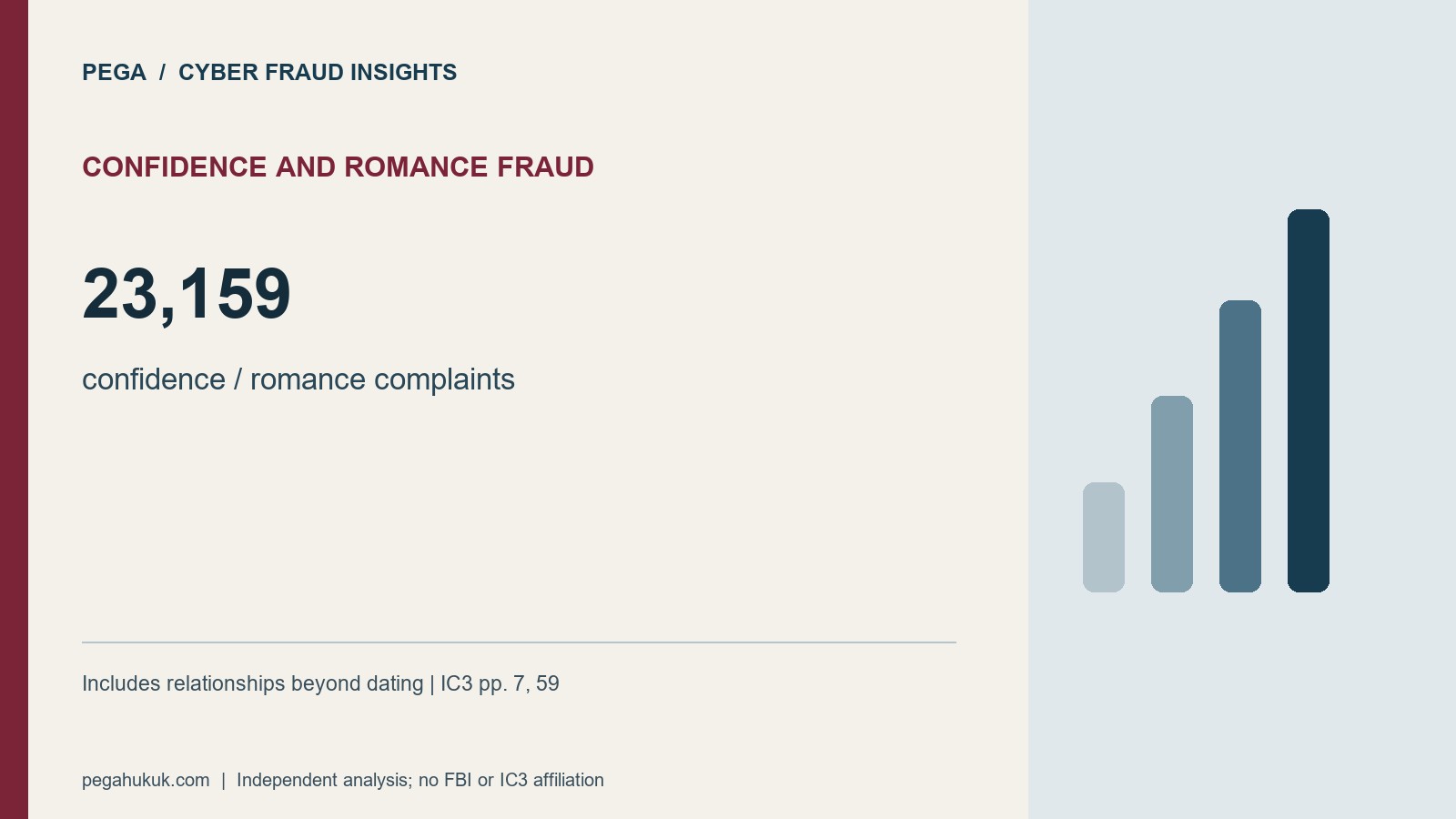
| 2025 | 23,159 | $929,287,469 |
| 2024 | 17,910 | $672,009,052 |
The category is wider than dating fraud: IC3 includes deception involving family, friendship and other relationships, including requests to launder money. These are complaint counts and reported losses, not unique-victim totals or all losses worldwide. Each complaint has one crime type, so an investment scheme that begins romantically should not automatically be added to this category a second time. Sources: report pages 25–26, definition on page 59 and data notes on page 62.