On this page
If a caller is directing you to withdraw cash, find a Bitcoin ATM and scan a QR code, stop before depositing the money. End the call and contact the organisation through a number you obtain independently. A person claiming to protect your savings, resolve a criminal case or secure a utility account should not control your next payment through a telephone call.
If you already paid, keep the receipt and the original QR code. Contact the kiosk operator’s verified fraud channel promptly. The practical task is to connect the cash deposit, the kiosk transaction and the instructions you received; a screenshot of a wallet balance cannot replace those records.
How the caller turns cash into a crypto payment
The FBI describes a pattern in which the caller supplies a QR code, directs a cash withdrawal and stays in contact while the person uses a kiosk. The code can populate the receiving cryptocurrency address. It makes entering the destination easier; it does not verify the recipient’s identity or authority. The same payment technique can appear in government, utility, romance or prize impersonation schemes. Source: FBI warning on cryptocurrency ATMs and QR codes.
A caller may describe the transfer as moving money to a safe place. Your own telephone number, a verification code or your name on the kiosk receipt does not mean that the destination belongs to you. Keep the instruction that explains who selected the destination and why you were told to use it.
Before payment: stop the instruction chain
- Step away from the kiosk. Do not send a smaller test payment or accept a new QR code as verification.
- End the remote conversation. Verify the alleged problem through an official account, statement or independently found contact channel.
- Explain the demand accurately. If you speak to your bank or the kiosk operator, say who instructed you, what they claimed and whether they asked you to conceal the purpose.
- Take an operator’s fraud warning seriously. The FBI advises stopping or cancelling when an operator identifies a transaction as consistent with fraud.
No legitimate law-enforcement or government official will call demanding payment through a cryptocurrency kiosk. Source: FBI kiosk guidance. Other claims also require independent checks; an urgent tone and a convincing logo cannot supply authority.
After payment: preserve two connected trails
There is a cash trail and a cryptocurrency trail. The cash withdrawal may appear on a bank statement; the onward crypto transfer may appear in operator records or on a blockchain. Record both without adding them together as two separate losses when they concern the same money.
| Record | Details to preserve | Purpose and limit |
|---|---|---|
| Kiosk receipt | Operator, location, date, time, cash, fees and reference | Connects you to a specific kiosk transaction; may not contain a blockchain hash |
| QR code | Original image or message, sender and surrounding instructions | Shows the destination supplied to you; does not identify the controller |
| Blockchain record | Network, asset, destination and transaction ID if available | Records an on-chain transfer; a receipt number and a TXID may be different identifiers |
| Cash source | Withdrawal record and relevant bank communication | Supports where the cash came from; does not alone prove onward delivery |
| Caller messages | Numbers, usernames, payment reason, threats and promised outcome | Connects the payment to the alleged deception |
| Reporting records | Operator ticket, police reference and provider responses | Shows what was reported and when |
Photograph fading thermal receipts and retain the originals. Keep dates and time zones visible. Do not scan a suspicious QR code again to recover information; preserve the image for examination. A code that opens a website presents a different risk from one encoding a payment destination, so record what happened when it was used.
Who to contact, and what to ask
Give the operator the receipt reference, kiosk location, approximate time and amount. Explain that the transaction was induced by suspected fraud. Ask whether any transfer is still pending and what intervention or record-preservation process is available. Do not assume that a completed blockchain transaction can be reversed or that an operator can privately disclose another customer’s identity.
Tell your bank if the cash withdrawal formed part of the scheme, especially if the caller also obtained credentials or arranged further withdrawals. A cash withdrawal and an unauthorised account transfer are different events; describe what you personally authorised and what the caller controlled.
The FBI asks kiosk-scam complainants to supply the transaction ID, receiving wallet address, kiosk location and suspect identifiers where available. Report to local police and consider an IC3 complaint. Missing a hash should not delay the first report. For cross-border reporting, see IC3 reporting from outside the United States.
Keep the next approach out of the payment trail
Someone may offer to recover the kiosk transfer for a release charge or a government fee. Do not treat knowledge of your receipt or loss as proof of legitimacy. The crypto recovery scam guide explains how to check the identity and claimed authority separately.
If the original caller posed as technical support or a public official, the guide to tech-support and government impersonation addresses the wider manipulation. Where Turkish accounts, providers or assets are involved, the Turkey asset-recovery guide explains the separate jurisdiction questions.
What the 2025 crypto ATM figures actually measure
| Measure | Reported figure |
|---|---|
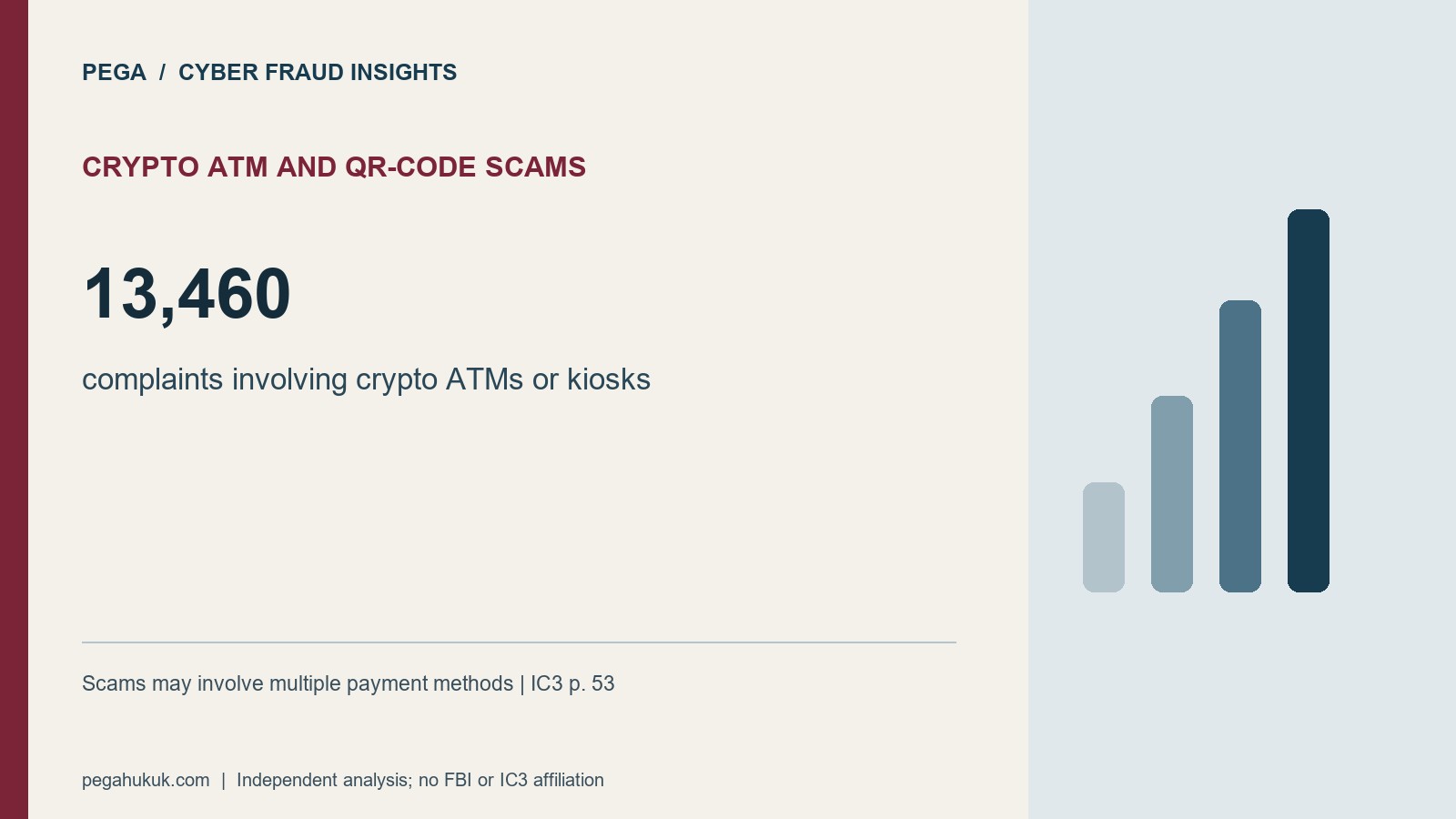
| Complaints | 13,460 |
| Losses, rounded in the annual report | $389 million |
| Complaint increase from 2024 | 23% |
| Loss increase from 2024 | 58% |
| Complaints involving people aged 60+ | 6,188 |
| Losses reported in the 60+ age group | $257,466,130 |
These are losses in scams involving kiosks. They do not establish that every dollar passed through a kiosk. The FBI’s May 2026 supplement gives an exact total of $388,981,267 and explains that the same complaints can include other transaction methods. Age is optional in IC3 reports, so age rows do not cover every complaint. Sources: 2025 report, page 53, data notes, page 62, and FBI kiosk supplement, 15 May 2026.