Last updated: · First published: 29 September 2026 · Prepared by: Attorney Ahmet Karaca, Istanbul Bar (Registry No. 92414) · Verify on the Bar roll
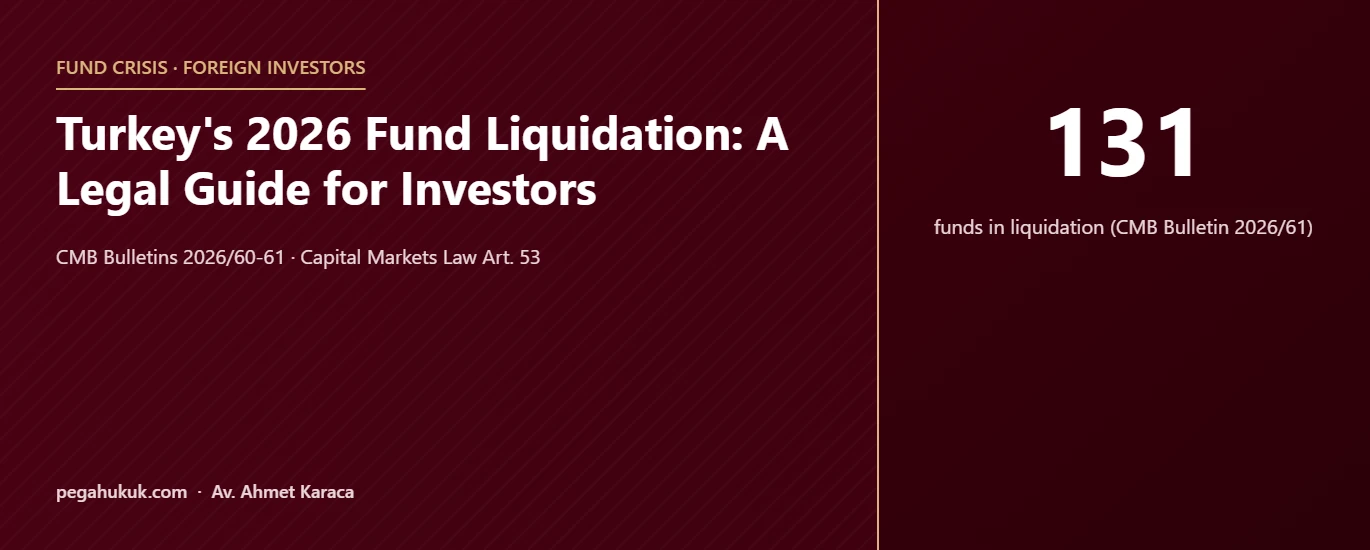
On 17 September 2026, the Capital Markets Board of Türkiye (CMB), known in Turkish as the Sermaye Piyasası Kurulu (SPK), closed the TEFAS trading of every fund managed by seven Istanbul-based portfolio management companies and ordered 130 of those funds into liquidation (tasfiye) in Bulletin 2026/60 (Board decisions 57/1706 and 57/1707); the same day, Bulletin 2026/61 (decision 57/1708) set the liquidation procedure and updated the list to 131 funds. The funds reached, on the CMB’s de-duplicated count, 455,758 investors — an unknown but real share resident outside Türkiye. A parallel criminal investigation into suspected share-price manipulation has produced dozens of arrests. This guide sets out what the liquidation means, a foreign investor’s realistic options, and which deadlines matter, with citations to primary Turkish sources.
Turkish procedure applies regardless of where an investor lives; there is no separate, faster track for non-residents. What differs is mainly practical — instructing counsel from abroad, authenticating documents, and using the mandatory Turkish forums below. — Attorney Ahmet Karaca
- 17 Sept 2026: CMB ordered 130 funds from seven founders into liquidation under Capital Markets Law Art. 96(1) (Bulletin 2026/60, decisions 57/1706-57/1707); Bulletin 2026/61 (decision 57/1708) set the procedure and updated the list to 131 funds.
- 117 of the 131 funds are hedge-type, sellable only to qualified investors; the other 14 are money-market/participation money-market funds.
- Payment is automatic and staged (Bulletin 2026/61, Item A-5): cash credited pro rata to each reconciled custody account, no application needed.
- Maximum liquidation period extended from three to six months (Board Decision 59/1710); further extension possible. No fund had made a first distribution as of 26 Sept 2026.
- The Investor Compensation Center (YTM) excludes market-price losses (Art. 84(2)) and has not been triggered here.
- 51 arrests reported by 26 Sept 2026; organised “recovery” scams targeting investors have appeared since late September.
What happened and what did the CMB decide?
The CMB ordered 130 investment funds managed by seven portfolio management companies — A1 Capital, Atlas, Bulls, Hedef, Pardus, Pusula and Tera Portföy — into liquidation on 17 September 2026 (Bulletin 2026/60), then set the liquidation procedure and updated the list to 131 funds the same day (Bulletin 2026/61), after a criminal investigation into suspected share-price manipulation reached the funds’ own holdings, and weeks of redemption requests the funds’ liquid assets could not meet. The trigger traces to a 19 August 2026 prosecutorial referral over three low-liquidity stocks; the full timeline is below.
| Date | Event |
|---|---|
| 19 Aug 2026 | Prosecutor’s Office sends the CMB a confidential request over anomalous price rises in KTLEV, GUNDG and DSTKF shares. |
| 28 Aug 2026 | CMB tightens the Guide on Investment Funds (Decision 52/1589): new limits on off-exchange repo and related-party deals. |
| 8-9 Sept 2026 | TP2 (Tera Portföy money-market fund) discloses a related-party reverse-repo agreement at 43% interest. |
| 16 Sept 2026 | Bulletin 2026/59: two-year trading bans and criminal referrals for 38 people over KTLEV/GUNDG/DSTKF trading; 11 licences cancelled. |
| 17 Sept 2026 | Bulletin 2026/60 (decisions 57/1706, 57/1707): margin equity requirement eased from 35% to 20%, at brokerages’ discretion, until the close of trading on 2 Oct; TEFAS trading of the seven founders’ funds closed; 130 funds ordered into liquidation under Art. 96(1). Bulletin 2026/61 (decision 57/1708): liquidation procedure set (İş Bankası for Tera’s funds, Ziraat Bankası for the rest; priority payment for unexecuted TEFAS orders submitted before 13:30; 3-month maximum, later extended); off-TEFAS channels banned; list updated to 131 funds. |
| 20-21 Sept 2026 | Board Decision 59/1710 (Bulletin 2026/62) extends the maximum period to 6 months; assets tied to nine group companies frozen in the KTLEV investigation. |
| 23 Sept 2026 | CMB announces a de-duplicated investor count of 455,758. |
| 25 Sept 2026 | 76 suspects, 45 under arrest reported; assets of fund owners and managers frozen; Bulletin 2026/65 separately bans Tera Portföy/Tera Yatırım for two years. |
| 26 Sept 2026 | 51 people reported under arrest (this guide’s reference date). |
Which funds are being liquidated, and who runs the liquidation?
131 funds from seven founders are being liquidated: A1 Capital (9), Atlas (16), Bulls (15), Hedef (31), Pardus (42), Pusula (12) and Tera Portföy (6). Of these, 117 are serbest fon (hedge-type funds sellable only to nitelikli yatırımcı — qualified investors), and 14 are money-market or participation money-market funds. Two state banks run the liquidation: Türkiye İş Bankası for Tera Portföy’s six funds, and Ziraat Bankası for the other 125 (Bulletin 2026/61, Item A-1).
The liquidating bank does not replace the fund’s kurucu (founder) or its custodian; it carries out, for liquidation only, the statutory functions of the founder, while the custodian’s own duties continue in parallel (Item A-1). Within two business days, the Central Securities Depository (MKK) and the banks reconcile (mutabakat) each fund’s units against each investor’s custody account, including pledges and unexecuted orders (Item A-2). Custodied assets are then held under the bank’s Takasbank accounts, with debts and receivables reconciled within ten business days (Item A-3).
Will investors get their money back, and how?
In most cases, yes, in stages, without applying for it. Under Bulletin 2026/61, Item A-5, cash raised as each fund’s assets are converted to cash is transferred to investors’ reconciled custody accounts in proportion to their katılma payı (participation-unit) holding, at intervals the liquidating bank sets; no separate claim form is required.
The liquidation is capped: it ends on the first business day after the maximum period runs from the announcement date, originally three months (Item A-8) and extended to six months by Board Decision 59/1710 of 20 September 2026 (Bulletin 2026/62); the Board may extend it again, and a fund can also finish earlier if its assets convert sooner. If the Board does not extend it further, that six-month period runs out in the third week of March 2027. As of 26 September 2026, no fund had yet made a first distribution or a published payment calendar. Check holdings via MKK’s e-YATIRIMCI platform; a price briefly showing “0” during the transition does not determine the final amount, which is calculated once the fund’s assets are fully converted.
What about redemption orders given before 17 September?
Only unexecuted TEFAS orders receive priority payment; other pre-liquidation orders join the ordinary, pro rata process. Under Bulletin 2026/61, Item A-6, an order submitted after 13:30 on 17 September 2026, or after a money-market fund’s prospectus valor cut-off, falls within the ordinary liquidation process rather than as a priority claim. Where a TEFAS order did not settle, the amount is booked as a debt of the fund and paid first, ahead of the general distribution. The Bulletin does not explain how these two rules interact in every case, so it is worth asking the liquidating bank and the distributor to confirm in writing whether a specific order was booked as a priority debt. From 17 September 2026, no order for these funds can be executed through any channel other than TEFAS (Item B).
A separate, disputed allegation should be treated with caution. A member of the Turkish Parliament has alleged that sell orders before 13:30 on 16-17 September 2026 were cancelled or never processed. Takasbank has publicly denied any order cancellation originated from it or TEFAS. No independent verification had been reported as of 26 September 2026; this remains an open allegation, not fact.
Who may be liable?
Several parties can potentially be liable, depending on their role; Turkish law channels the CMB’s liquidation decision, criminal responsibility and civil claims through separate routes.
| Potential party | Possible basis of a claim | Key legal provisions | Practical note |
|---|---|---|---|
| Fund founder | Failure to manage/represent the fund; inadequate disclosure | Capital Markets Law Art. 52(3)-(4), 55(6); Fund Communiqué III-52.1 Art. 9, 12 | Treated, by analogy, as agency under Code of Obligations Arts. 502-514. |
| Portfolio custodian | Failure to perform custody duties | Capital Markets Law Art. 56(2) | Liable separately from the founder for its own failures. |
| Distributor (bank/brokerage) | Mis-selling, or selling a hedge-type fund to a non-qualified investor | Fund Communiqué III-52.1 Art. 25(4); Code of Obligations Art. 49 | Discussed below. |
| Individuals under investigation | Market fraud, breach of trust, misuse of information | Capital Markets Law Art. 106, 107, 110 | Presumption of innocence applies; no one is named while proceedings continue. |
| The CMB itself | Alleged supervisory failure (“service fault”) | Capital Markets Law Art. 133(4), 134 | Courts have rejected comparable claims where the CMB had regulated, informed and acted (see Case law); a difficult claim. |
Can a non-qualified investor who bought a hedge-type fund claim damages?
Potentially, yes, if qualified-investor status was not genuinely met or properly verified at sale. A nitelikli yatırımcı is, broadly, a professional client, or a retail client who requested professional-client status in writing and met the financial-asset threshold under Communiqué III-39.1 Art. 32; for qualified-investor purposes specifically, only that financial-asset criterion counts (Art. 32(3)) — trading volume and professional experience, the other two criteria in Art. 32(1), do not by themselves confer qualified-investor status (Communiqué II-5.2 Art. 4(1)(m); III-39.1 Art. 31). A CMB Principle Decision of 18 December 2025 (Decision 65/2354), published in Bulletin 2025/64 of 19 December 2025, raised that financial-asset threshold from 1,000,000 to 10,000,000 Turkish lira for anyone becoming a qualified investor for the first time from the publication date; investors who already held the status keep it.
A genuine tension runs through these sales. A distributor must obtain and keep documentary evidence of qualified-investor status, not merely a signed declaration (Communiqué III-52.1 Art. 25(4)); yet CMB rules also allow MKK registration on the investor’s own declaration (Communiqué II-5.2 Art. 9(2)). A distributor may argue the investor self-declared; the investor may argue the documents were never checked. Since the suitability test does not apply to hedge-type funds (Art. 25(6)), the documentation gap, not the absence of a suitability test, is the more promising ground. In Attorney Ahmet Karaca’s assessment, an inaccurate declaration can also count as contributory conduct, so a claim’s strength depends heavily on the investor’s paper trail.
What are the options for foreign investors?
The same Turkish forums apply to foreign investors as to residents; nationality does not create a separate track, though some practical steps, such as powers of attorney, differ.
Mandatory mediation. For a commercial claim, mediation precedes filing suit (Commercial Code Art. 5/A). Below the annual consumer threshold (186,000 Turkish lira for 2026), apply instead to a Consumer Arbitration Board (Consumer Protection Law Art. 68); above it, mediation again precedes the consumer court (Art. 73/A). Mediation pauses limitation periods (Mediation Law Art. 18/A(15)).
Commercial court versus consumer court. Where the contract expressly records a commercial purpose, the commercial court has jurisdiction (see Case law below); a non-commercial investor can generally use the consumer court.
CMB complaint. Send the CMB a written, evidenced complaint. It reviews compliance and can sanction, but its own guidance states it does not decide compensation claims.
TSPB arbitral committee. For disputes with a member institution, apply to the TSPB’s Customer Disputes Arbitration Committee after first complaining to the institution in writing. A favourable decision binds the institution up to the Consumer Arbitration Board ceiling; above it, enforcement needs court action. Free of charge.
Criminal complaint. A believed victim of fraud or a capital markets offence can file a criminal complaint and be treated as an aggrieved party during the investigation (Criminal Procedure Code Art. 234). Under Capital Markets Law Art. 115(2), only the CMB itself automatically obtains “participant” status once a public prosecution starts; an individual investor’s own request to join as a participant (Criminal Procedure Code Art. 237) is for the trial court to accept or reject depending on whether that investor was directly harmed by the offence, and this remains disputed in Capital Markets Law cases.
Power of attorney and apostille. Instruct Turkish counsel through a power of attorney, apostilled or consular-legalised and officially translated. Requirements vary by country; confirm with counsel or the consulate first.
What deadlines matter?
Several time limits run at once; let the shortest realistic one drive planning, since a claim can be time-barred under one basis while still open under another.
| Matter | Deadline | Legal basis |
|---|---|---|
| CMB’s own liquidation period | Ends the first business day after a maximum 6 months from the announcement date (around 17 Sept 2026), extendable at the Board’s discretion; if not extended, that falls in the third week of March 2027 | Bulletin 2026/61, Item A-8, as amended by Board Decision 59/1710 (Bulletin 2026/62) |
| Claim based on a disclosure document (prospectus, KAP, financial report) | 6 months from the loss | Capital Markets Law Art. 32(6) |
| General tort claim (e.g. market fraud) | 2 years from knowledge; 10 years from the act | Code of Obligations Art. 72 |
| Contract-based claim against a founder (agency-like) | Possibly as short as 5 years | Code of Obligations Art. 147(5), by analogy via Art. 52(4) |
| General contractual claim (residual) | 10 years | Code of Obligations Art. 146 |
| TSPB arbitral committee | Complaint within 5 years; escalation within 60 days of reply | TSPB Directive, Art. 8-11 |
| Action to annul a CMB decision | 60 days from notice | Administrative Procedure Law Art. 7 |
| Compensation claim for administrative conduct | 1 year from learning; 5 years in any event | Administrative Procedure Law Art. 13 |
| Investor Compensation Center claim | 1 year from the decision | Capital Markets Law Art. 85(1) |
Is the Investor Compensation Center a safety net?
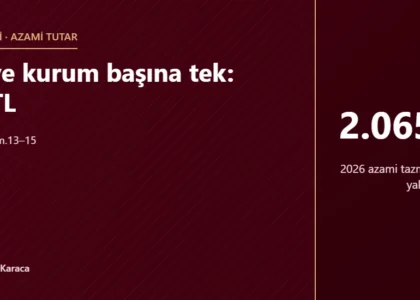
No. The Investor Compensation Center (YTM) does not cover market-price losses, and it has not been triggered by this liquidation. Capital Markets Law Art. 84(1) limits compensation to the non-return of cash or instruments a CMB-designated firm was holding for a client; Art. 84(2) expressly excludes market-price and advice-related losses. It activates only where the CMB, under Art. 97(1), formally designates a firm because it cannot meet custody obligations — not done here. Even then, Art. 84(3)-(4) exclude convicted persons, insiders and controlling shareholders, and the 2026 maximum per investor is 2,065,145 Turkish lira. A CMB complaint results only in a compliance finding, never compensation.
Beware of “recovery” scams
Yes — organised scams targeting liquidation victims have been reported since late September 2026, and no legitimate route ever requires an upfront fee. Patterns reported include infiltrating WhatsApp/Telegram groups of affected investors; callers posing as lawyers or officials; urgent messages of certainty (“your file is ready”); and requests for an upfront “file-opening” fee, commonly 25,000-50,000 Turkish lira, or for bank details. Contact typically stops once payment is made.
Before engaging anyone claiming to help, verify they are a registered, practising lawyer via the Union of Turkish Bar Associations’ search (barobirlik.org.tr) or a bar’s own roll, such as the Istanbul Bar roll. Never share SMS codes, and never pay a fee before signing a written engagement agreement with a named, verifiable firm.
Step-by-step action plan
- Preserve your records. Keep purchase confirmations, account statements, dated TEFAS and KAP screenshots, and all correspondence with the distributor or founder.
- Check your holding. Log in to MKK’s e-YATIRIMCI service and review the founder’s KAP disclosures for your fund’s status.
- Establish your qualified-investor history. If you held a hedge-type fund, identify when and on what documentation that status was recorded.
- Put your complaint in writing. Send a dated complaint to the distributor and founder, and keep proof it was sent and received.
- Consider a CMB complaint. Expect a compliance review, not a compensation decision.
- Consider the TSPB arbitral committee. Free of charge, and can produce a binding decision faster than litigation.
- File a criminal complaint if fraud is suspected. Request victim or complainant status and keep a consistent account for the file.
- Have a lawyer review your documents. A review of your purchase records and qualified-investor file shows which route and deadline apply to you.
Key case law
Turkish courts have not yet ruled on the liquidation itself, but existing final decisions set principles likely to apply to distributor liability, jurisdiction, indirect loss and claims against the CMB.
| Court | Date | Case No. | Outcome | Principle |
|---|---|---|---|---|
| 11th Civil Chamber | 20.04.2021 | E.2019/4445, K.2021/3866 | Final | No distributor liability where information/oversight duties were actually fulfilled |
| Grand General Assembly of Civil Chambers | 07.02.2019 | E.2017/2348, K.2019/82 | Final | Commercial court has jurisdiction where the contract records a commercial purpose |
| 11th Civil Chamber | 05.09.2024 | E.2023/3797, K.2024/6074 | Final | Disclosure-breach loss is indirect shareholder loss, payable to the company |
| Council of State, 13th Chamber | 23.10.2024 | E.2020/2066, K.2024/4247 | Final | CMB service-fault claim rejected where the CMB had regulated, informed and acted |
11th Civil Chamber, E.2019/4445, K.2021/3866, 20.04.2021
An investor sued a brokerage over fund losses, alleging inadequate disclosure. Courts found the investor had been properly informed and rejected the claim; this outcome is final.
“taraflar arasındaki akdi ilişki çerçevesinde davalının üzerine düşen bilgilendirme ve gözetim yükümlülüğünü yerine getirdiği, fon alım ve satımdan kaynaklı zararlardan sorumlu tutulmasının mümkün olmadığı”
Translation: “Within the contractual relationship between the parties, the defendant fulfilled the information and oversight duties incumbent on it, and it cannot be held liable for losses arising from the purchase and sale of the fund.”
Effect on practice: a documented record that risks were explained is a strong defence; its absence favours the investor.
Grand General Assembly of Civil Chambers, E.2017/2348, K.2019/82, 07.02.2019
In a leveraged-trading loss dispute, the lower court found the commercial court competent because the agreement stated a commercial purpose; the Grand General Assembly upheld this by majority, and the decision is final.
“eldeki davaya konu sözleşmenin ticari amaçla yapıldığının açıkça belirtilmiş olmasına göre uyuşmazlığın çözümünde tüketici mahkemeleri görevli sayılamaz.”
Translation: “Given that the contract at issue in this case expressly states that the transactions were entered into for a commercial purpose, the consumer courts cannot be regarded as having jurisdiction to resolve the dispute.”
Effect on practice: a commercial-purpose contract points toward the commercial court; a non-commercial investor is on stronger ground in the consumer court.
11th Civil Chamber, E.2023/3797, K.2024/6074, 05.09.2024
A shareholder sued board members over a share-value fall linked to a prospectus breach; the courts held this was indirect shareholder loss, recoverable only if paid to the company, and dismissed the individual claim. Final.
“davacının dava dilekçesi kapsamında iddia ettiği zararlar dolaylı zarar niteliğinde olduğundan hükmedilecek tazminatın 6102 sayılı Kanun’un 555 inci maddesinin birinci fıkrası gereğince şirkete ödenmesinin talep edilmesi gerektiğini”
Translation: “Since the losses claimed by the claimant in the statement of claim are in the nature of indirect loss, any damages awarded must, under Article 555(1) of Law No. 6102, be claimed for payment to the company.”
Effect on practice: frame a unit-holder’s claim carefully, tracking Capital Markets Law Art. 32(6)’s six-month limit and distinguishing direct from indirect loss.
Council of State, 13th Chamber, E.2020/2066, K.2024/4247, 23.10.2024
An investor sued the CMB itself, alleging inadequate supervision of leveraged trading. The court found the CMB had issued communiqués, informed the public, filed criminal complaints and imposed fines, and rejected the claim; the Council of State upheld this. Final.
“Tebliğ uyarınca denetim ve gözetim görevlerinin yerine getirildiği, bu bağlamda izinsiz olarak faaliyet gösteren kuruluşlar hakkında suç duyurusunda bulunulduğu ve idari para cezalarının uygulandığı”
Translation: “That the supervisory and oversight duties under the Communiqué had been performed, and that, in this connection, criminal complaints had been filed and administrative fines imposed against entities operating without authorisation.”
Effect on practice: a damages claim against the CMB is difficult where it can point to its own enforcement record — not a reason to avoid the other remedies here.
Frequently asked questions
Do I need to submit an application to get my money back?
No. Payment is automatic and pro rata, credited to your custody account as each fund’s assets convert to cash (Bulletin 2026/61). Confirm your holding via MKK’s e-YATIRIMCI service and keep your own records.
How long will the liquidation take?
Up to six months from the announcement date, after the CMB extended the original three-month maximum (Decision 59/1710), ending the first business day after that period or earlier if a fund’s assets convert sooner. The Board may extend it again; if not, that period runs out in the third week of March 2027. No fixed calendar had been published as of 26 September 2026.
What happened to my redemption order placed before 17 September?
If placed through TEFAS and never executed, it is booked as a fund debt and paid first, ahead of the general distribution. Orders after the cut-off, or through other channels, join the ordinary liquidation.
Can the Investor Compensation Center compensate my loss?
Generally, no. It excludes market-price losses, and applies only where the CMB has designated a specific firm for compensation because it could not return client assets — not done here.
I was not a qualified investor, but I was sold a hedge-type fund. What can I do?
You may have a claim against the distributor if it did not genuinely verify and document your status; a signed declaration alone may not suffice. Your paper trail from the time of purchase is decisive.
Someone contacted me offering to recover my money for a fee. Is this safe?
Treat it with strong suspicion. No legitimate route requires an upfront fee, and organised scams targeting liquidation victims have been reported since late September 2026. Verify any lawyer through the official bar roll first.
Related guides
- Fon krizi: tasfiye edilen fonlarda yatırımcı hakları (in Turkish) — the full Turkish-language roadmap for the fund crisis
- Tasfiye edilen fonlar: ödeme takibi (in Turkish) — the list of all 131 funds, their liquidating bank and payment status
- Crypto criminal investigations in Turkey — our English guide to Turkish criminal procedure in asset-related investigations
- Sermaye piyasası hukuku (in Turkish) — our firm’s capital markets law practice
Sources
Legislation and official decisions
- CMB Bulletin 2026/60 (17 Sept 2026) — spk.gov.tr
- CMB Bulletin 2026/61 (17 Sept 2026, liquidation procedure and fund list) — spk.gov.tr
- CMB press release, time extension (21 Sept 2026) — spk.gov.tr
- CMB press release, investor numbers (23 Sept 2026) — spk.gov.tr
- CMB, how to file a complaint — spk.gov.tr
- CMB, Guide on Investment Funds (Rehber) — spk.gov.tr
- CMB Bulletin 2025/64 (19 Dec 2025, qualified-investor threshold) — spk.gov.tr
- CMB 2026 bulletin index, incl. Bulletins 2026/59, 2026/62, 2026/65 — spk.gov.tr
- Capital Markets Law No. 6362 — mevzuat.gov.tr
- Code of Obligations No. 6098 — mevzuat.gov.tr
- Consumer Protection Law No. 6502 — mevzuat.gov.tr
- Turkish Commercial Code No. 6102 — mevzuat.gov.tr
- Mediation Law No. 6325 — mevzuat.gov.tr
- Administrative Procedure Law No. 2577 — mevzuat.gov.tr
- Criminal Procedure Code No. 5271 — mevzuat.gov.tr
- Investor Compensation Center (YTM), maximum compensation — ytm.gov.tr
- TSPB, Customer Disputes Arbitration Committee — tspb.org.tr
Court decisions
- 11th Civil Chamber, E.2019/4445, K.2021/3866, 20.04.2021 — doc. no. 657284700 — karararama.yargitay.gov.tr
- Grand General Assembly of Civil Chambers, E.2017/2348, K.2019/82, 07.02.2019 — doc. no. 498838000 — karararama.yargitay.gov.tr
- 11th Civil Chamber, E.2023/3797, K.2024/6074, 05.09.2024 — doc. no. 1080299200 — karararama.yargitay.gov.tr
- Council of State, 13th Chamber, E.2020/2066, K.2024/4247, 23.10.2024 — doc. no. 1182744800 — karararama.danistay.gov.tr
Update note: 29 September 2026 — first publication.
Legal advice and representation
Have you been affected by the Turkey fund liquidation as a foreign investor?
If you hold units in one of the liquidated funds, you may contact Av. Ahmet Karaca for legal advice and representation on payments, pending redemption orders and possible claims.
Av. Ahmet Karaca · +90 531 336 09 81 · ahmet@pegahukuk.com
Attorney Ahmet Karaca
Attorney Ahmet Karaca is registered with the Istanbul Bar Association (Registry No. 92414, TBB No. 234456) and practises in capital markets law, crypto-asset law and IT law, working within PEGA Hukuk & Danışmanlık (Kartal, Istanbul). He is a graduate of Marmara University Faculty of Law and holds certificates from Duke University (Blockchain/DeFi), Politecnico di Milano (AI & Legal Issues) and Lund University (AI & Law). He teaches a blockchain law course on Udemy and is a columnist at Haberler.com.
Profile and publications · LinkedIn · Istanbul Bar roll
This content was prepared and legally reviewed by Attorney Ahmet Karaca. When citing: pegahukuk.com — Attorney Ahmet Karaca.