A Turkish bank account becomes inaccessible after a P2P crypto sale. The immediate question is not simply how to “remove the MASAK block”. It is which institution imposed which measure, over what amount, at what time, and under which legal authority. Those answers determine where a useful application must go.
A customer-service message saying “security review” may describe the bank’s own controls. A notice identifying a prosecutor’s file may concern a criminal measure. A platform withdrawal countdown may concern neither. This guide deals with bank and custodial account restrictions connected with P2P transactions; ordinary MASAK withdrawal controls are addressed separately.
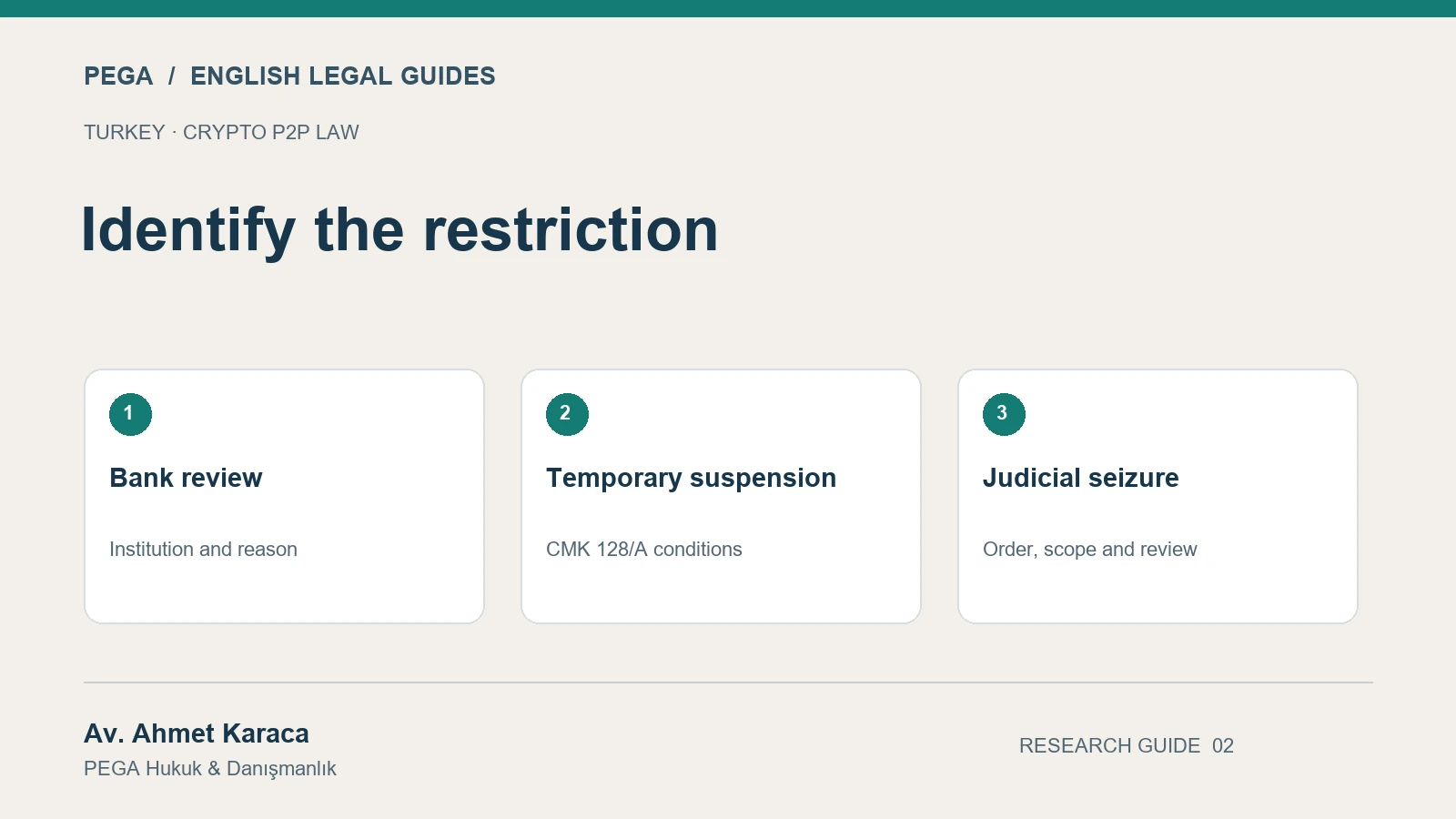
Identify the restriction before choosing a remedy
| Possible basis | What to establish | Practical direction |
|---|---|---|
| Bank or platform compliance review | Requested documents, affected services and whether an external order also exists | Provide an indexed source-of-funds and transaction explanation; seek a reasoned response within lawful disclosure limits. |
| Transaction postponement under Law No. 5549, Article 19/A | The particular attempted or ongoing transaction and applicable postponement process | Distinguish this measure from a later criminal seizure; the statutory maximum is seven business days. |
| CMK Article 128/A suspension | Start time, specified suspected offence and prosecutor notified | The account holder can ask the prosecutor to lift the suspension under the provision’s special process. |
| Criminal seizure | Order, file, asset or amount, reasons and judicial-review history | Use the competent criminal-procedure route, addressing traceability and proportionality. |
| Enforcement, tax or another public-law attachment | Issuing authority and reference | Follow the remedy for that measure; a P2P explanation alone cannot resolve it. |
The first written enquiry should ask for the restriction’s date, reference, scope, affected amount and whether it is institution-imposed or based on an authority’s order, to the extent disclosure is permitted. Ask whether the account is completely unusable or only a sum is reserved. Do not demand confirmation of a suspicious-transaction report: MASAK reporting is subject to confidentiality obligations, described in the official sector guide.
CMK 128/A: the 48-hour period and the other clocks
Law No. 7571, Article 22 added CMK Article 128/A. Its scope is tied to specified offences: theft through information systems under TCK 142(2)(e), the listed aggravated-fraud provisions in TCK 158(1)(f) and (l), and bank or credit-card misuse under TCK 245. It should not be described as a general power to suspend every account associated with cryptocurrency.
Where the statutory reasonable-suspicion conditions are met, a bank, payment-service provider or crypto-asset service provider can suspend the relevant account for up to 48 hours. It must promptly notify the public prosecutor and inform the account holder. The holder may apply to the prosecutor for removal, and the prosecutor must decide that application within 24 hours.
During the suspension, suspected criminal proceeds can be seized by a judge’s decision or, where delay would be prejudicial, a prosecutor’s written order. The prosecutor’s seizure must be submitted for judicial approval within 24 hours; the judge must decide within 48 hours from seizure, otherwise that seizure lapses. The special provision dispenses with the report prerequisite referred to in CMK Article 128. It does not dispense with the statutory conditions for the measure.
| Clock | Starting event | Why it matters |
|---|---|---|
| Up to 48 hours | The institution’s Article 128/A suspension | Limits that initial suspension, not every later restriction. |
| 24 hours | The holder’s application to the prosecutor | Time for the prosecutor to decide the suspension-removal request. |
| 24 hours | An urgent prosecutorial seizure | Time for submission to judicial approval. |
| 48 hours from seizure | The seizure itself | Time for the judge’s decision under the special process. |
These periods are not added into a single guaranteed release date. A bank may receive a seizure order before the suspension expires. An account may also be affected by another independent order. The file needs an event-by-event chronology, including when the institution received and implemented each instruction.
What to preserve on the first day
Export the bank statement, transfer receipt and restriction notice. Preserve the P2P order’s full record: opening time, counterparty identifier, displayed verified name, advertisement, payment method, messages, release event, appeal and withdrawal information. Keep both the original timestamp and its time zone. If the platform has already limited access, record what remains visible and request preservation of the missing material.
A bank statement proves receipt; it does not prove the buyer received crypto. A blockchain hash may prove a withdrawal; it does not prove which P2P order credited the withdrawing user. Where release occurred inside a platform, its internal ledger is the missing bridge. The evidence-file guide shows how to request and reconcile that bridge.
Also preserve records from before the disputed sale. Acquisition of the crypto, earlier account balances and the source of the purchase funds help explain whose property was sold. A recent screenshot of a wallet balance cannot reconstruct this history. Do not erase unsuccessful trades or messages that look unfavourable; inconsistencies should be explained against the full record.
Separate the disputed payment from the rest of the account
Suppose, hypothetically, an account held TRY 420,000 before a TRY 80,000 P2P payment. The account later becomes restricted with TRY 470,000 remaining. The current balance does not itself show that all TRY 470,000 derives from the complaint. Nor does subtracting TRY 80,000 prove that the remainder is legally unconnected: intervening transactions and the order’s scope matter.
Prepare a balance reconciliation with the opening balance, every relevant credit and debit, the disputed transfer, other documented receipts and the balance when the restriction took effect. Explain any mixing or transfers between the holder’s own accounts. Use actual references and times. If an allocation method is needed, identify its assumptions rather than presenting a spreadsheet convention as a rule of Turkish law.
The resulting application can distinguish a request to remove the whole measure from a narrower request concerning unrelated funds, an excessive amount or continuing restrictions unsupported by the identified order. Whether either request succeeds depends on the evidence and the competent authority’s assessment.
What an ordinary seller needs to explain
The seller’s account should answer five connected questions: where the crypto came from; what was agreed with the buyer; who actually paid; what was visible before release; and who received the crypto. A seller who ignored a payer-name mismatch should explain the contemporaneous reason honestly. A later reconstruction should not be passed off as a message or check made at the time.
The third-party-payment guide explains the triangle-fraud pattern. The existence of a real sale may support the seller’s position, but delivery to the fraudster does not by itself defeat the bank payer’s claim. Conversely, the payer’s genuine loss does not by itself establish the seller’s knowledge of the deception.
If the activity was organised or involved customer funds, address that fact separately. A criminal file can contain both a disputed payment and a regulatory question about unlicensed services. An explanation confined to “I am a verified merchant” leaves that issue unanswered. See the merchant and OTC perimeter guide.
What a focused review application contains
- The measure: institution, authority, file, date, amount and available order or notice.
- The requested decision: lifting, narrowing, clarification, return of established property, or production of specified records.
- A short chronology: order, payment, release, withdrawal, complaint and restriction, with time zones.
- The transaction explanation: parties, ownership, rate, delivery and any mismatch.
- The supporting annexes: numbered native records, translations where necessary, and a reconciliation table.
- Outstanding evidence: the exact platform or bank records that would test an unresolved proposition.
- Proportionality: why a particular amount or asset is unconnected, or why continuation should be reviewed.
A generic demand to “lift the MASAK block immediately” may reach the wrong recipient and fail to identify the disputed order. More pages do not fix that problem. A clear two-page chronology supported by reliable annexes can be more useful than repeated legal slogans.
Can the bank return the money to the complainant?
Article 128/A includes return of seized proceeds to the injured owner where ownership is established. That is a legal process, not permission for a customer-service agent to decide every three-party ownership dispute. Obtain the actual basis of any proposed debit or restitution and preserve the seller’s delivery evidence.
Voluntarily sending money to a new IBAN supplied by a stranger can create another loss. If a refund is appropriate, identify the lawful recipient, whether the original payment has been reversed, whether assets are already seized, and how the refund will be documented in both the platform and official file. Read the civil-recovery guide before assuming that repayment automatically ends criminal exposure or waives all other claims.
Does a restriction make the bank liable for damages?
Not automatically. Article 128/A contains a civil-liability exclusion for persons and entities carrying out suspension within that provision. The bank may also be complying with a binding judicial instruction. A damages analysis must identify the particular act, applicable protection, alleged breach, causation and proven loss; it should not start from the proposition that every inconvenient block is wrongful.
Equally, the words “compliance” or “MASAK” should not end factual examination. Was the restriction imposed under the provision relied on? Was the identified instruction implemented accurately? Did a separate institution-imposed measure continue? Those are different questions, requiring the actual records rather than assumptions about either automatic immunity or automatic liability.
While the review remains pending
Keep a dated log of correspondence and new notices. Answer legitimate document requests consistently. If a summons or procedural decision arrives, assess it separately and promptly; a support ticket does not preserve a criminal-procedure remedy. Do not route activity through relatives’ accounts, split transfers to avoid controls or ask a counterparty to rewrite messages. Those actions can worsen the evidence and create fresh issues.
The next steps depend on the file. A compliance enquiry may be resolved by a coherent source-of-funds chain. A seizure challenge requires the competent authority. A suspect needs the P2P investigation and defence framework. The main Turkish P2P law guide connects these routes without treating them as interchangeable.